
Decision Guide
Choosing the Right Soil Bioengineering Technique
Match your erosion or slope stability problem to the right bioengineering method. Decision guide for contractors, land managers, and environmental professionals working on BC sites.
Site Assessment First
Technique choice follows from a physical site assessment, not a catalogue or default preference.
Flow, Slope, and Material
Water velocity, bank angle, and substrate type are the primary selection criteria.
Combinations Often Required
Most sites call for two or more techniques used in sequence or zone-by-zone.
Every eroding slope and degraded streambank has a specific problem, over-steepening, surface raveling, bank scour, seepage, mine reclamation, coastal erosion. The right technique depends on understanding what is actually failing and why. This guide matches the most common site problems to the appropriate soil bioengineering methods.
The Decision-First Approach
Soil bioengineering is not a single method, it is a toolkit of techniques developed to address different failure mechanisms. Applying the wrong technique wastes money and often fails to address the underlying problem. A wattle fence installed on a bone-dry south-facing slope will not root. Live stakes installed in actively scoured streambank substrate will be removed by the next freshet. Modified brush layers on a seepage-driven instability zone will not address the water that is causing the problem.
The first question is always: what is causing the erosion or instability? The technique choice follows from that diagnosis.
Quick Reference: Problem to Technique
| Site Problem | Primary Technique | Secondary / Combined | Notes |
|---|---|---|---|
| Over-steepened slope, moist | Wattle Fences | Live staking between fence lines | Moisture essential for establishment |
| Over-steepened slope, dry or raveling | Modified Brush Layers | Rough and loose + live staking | Cuttings still need moisture to establish |
| Eroding streambank, active scour | Live Bank Protection | Live palisades for high-energy sites | Match intensity to stream energy |
| Eroding streambank, slower rivers | Live Staking | Wattle fences for severely eroded | Simple and cost-effective |
| Bare gravel bars / braided channels | Live Gravel Bar Staking | Live bank protection on adjacent banks | Excavator-assisted installation common |
| Seepage zones / piping failures | Live Pole Drains | Wattle fences for associated slope instability | Drain intercepts subsurface water |
| General revegetation / most disturbed sites | Live Staking | Any of the above as needed | The baseline technique |
| Fish stream channels, shade deficit | Live Shade | Live staking adjacent banks | A-frame log structures + plantings |
| Flowing mud on slopes | Live Smiles | Live staking on stabilized areas | Crescent-shaped brush dams |
| Mine reclamation / large disturbances | Rough and Loose + Live Staking | Modified brush layers on slopes | Cost-effectiveness is key |
| Riparian buffer / new road ditches | Live Bank Protection | Brush mats + live staking | Stabilize before revegetation |
| Residential shoreline / Green Shores | Beach log installation + live staking | Wattle fences for any bluff component | Green Shores rating framework |
| Complex / multiple failure mechanisms | Combination treatment | Site-specific assessment required | Combinations are the rule, not the exception |
Detailed Technique-to-Problem Guide
Over-Steepened Slopes
Over-steepened slopes, slopes cut beyond the natural angle of repose for the material, are the most common soil bioengineering challenge. The slope wants to shed material; the job is to intercept that material, reduce the effective slope angle, and re-establish root cohesion.
Moist sites: Wattle Fences are the primary tool. Contour lines of willow structures with horizontal stems behind vertical posts terrace the slope, intercept material, and grow into a dense woody cover. Effective on slopes up to 70 degrees where soil moisture supports cutting establishment. Live staking between the fence lines accelerates full-slope revegetation.
Dry or raveling sites: Modified Brush Layers address the drier slope condition. Horizontal brush layers protect the surface from raindrop impact and runoff without depending on immediate rooting success, the cuttings are embedded in a way that protects the slope even before full establishment. On very large sites, rough and loose surface treatment can be combined with live staking where suitable plant material and moisture are available.
Eroding Streambanks
Streambank erosion ranges from gradual surface sloughing to catastrophic scour during high flows. The appropriate technique depends primarily on stream energy: the combination of flow velocity, discharge, and the substrate of the bank.
High-energy streams / large rivers: Live Palisades provide the strongest protection. Long, large-diameter poles driven deeply into the bank toe resist scour and root into the bank structure. Combined with brush layer backfilling behind the palisade line, this is the right approach for actively failing banks on larger streams.
Moderate streams: Live Bank Protection may combine brush layers, anchor logs, and live staking where hydraulic conditions and bank geometry support that design. Brush layers can help shield the bank face from scour while suitable cuttings may root as moisture, species, and installation conditions allow.
Gentler rivers and small streams: Live Staking alone is often sufficient. Simple, inexpensive, and effective where bank scour is not severe. On severely eroded small streams, wattle fences at the bank toe add structural protection.
Bare Gravel Bars and Braided Channels
Braided stream channels with active gravel bar migration are notoriously difficult to revegetate by conventional methods, seeds planted in gravel fail to establish, containerized plants are removed by floods, and conventional seeding has no purchase in clean gravel.
Live Gravel Bar Staking addresses this directly. Large-diameter willow cuttings can be installed deeply in a gravel bar, often using an excavator to open a pilot hole in coarse substrate, so the cuttings can reach subsurface moisture. The roots access subsurface moisture independent of surface conditions. The installed willows then trap sediment, stabilize the bar, and begin the successional recovery trajectory.
Seepage Zones and Piping Failures
Seepage-driven instability is one of the most commonly misdiagnosed slope problems. The symptom looks like surface erosion; the cause is subsurface water under pressure. Surface treatments alone will not solve it.
Live Pole Drains intercept and divert the subsurface flow. A trench cut to the depth of the seeping zone, filled with a bundle of large willow and cottonwood poles, provides a permeable drainage pathway while the poles root and transpire, the established willows eventually draw down the water table through transpiration, progressively reducing the seepage problem biologically.
Combined treatment: Piping failures and seepage zones can have associated surface instability. A live pole drain may address concentrated water while wattle fences or another surface treatment address the slope condition above; whether they belong in one package depends on site assessment.
Newly Constructed Fish Channels and Small Streams
Constructed or restored fish channels often have over-wide, over-bright channels that lack the riparian shade critical to summer temperature regulation in cold-water fish habitat.
Live Shade structures are A-frame assemblies of large logs placed over a stream, with willow and cottonwood cuttings inserted into the substrate through holes drilled in the logs. They can provide initial structural shade while suitable cuttings establish riparian vegetation that may eventually reduce reliance on the log structure. The technique was developed for small constructed fish channels in logged or cleared riparian zones.
Mine Reclamation and Large Industrial Disturbances
Mine reclamation presents a specific challenge: vast areas of disturbed, often compacted, low-organic substrate where conventional seeding routinely fails to establish. The conventional response, grade smooth, apply topsoil, seed with commercial grass mix, is both expensive and frequently unsuccessful.
Rough and Loose Surface Treatment is the low-cost, high-effectiveness alternative. The deliberate creation of surface microtopography, through slash retention, rough grading, and surface scarification, creates seed-catching features, slows runoff, retains moisture, and allows organic matter accumulation. Where suitable willow or cottonwood material is available, live staking can add pioneering woody vegetation without relying on a uniform seeded surface.
Residential Shorelines and Green Shores
Residential shorelines present a distinct problem: private property owners with eroding or overdeveloped shoreline who want to stabilize the bank, maintain waterfront access, and improve ecological function, ideally without losing view or access.
The Green Shores framework (developed by the Stewardship Centre for BC) provides a rating system for shoreline habitat condition and restoration quality. PES brings the soil bioengineering expertise to the ecological restoration component: beach log placement, live staking of native riparian species, wattle fences where bluffs are present, and removal of invasive shoreline armoring that is disrupting sediment dynamics.
Complex and Multiple-Problem Sites
Many sites have more than one problem. A streambank may be actively eroding at the toe, with a seepage zone mid-slope driving shallow instability, and bare gravel bar conditions on the bar below. The right treatment is a combination: live pole drain for the seepage, wattle fences for the slope instability, live bank protection at the bank toe, and live gravel bar staking on the bar.
Reading the combination of failure mechanisms on a site, and specifying the right combination of techniques to address each one, is the core expertise that Polster Environmental brings to every project.
Not Sure Where to Start?
If you can describe the problem, what the site looks like, what it is doing, and what you want it to do, we can usually identify the right technique from a brief conversation and photographs. For more complex sites, a site visit is the most reliable starting point.
Polster Environmental Services, soil bioengineering for slope stabilization and ecological restoration across British Columbia.
Related Reading and Next Steps
Need Site-Specific Guidance?
We can review the conditions on the ground and recommend the right living system, sequence, or combination of techniques.
How to Select the Right Technique
Choosing the wrong bioengineering technique is one of the most common causes of restoration failure, not because the techniques don't work, but because each is designed for a specific set of site conditions. Wattle fences fail on dry sites where modified brush layers would succeed. Live staking works on silty soils but not on rocky slopes. The selection process starts with a rigorous site assessment, not with a preferred technique. The question to ask first is: what are the specific filters preventing natural recovery?
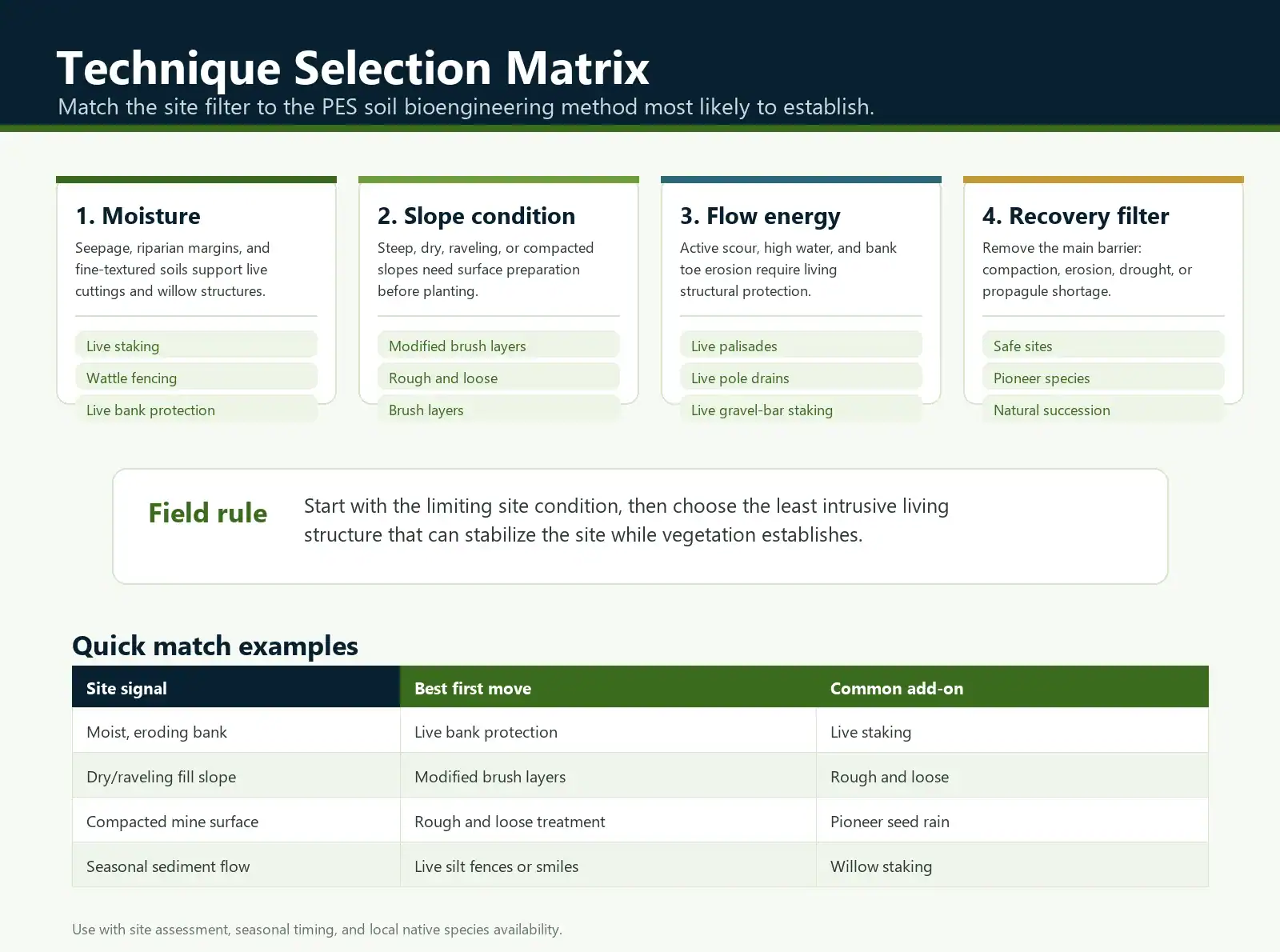
Step-by-step procedure:
- Assess site moisture: moisture is the primary determinant for most techniques. Seepage zones, fine-textured soils, and riparian margins support wattle fences and live bank protection. Drier slopes require modified brush layers or rough-and-loose approaches.
- Distinguish surface movement from deeper failure. Check the slope geometry, water and expected loading before deciding whether living terraces are appropriate.
- Identify the primary failure mode: Excess soil moisture causing slumps → Live Pole Drains. Slope too steep for vegetation → Wattle Fences or Modified Brush Layers. Bank erosion by stream flow → Live Bank Protection or Live Palisades. Compacted, smooth surfaces → Rough and Loose. Bare gravel bars → Gravel Bar Staking. Piping failures / overhangs → Live Reinforced Earth Walls.
- Consider access constraints: some techniques (gravel bar staking, modified brush layers) can be done by hand crews without equipment. Others (brush layers in fills, live pole drains in large seepage areas) benefit from or require excavator access.
- Match species to conditions: willows for moist riparian and seepage; cottonwood/balsam poplar for stream banks and palisades; dogwood for understory diversity; poplar for fast-growing canopy over fish habitat.
- Plan for combinations: complex sites typically require multiple techniques: live pole drains to address moisture combined with wattle fences for slope support; rough and loose site preparation before live staking on riparian margins.
Key specifications:
- Wattle fences: fine-textured moist soils; seepage zones; surface slopes where geometry, moisture and loading support living terraces
- Modified brush layers: drier slopes; talus; road cuts; buried cuttings still need suitable moisture
- Live pole drains: seepage-driven slumps; flowing silts; 'soupy' soils
- Live bank protection: stream bends; undercutting banks; riparian margins
- Live palisades: cleared streambanks; farm fields; large eroding cutbanks
- Gravel bar staking: unstable gravel bars; excess gravel in stream channels
- Live staking: slumping silts; sod pinning; low-cost riparian establishment
- Rough and loose: any compacted or smooth-surface disturbance as first step
Common failure modes:
- Technique chosen before site is assessed, mismatch with actual conditions
- Wattle fences on dry, coarse-grained sites, cuttings desiccate before rooting
- Live pole drains where the problem is slope angle, not moisture, wrong filter addressed
- Skipping rough and loose site prep, all bioengineering performs better on properly prepared sites
Research & Evidence
The filter concept, identifying the specific physical or biological constraint blocking natural recovery and designing interventions to remove that filter, is the organizing principle behind effective technique selection. Polster (2011) identifies eight common abiotic filters (including compaction, steep slopes, and adverse chemical properties) and six biotic filters (including herbivory and competition from exotic species). Effective restoration requires diagnosing which filters are operating and designing treatments that specifically address them.
Selecting techniques that work with natural successional processes, and using native pioneer species that would naturally colonize the site where conditions are suitable, can support resilient outcomes. The degree of self-sustaining recovery depends on the active filters, site conditions, and follow-up (Polster, 2014).
Oil and Gas and Pipeline Contexts
Oil and gas disturbance sites, reclaimed well pads, pipeline rights-of-way, access road decommissioning, follow the same technique selection logic as mine reclamation and highway slope work. The key variables are surface preparation state (compacted vs. rough and loose), moisture availability, and the biogeoclimatic subzone. On moist, fine-grained soils along pipeline rights-of-way, live staking and brush layers perform well. On dry, compacted well pad surfaces in the dry belt, rough and loose preparation is required before any planting or staking. On steep grade breaks at access road turnaround points, live palisades or modified brush layers are appropriate. Technique selection should always begin with site assessment, not with a predetermined species list.
Sources: Polster, D.F. (2011). Natural processes for the restoration of disturbed sites. Proceedings, Annual Meeting of the Canadian Land Reclamation Association. | Polster, D.F. (2014). Cost-effective strategies for the restoration of large disturbances. Proceedings of the International Conference on Acid Rock Drainage (ICARD).
The PES projects archive covers over twenty documented field sites across BC and Yukon, each presenting a distinct combination of failure mechanism, moisture regime, and substrate that illustrates why technique selection matters as much as installation quality.
“Figuring out what it is that is preventing vegetation from establishing, the filters.”
Sources and further reading
These references provide wider technical context. Method selection and design remain site-specific.