
Live Palisades
Live palisades use large cottonwood posts installed to the water table to stop active riverbank erosion in BC. Learn how this deep-rooting technique provides lasting bank stabilization.
Vertical Cutting Installation
Large-diameter cuttings installed vertically to create an immediate living bank barrier.
Deep Rooting System
Poles driven into saturated bank sediment root from the base, anchoring the bank from below.
Scour-Resistant Design
Used where surface scour or undercutting is too severe for shallower methods.
Live palisades use large-diameter cottonwood posts to address severe riverbank erosion. The posts root toward the water table and establish a living barrier against stream encroachment.
What Are Live Palisades?
Live palisades are rows of large living cottonwood posts installed in a trench adjacent to an actively eroding river or stream bank. Unlike other soil bioengineering techniques that use smaller cuttings, live palisades work with posts 15–20 cm in diameter and 3–4 m long, providing enough mass to withstand the hydraulic forces of an actively migrating channel while rooting deeply enough to survive BC's summer drought conditions.
The name "palisade" reflects the structural character of the installation: a fence-like row of heavy vertical posts, closely spaced, presenting a dense wall of living material against the erosive force of the stream. As the posts establish, their growing root systems add to the structural work of the palisade.
Live palisades were developed and refined by David Polster, M.Sc., R.P. Bio., for situations where smaller-diameter cuttings lack the structural mass to withstand active erosion and where the water table is deep enough that only large-diameter material can reach it reliably.
Why Cottonwood?
Cottonwood (Populus balsamifera), also called black cottonwood or balsam poplar, combines the necessary properties for live palisade applications:
Diameter and strength. Cottonwood grows rapidly to large diameters and produces straight stems suitable for post-length material. A 15–20 cm diameter cottonwood post has the structural mass to resist both the mechanical installation process (excavator trenching adjacent to an active stream) and the hydraulic loading of flood flows.
Root development depends on the species, source material, moisture and temperature. A single root-extension rate does not predict how far roots will spread before summer drying at another site.
Root architecture. Cottonwood roots along the entire below-ground length of the post, not just from the cut end. A 3-m post with 2 m below ground produces roots along the full buried length, creating a dense cylinder of roots that progressively locks the palisade into the surrounding soil.
Tolerance of disturbance. Cottonwood is one of BC's most flood-tolerant native tree species. It is naturally adapted to the dynamic disturbance regime of active floodplains, where live palisades are applied.

How Live Palisades Are Installed
Site Selection
The key criterion is water table depth. Live palisades must be installed where the posts can reach the capillary fringe above the water table within their buried length. On active river bars and alluvial flats in BC, this typically means a water table within 2–3 m of the surface during the growing season. Where water tables are deeper, posts may not establish reliably.
Construction Process
1. Locate the palisade line. The row of posts is placed a few metres back from the actively eroding bank rather than at the edge itself. This setback is critical: excavating a trench directly at an active erosion face increases the risk of bank collapse. The setback allows the stream to continue its lateral migration until it encounters the palisade, at which point the rooted posts provide resistance.
2. Excavate the trench. An excavator digs a trench to a depth that reaches the anticipated water table zone. On gravelly alluvial materials, a standard excavator bucket is used. On fine silty materials, a tractor-mounted post-hole auger with an extension can be more effective and causes less disturbance to the surrounding bank material.
3. Install the cottonwood posts. Large cottonwood posts (15–20 cm diameter, 3–4 m long) are placed in the trench at approximately 50 cm spacing. This spacing is deliberate: cottonwood roots extend laterally as well as downward, and at 50 cm spacing the root systems of adjacent posts will overlap within a single growing season, creating a continuous subsurface root mass along the palisade line.
4. Add supplementary cuttings. As the trench is backfilled, smaller cuttings of willow and red-osier dogwood are inserted alongside the cottonwood posts. These cuttings fill the gaps between posts and establish a more diverse riparian plant community as the site recovers.
5. Double-row installation. On sites where the bank geometry permits, two rows of palisades can be installed in a single trench by laying the posts at an angle, with one row vertical and the second angled back into the bank. This approach maximizes root mass and structural resistance without requiring a second excavation.
6. Backfill. The trench is backfilled with native material. The posts and supplementary cuttings should be in firm contact with moist substrate throughout their buried length.
Applications
Live palisades are most appropriate for:
- Actively migrating river channels where the stream is laterally eroding into adjacent land, roads, or infrastructure and smaller-diameter bioengineering techniques lack the structural mass to resist the erosion force
- Large alluvial rivers in BC's interior and coastal regions where the stream migrates across a broad floodplain
- Sites where conventional bank protection (riprap, rock armor) would be ecologically damaging or cost-prohibitive given the scale of the problem
- Riparian restoration projects where re-establishing a mature cottonwood-dominated riparian corridor is an explicit goal
Live palisades are not typically appropriate for small streams, confined channels, or sites where water table depth is not accessible within the post length. A site assessment establishes whether the water table conditions support the technique.
Long-Term Outcomes
The progression of a live palisade installation:
Installation: Physical posts in place, providing immediate structural resistance to bank erosion. Stream can continue to approach the palisade line but will encounter increasing root and structural resistance as posts establish.
First growing season: Roots developing rapidly through the substrate. Shoots appearing from the upper portions of the posts and from supplementary willow cuttings. Root overlap between adjacent posts beginning.
Year 2–3: Dense cottonwood stand developing along the palisade line. Continuous root mass providing substantial structural resistance. Stream channel stabilization becomes evident as erosion at the palisade line ceases.
Year 5–10: Maturing cottonwood/willow riparian corridor. The palisade has transitioned from a structural installation to a functioning native riparian woodland. The stream has a stable, vegetated bank rather than an eroding face.
Year 20+: Mature riparian forest. Large wood recruitment to the stream providing fish habitat complexity. The original palisade installation is invisible within the established vegetation.
Frequently Asked Questions
Q: Why use cottonwood specifically for palisades? Can willow work?
Willow cuttings at palisade-sized diameters are available on some BC sites, but cottonwood is preferred because of its faster root growth rate, greater stem diameter potential, and structural mass. For smaller-scale bank protection applications, willow is entirely appropriate. For live palisades on large rivers, active erosion sites, and sites with water tables more than 2 metres deep, cottonwood provides rapid root growth and substantial structural mass.
Q: How close to an active channel can a palisade trench be excavated safely?
This is a site-specific judgment that depends on bank material, channel geometry, and current erosion rate. As a rule, the palisade line should be set back sufficiently that the excavation itself does not trigger bank collapse. On gravelly alluvial materials this setback may be 3–5 m. On stable fine-grained banks, it may be possible to work closer. We assess this as part of our site evaluation.
Q: Are there situations where live palisades and wattle fences would be used together?
Yes. On sites where the stream bank is eroding at the base while the slope behind the bank is also unstable, live palisades can address the stream-bank stabilization while wattle fences treat the upslope erosion. The two techniques address different components of the same problem.
From David Polster’s Course: Live Palisades in the Field
Drawn from David Polster's bioengineering course, using his photographs and words to explain how live palisades were built and how they performed, from a bank-erosion project on the Bulkley River in northern B.C. to a double-row refinement on Germaine Creek in the Yukon.
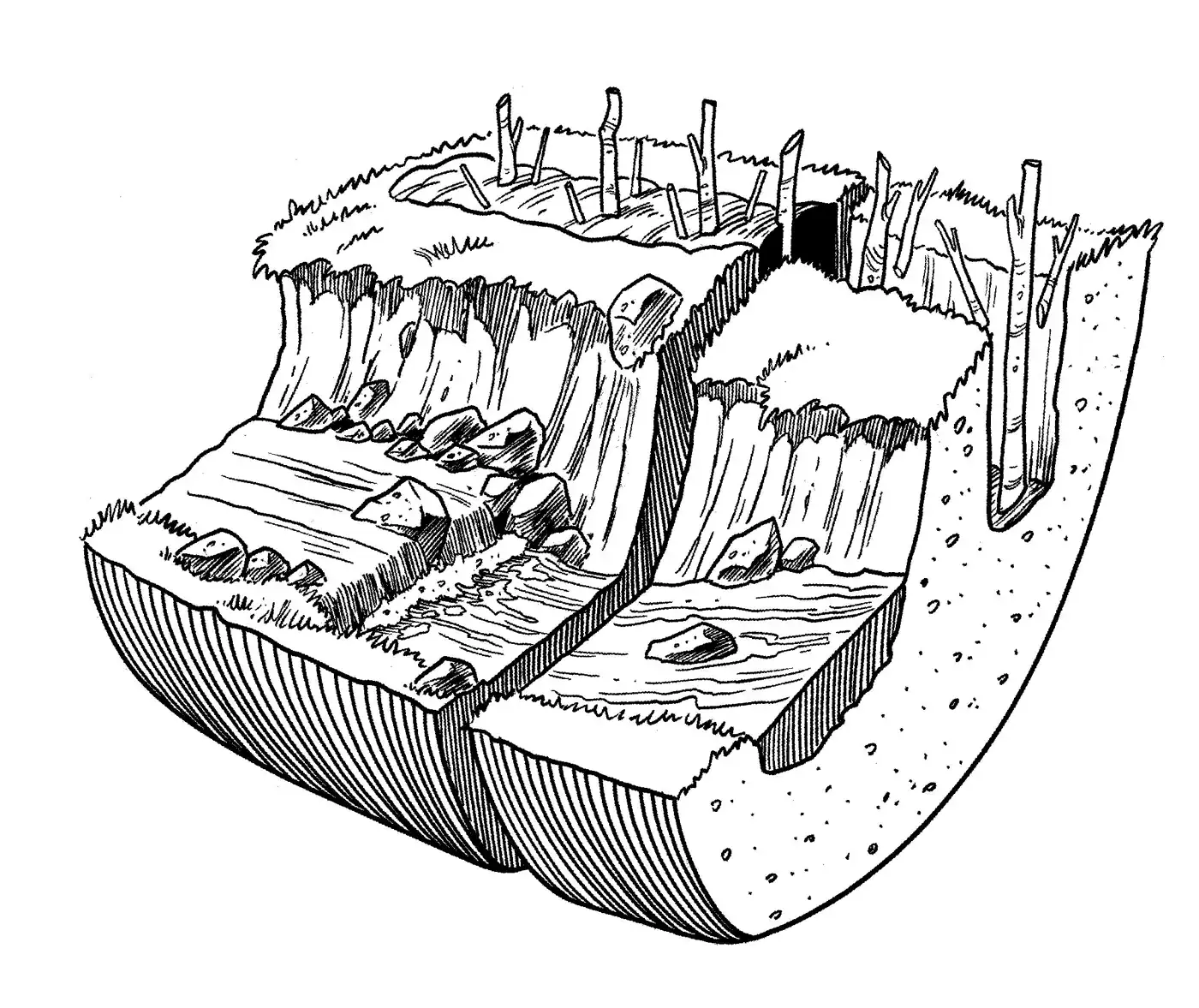
Another technique that has proven to be very effective is a technique I call “live palisades.
Live palisades are simply a row of cottonwood cuttings, as well as red-osier dogwood and willow, that are sunk in a trench down to the water table to protect the bank from erosion.

Large cuttings are used. These are soaked to be fully hydrated and to wash out any rooting inhibitors.
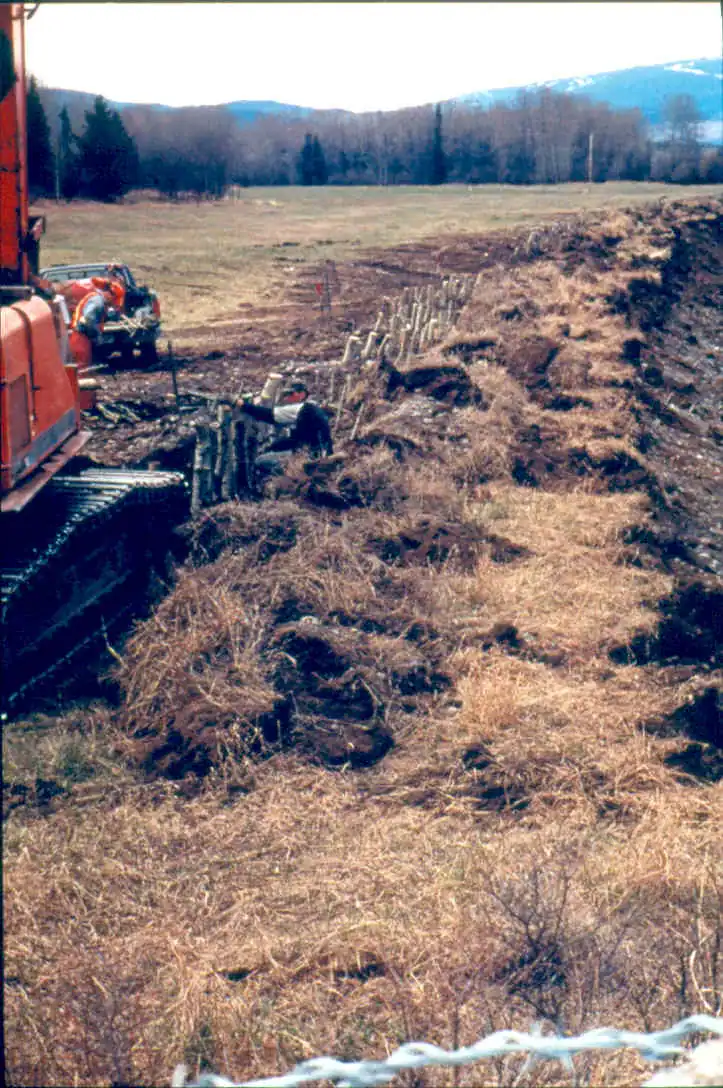
Then they are planted in a trench dug by an excavator. This project, along the Bulkley River in northern B.C. was conducted on lands that had been cleared for agriculture. Without the normal riparian vegetation, the river was actively eroding the bank.

In addition to the live palisades, live gravel bar staking was used along the actual bank. I will talk about gravel bar staking in a moment.
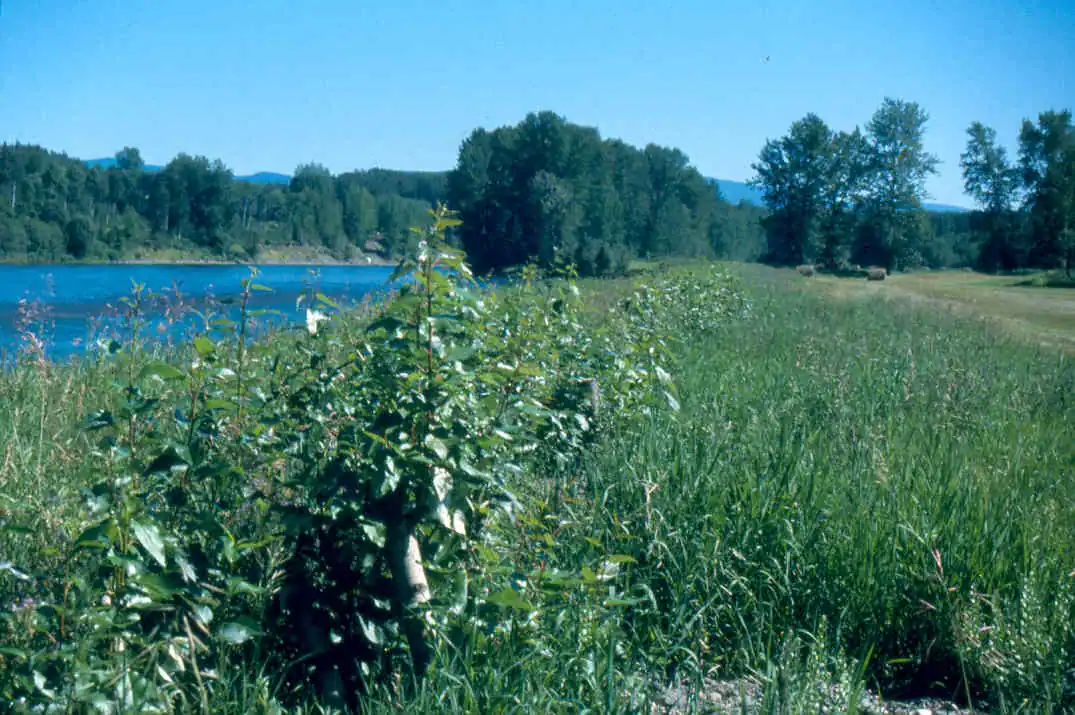
The cuttings grow vigorously because they reach to the water table, and will eventually form a stand of cottonwood trees that will provide the riparian functions needed for this site.
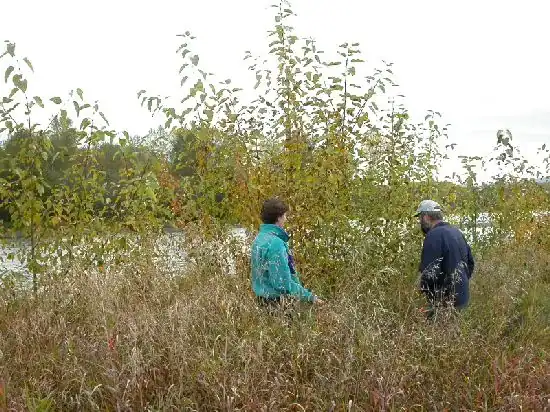
The abundant moisture and the rich alluvial soils create an ideal combination for cottonwood growth.
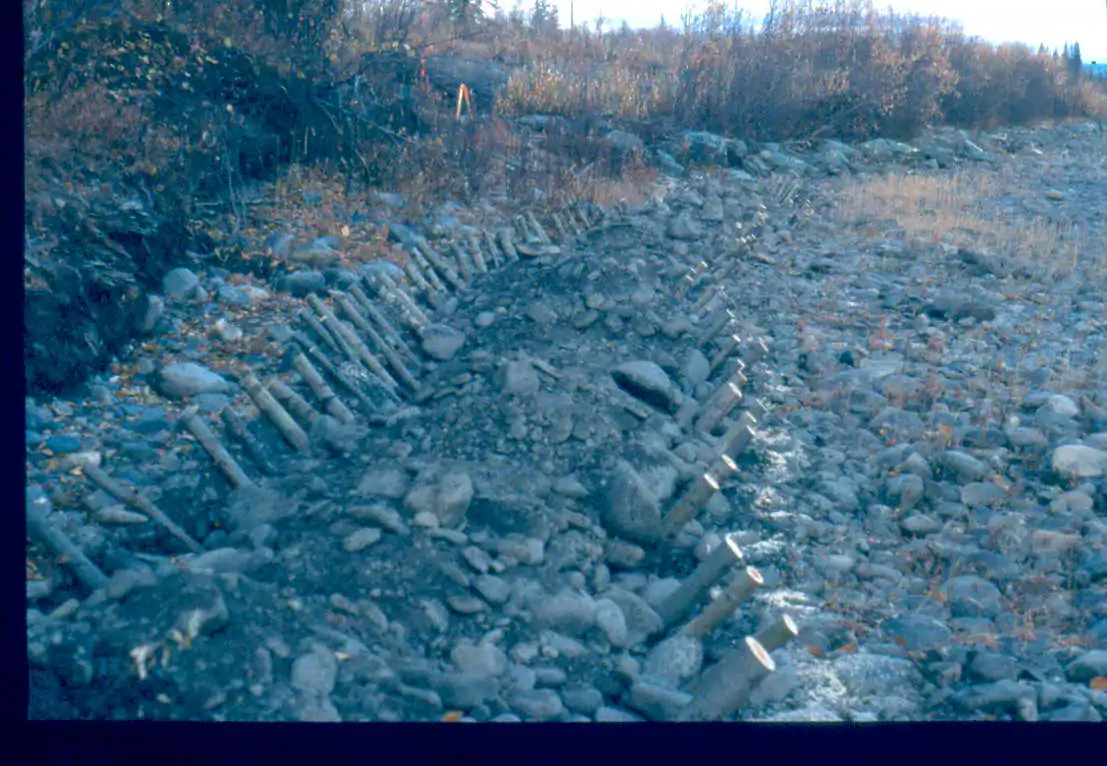
Back to the Yukon, I just wanted to show you a refinement we have made to the live palisade design and that is to use the trench to place a double row of poles.
Is This the Right Technique for Your Site?
We assess saturated bank conditions, flow direction, bank height, and available woody material to set palisade alignment, depth, and spacing.
Sources and further reading
These references provide wider technical context. Method selection and design remain site-specific.
Live palisades: from construction to a living bank barrier
This David Polster field record follows a Bulkley River live-palisade treatment from pole preparation and trenching through woody establishment, then shows the double-row refinement used at Germaine Creek.
The field record opens with the living-palisade approach: large cuttings are used to build a woody bank barrier.
Source: David Polster's Segment Live Palisades Bulkley River deck and the existing public field media. The sequence combines the Bulkley River treatment record with the dated Germaine Creek refinement; it is a source-led field progression, not a fixed-camera survey comparison.