
Rough and Loose Surface Treatment
Rough and loose surface treatment uses an excavator to create microsites for natural regeneration on mine and industrial disturbances. David Polster's published examples document the method, its costs, and its field results.
Excavator-Only Technique
Requires a standard excavator, without seeding, imported topsoil, or fertilizer.
Natural Microsite Creation
Disturbed material left rough creates shade, moisture, and seed traps for natural recruitment.
Mine Reclamation at Scale
Used on large disturbed sites where conventional revegetation would be prohibitively expensive.
Rough and loose surface treatment uses an excavator to create conditions for native ecosystem recovery. David Polster's published examples show substantially lower historical costs than conventional seeding.
The Problem with Conventional Mine Reclamation
Walk through a "successfully reclaimed" mine site and what do you typically find? A uniform cover of introduced grasses and legumes. A smooth, graded surface. Shrubs, trees, soil fauna, and ecological function may remain absent. It looks green from a distance, but ecologically it is nearly inert.
David Polster, M.Sc., R.P. Bio., spent decades studying why conventional reclamation fails to achieve genuine ecological recovery and what to do about it. His diagnosis was clear: smooth, seeded surfaces create successional dead-ends.
Grass and legume mixes introduced on smooth, compacted mine surfaces build soil organic matter slowly, create competitive exclusion barriers that prevent native woody species from establishing, and attract ungulate populations (deer, elk, caribou) that suppress any shrub or tree seedlings that do try to colonize. The result can be a site that remains at an early, impoverished seral stage for decades. It may meet the legal requirement for "vegetative cover" while failing to develop any of the ecological structure, function, or diversity that the regulatory and land management intent behind reclamation actually requires.
Rough and loose surface treatment is the alternative David developed. Records from BC mine sites show how treated surfaces changed over multiple growing seasons.
What Is Rough and Loose Surface Treatment?
Rough and loose creates a micro-topography of holes and mounds across the reclamation surface using an excavator, replacing the smooth, compacted surface left by grading with a landscape of alternating depressions and raised areas with varied depressions and raised ground.
The name describes exactly what the technique does: it makes the site surface rough (irregular, micro-topographic variation) and loose (disrupted, unconsolidated substrate that is not compacted). Roughness and looseness allow natural colonization to begin on bare disturbed sites. They are what is destroyed when a reclamation crew grades a mine surface smooth.
How It Works: The Excavator Method
The technique requires an excavator equipped with a digging bucket , not a clean-up or grading bucket. The goal is to dig and disturb, not to smooth.
Installation Steps
1. Begin at the upper end of the treatment area and work downslope.
2. Dig holes using the excavator bucket, opening holes with a digging bucket and placing the excavated material in mounds between the holes. Keep the material adjacent to the excavation rather than casting it downslope, so the paired holes and mounds retain surface heterogeneity.
3. Offset alternating rows. Each row of holes should be offset from the previous row so that holes and mounds alternate in a checkerboard pattern rather than aligning in columns. This prevents the formation of linear drainage paths between rows that would allow water to move rapidly across the surface.
4. Shatter material between holes. Use the bucket to strike and break up any hardpan or compacted layers between the excavated holes. This is the \u0022loose\u0022 component. The goal is a surface where no large flat compacted areas remain.
5. Keep the holes and mounds varied rather than smoothing the surface. The goal is a heterogeneous pattern that can capture moisture, seeds, and organic matter while remaining workable for any planned live staking.
6. Target coverage: treat the intended area continuously enough that smooth, compacted islands do not remain within the designed treatment zone. Final coverage depends on the site and restoration design.
Works on Slopes Up to 2:1 (26°)
Rough and loose has been successfully applied on slopes as steep as 2:1 (26 degrees). On steeper slopes, the technique may need modification to prevent the excavated material from rolling or slipping downslope before it can be used to form mounds. Slopes steeper than 2:1 typically require additional bioengineering treatment (live staking, wattle fences) in combination with rough and loose.
Works on Coarse Substrates
One of the significant advantages of rough and loose over seed-based reclamation is its effectiveness on coarse substrates such as alluvial boulders, cobbles, gravel, and mine waste rock, where conventional seeding may be ineffective. On these substrates, rough and loose creates the fine-textured trapped sediment microsites that allow natural regeneration to proceed even where no fine-grained planting medium is present.
Why It Works: The Ecological Mechanism
The micro-topography created by rough and loose surface treatment generates a variety of site microsites . These are small habitat patches with different moisture, temperature, and substrate conditions. These microsites do the ecological work:
Moisture capture. Depressions trap rainfall and snowmelt that would otherwise run off a smooth surface. In BC's dry interior, the ability to retain moisture in the surface 30 cm of substrate is often the limiting factor for plant establishment. Rough and loose creates thousands of moisture-trapping micro-depressions per hectare.
Seed capture. Wind-dispersed seeds of native pioneering species, including alder, balsam poplar, and willow, require a physical catch point to settle and germinate rather than being blown across and off a smooth surface. The irregular micro-topography of a rough and loose surface provides abundant seed-catch microsites.
Frost protection. The mounded surfaces warm quickly in spring, providing microsite temperatures above ambient that allow germination earlier in the season than smooth surfaces.
Nutrient concentration. Leaf litter, plant parts, and fine woody material accumulate in depressions, providing the initial organic matter and nutrient input that is absent on fresh mine surfaces.
Erosion prevention. A smooth, graded surface directs rainfall runoff into concentrated flows that erode channels. A rough and loose surface dissipates rainfall energy across the entire surface, dramatically reducing both runoff velocity and erosion. David Polster's field notes describe rough and loose as a way to reduce concentrated runoff and erosion by creating surface heterogeneity and opportunities for water to soak in.
Cost Comparison: Rough and Loose vs. Conventional Seeding
The cost advantage of rough and loose over conventional reclamation is substantial. David Polster's 2013 rough-and-loose field note reports about $700/ha of machine time for large areas:
| Treatment | Cost per hectare |
|---|---|
| Conventional grass/legume seeding (with seedbed prep, seed, application) | Baseline (higher) |
| Rough and loose surface treatment (excavator time only) | About $700/ha of machine time* |
The reported figure is a historical machine-time estimate, not a universal project price. Actual cost varies with access, substrate, location, equipment, and treatment design. The treatment is intended to support continued ecosystem recovery rather than maintain a seeded cover.
Conventional seeded covers can also carry ongoing management needs, such as re-seeding, weed control, or ungulate management. Rough and loose is intended to support natural recovery, but monitoring and follow-up still depend on site conditions and project objectives.
What Grows In
On BC mine sites treated with rough and loose, the native pioneer species that colonize naturally include:
- Balsam poplar / black cottonwood (Populus balsamifera): one of the most reliable and aggressive natural colonizers on fresh mineral substrates across BC
- Red alder (Alnus rubra): a nitrogen-fixer that dramatically improves soil conditions for subsequent colonizers
- Willows (Salix spp.): multiple species depending on moisture conditions
- Birches (Betula spp.) in appropriate climatic zones
- Scattered conifers (spruce, pine, fir) as pioneer trees begin to establish in the improving substrate
David Polster's 2013 field note describes a variety of local forest species establishing within a year on a Salt Spring Island rough-and-loose forest road. At Brenda Mine in BC's interior, a time series of photographs from 2012 to 2016 documented the transition from bare waste rock to a recovering native plant community with woody cover and increasing structural diversity through natural colonization of a rough and loose prepared surface.
Pairing with Live Staking
Rough and loose surface treatment and live staking work together particularly well. The micro-topography created by rough and loose provides the improved moisture retention and substrate stability that helps live stakes establish successfully, even on otherwise difficult coarse substrates. Live staking of balsam poplar and willow can accelerate establishment where natural seed sources are distant or site conditions call for supplemental planting. Timing varies with species, moisture, substrate, and follow-up care.
Applications Beyond Mining
While rough and loose was developed primarily for mine reclamation, the technique has proven effective across a range of large-scale disturbance scenarios:
Oil and gas wellpad and pipeline reclamation
Forestry road decommissioning and revegetation
Large cut slopes along highways and infrastructure corridors
Urban development disturbances
Any site with a large area of smooth, compacted, bare mineral substrate that needs to be revegetated is a candidate.
Frequently Asked Questions
Q: Does rough and loose require any seed or planting after the excavator work is done?
On many sites, particularly where there is an adjacent seed source of native pioneering species, natural colonization is sufficient and no additional seeding or planting is required. This is the lowest-cost and most ecologically appropriate outcome. On isolated sites distant from native seed sources, or on sites with aggressive invasive species pressure, supplemental live staking with pioneering species can accelerate the establishment of the native plant community.
Q: How does rough and loose satisfy reclamation regulatory requirements?
This is a valid concern and the answer is: it depends on the jurisdiction and the specific regulatory framework. Some reclamation permit conditions specify "uniform vegetative cover" in terms that effectively require grass seeding. David Polster spent considerable energy working with regulators to demonstrate that rough and loose produces better ecological outcomes than conventional seeding, even when it takes longer to produce visual green cover. We can assist clients in developing the technical case for rough and loose approaches with their permitting agencies.
Q: What if the mine waste material is chemically hostile (acid generating, high heavy metals)?
Rough and loose surface treatment is a physical surface preparation technique and does not address underlying geochemical problems. On acid-generating waste rock or tailings with elevated metal concentrations, chemical and geotechnical mitigation of the substrate toxicity is a prerequisite for any revegetation program. We can advise on the integration of rough and loose with appropriate geochemical management approaches.
Rough and Loose in the Field
Rough and loose surface treatment and live staking at the Butler Bros site in British Columbia.
Field Sequence: Breaking Compaction and Rebuilding Safe Sites
These Alaska field images show the logic of rough and loose treatment clearly: a broad compacted industrial surface, active excavator work to shatter the surface, and the debris-rich microtopography that gives pioneering species somewhere to start.

Before treatment: a broad compacted pad with almost no surface diversity and very little establishment opportunity.

Excavator work breaking the compacted surface and starting the rough-and-loose pattern.

After treatment: woody debris and irregular relief create moisture traps, shade, and safe sites for colonizing species.
Additional Field Example: Trail Decommissioning at Fort Shephard
Fort Shephard shows the method working outside mine reclamation. Degraded off-highway vehicle trails were made rough and loose to stop access, break compaction, restore infiltration, and create enough microsite diversity for native shrubs and forest understorey species to return.

Before treatment: deeply eroded trail surfaces with little chance of natural recovery while traffic continues.
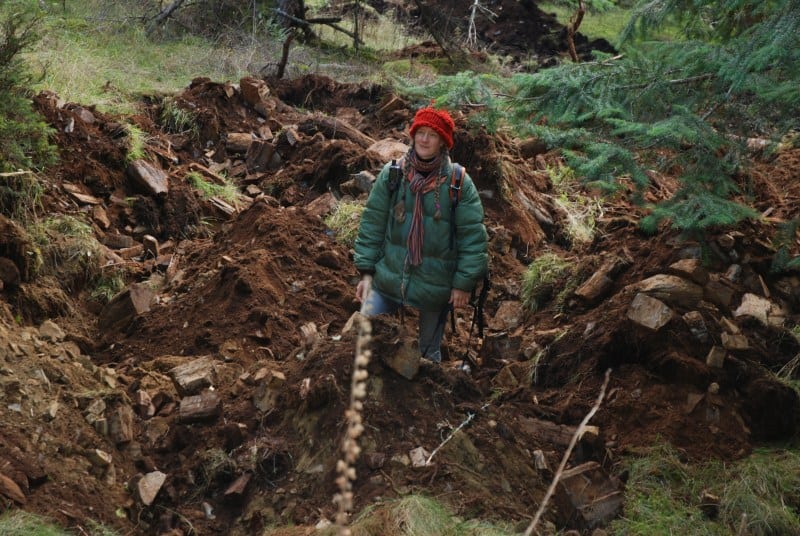
The scale of disturbance made it clear that signs alone would not reverse the ecological damage.
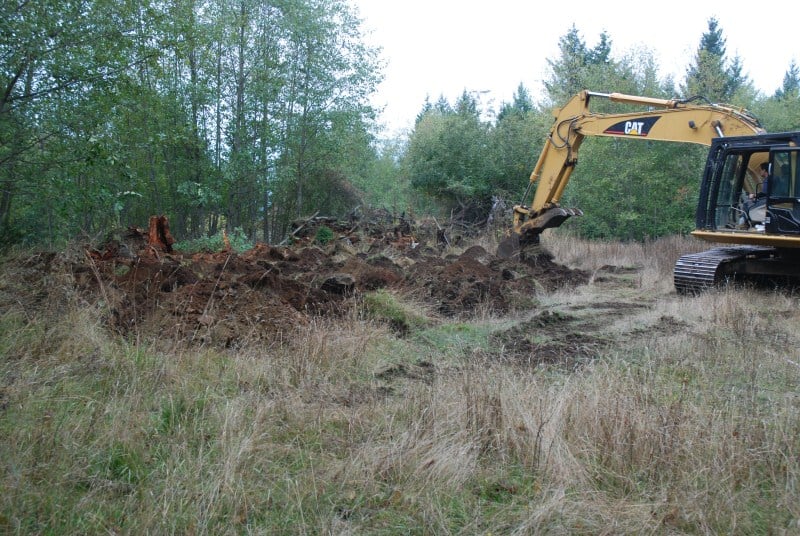
Excavator treatment breaks the compacted trail prism and creates a rough, inaccessible surface.

Native shrubs re-establish quickly once compaction, concentrated runoff, and repeated use are removed.

The target condition is a functioning ponderosa pine ecosystem, not a bare trail corridor held in arrested succession.
Related Methods and Next Steps
Is This the Right Technique for Your Site?
We assess compaction, drainage, available woody material, and surrounding seed sources to specify the excavator treatment and the distribution of recovery microsites.
Kinbasket Mounds: shaping rough and loose ground
David Polster's September 2015 field record shows how an excavator turns a smooth or compacted surface into a roughened landscape with woody material, hollows, and raised ground.
Both views are from the same dated field visit, but from different positions. This is a visual field sequence, not a fixed-camera before and after measurement.
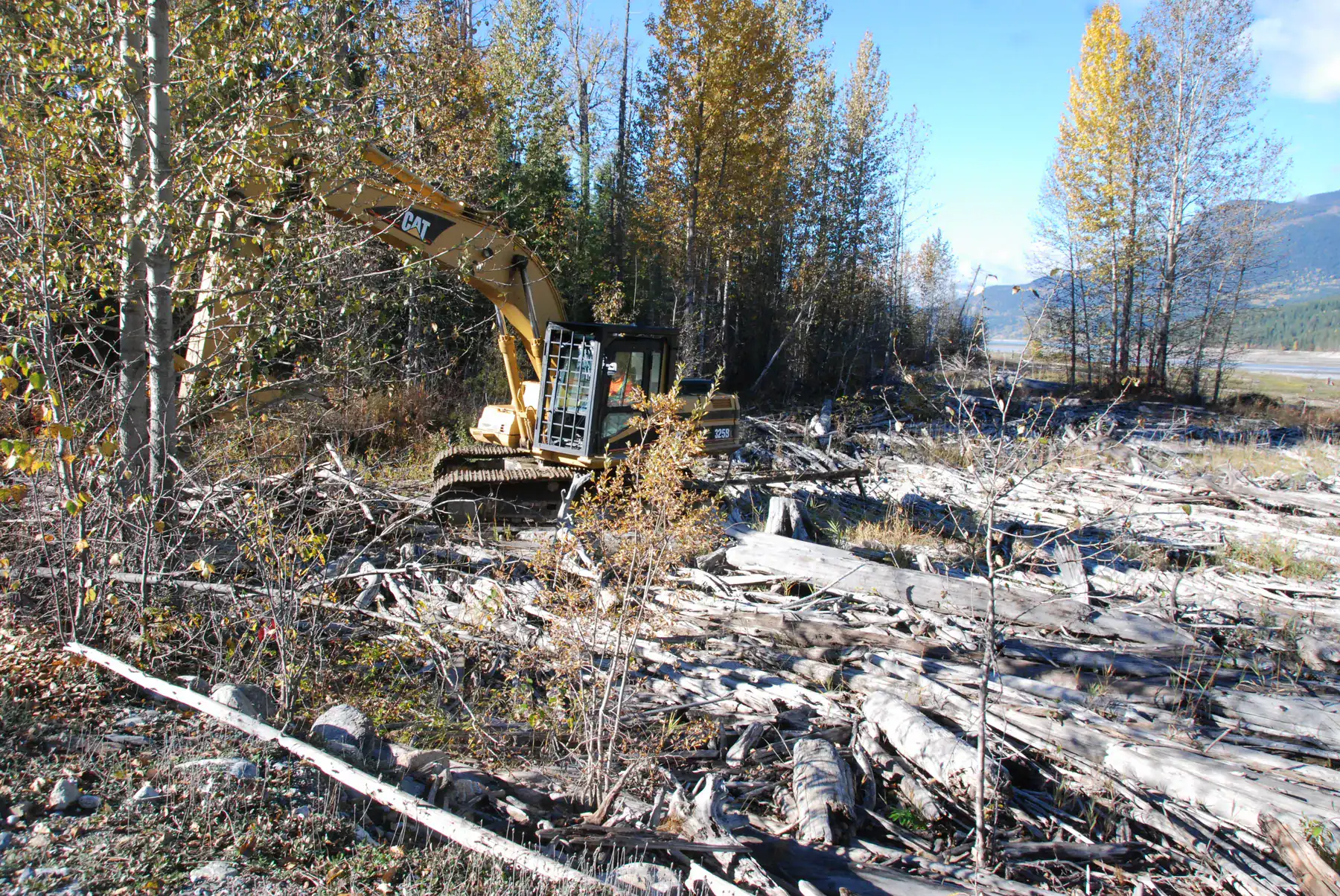
Excavator work among woody material, September 28, 2015.

Bucket work through soil, logs, and branches.

Alternate bucket view from the same field visit.
“By creating conditions that allow the natural processes to do the restoration work, the costs of conducting effective restoration can be greatly reduced.”
Sources and further reading
These references provide wider technical context. Method selection and design remain site-specific.