
Restoration videos
Browse complete slide presentations, practical restoration cases, and short field stories. Each presentation opens on its own viewing page with the supplied slides and visible credits.
Complete workshops and conference presentations
Full slide sequences from courses, conferences and workshops.
Harnessing Natural Processes: CCLT 2011, Part 1
A complete presentation on natural processes, succession and restoration planning.
Natural Processes and Erosion: CCLT 2011, Part 2
This course section examines soil-loss factors, erosion forms, and natural-process approaches to disturbed sites, including rough-and-loose preparation, stream daylighting, wattle fences, and modified brush layers.
Soil Bioengineering in Practice: CCLT 2011, Part 3
This section surveys soil-bioengineering structures and field examples, including reinforced earth walls, brush layers, live drains, gully breaks, palisades, pocket and joint planting, gravel-bar staking, monitoring, and maintenance.
Landslide Restoration and Closing Reflections: RRNW 2016
The closing presentation from the 2016 RRNW short course follows landslide restoration, pioneer planting and monitoring, community restoration work, and reflections on our relationship with the natural world.
Natural Processes: RRNW 2016
A short introduction to ecological restoration through natural processes, site filters, steep-slope examples, rough surfaces, pocket planting, and pioneer species.
Soil Bioengineering for Steep and Unstable Slopes
This presentation uses natural disturbance and recovery as a basis for treating steep and unstable slopes.
Soil Bioengineering: SER-NW 2018
This 2018 SER-NW webinar deck surveys living-plant treatments for steep slopes and riparian areas through dated project examples.
The Role of Seeding in Reclamation of Disturbed Sites: Whitehorse Workshop (2013)
A 96-page workshop presentation on seeded reclamation, vegetation succession, roadside management, and restoration examples.
Wet-side Soil Bioengineering: RRNW 2016
A complete presentation of living structures, wet slopes and streambank restoration examples.
Methods and project studies
Applied methods and site records, from concise demonstrations to longer project presentations.
Brenda Mine Biodiversity Enhancement
At Brenda Mine, the deck discusses how rough-and-loose patches, live staking, fencing and habitat structures can add topographic and vegetation diversity to disturbed mine sites. It includes dated growth examples from 2012 to 2016.
Cowichan Bay Shoreline Repair
Historic shoreline armouring and habitat loss at Cowichan Bay are followed by restoration work adding intertidal substrate and riparian vegetation. A source photograph is credited to Kerrie Talbot.
Cuttings Collection for Soil Bioengineering
Field slides cover collection locations, cutting tools, trimming and bundling woody cuttings, and soaking them before installation.
Fort Shephard Ecological Restoration
The Fort Shephard Conservancy Area deck identifies ecosystem pressures, then discusses rough-and-loose access treatment, vegetation establishment, forest ingrowth and reintroducing low-intensity surface fire after biomass reduction.
Highway Bioengineering: Wattles and Live Reinforced Earth Walls
Shows wattle fences supporting organic soils at Bowker Creek and live reinforced earth walls used to reinforce slopes and fill gullies, with observations from 2005 to 2007.
Island Copper Mine: Seeding and Succession
At Island Copper Mine, the deck documents planted alder and grass stands and discusses how dense seeded grasses and legumes can compete with alder, affecting later forest succession.
Klondike River Live Gravel-Bar Staking
Follows cutting collection and live gravel-bar staking at Germaine Creek on the Klondike River, with observations of growth, sediment deposition and woody debris from 2004 to 2018.
Modified Brush Layers for Dry Slopes
Shows modified brush layering for dry, stony slopes: install supports and cuttings, backfill and create planting pockets. It includes a 1996 slope failure and 1997 growth example.
Mount Robson Slope Problems (2018–2020)
A nine-page case study documenting slope conditions, a live-staking treatment, and site photographs from 2019 and 2020.
Pocket and Joint Planting at Seaton River
Introduces pocket planting on coarse talus and joint planting, with a dated Seaton River pocket-planting sequence from 2002 to 2014.
Qualicum Beach Slide Restoration
A five-slide sequence records work on the Qualicum Beach slide from a pre-treatment view in February 2020 through progress in March and April 2020.
Rough-and-Loose Treatment on Compacted Tundra
A short case showing rough-and-loose surface preparation on compacted tundra at an Alaskan industrial site, using machinery to break compaction and prepare for pioneering vegetation.
RPP Historical Wattle-Fence Sequence
Historical photo sequence of a steep till-slope treatment and vegetation development from 1986 to 2009.
San Juan River Live Gravel-Bar Staking
Follows live gravel-bar staking on the San Juan River from 1998 to 2014, showing plant growth, sediment collection behind woody debris, bar development and conifer establishment.
Stoltz Bluffs River-Slope Bioengineering
Traces river-meander pressure, slope failures and sediment entering the Cowichan River, then contrasts the bioengineered section and balsam-poplar growth with continued slumping nearby.
Tools for Soil Bioengineering
A short overview of tools used in soil-bioengineering field work.
UBC Slope Piping Failure: Brush Mattress and Wattle Fences
Five slides document a UBC slope-piping failure, brush-mattress drainage and wattle-fence reconstruction, followed by observed plant growth.
Use of Natural Successional Processes in Yukon Highway Vegetation Management
A case presentation on roadside succession, wildlife attraction, sightlines, and selective pruning along highways.
West Kelowna Powers Creek Delta Erosion
Describes missing riparian trees, bridge constriction and wave erosion at the Powers Creek delta, then presents re-establishing woody riparian vegetation as a restoration response.
Wexford Erosion Control on Moisture-Sensitive Slopes
A Wexford sequence compares erosion-control blanket treatments on moisture-sensitive soil, documents continued slope movement and repairs, and shows wattle fences holding soil while allowing drainage and cutting growth.
People and restoration legacy
Biographical and legacy presentations featuring David Polster.
David Polster: A Life in Ecological Restoration
A photographic introduction to David Polster's life and work in ecological restoration, including his participation in the 2017 Society for Ecological Restoration conference in Brazil.
David Polster: RRNW 2016 Introduction
An introductory biographical slide sequence about David Polster, his early field and academic experience, and selected landslide, riverbank, and restoration-course examples.
Short stories and animation
Selected project photo stories and a conceptual method animation.

Battle Lake restoration
A 62-second photo story following ground preparation and early vegetation growth, 2010–2013. On-screen text; no audio.
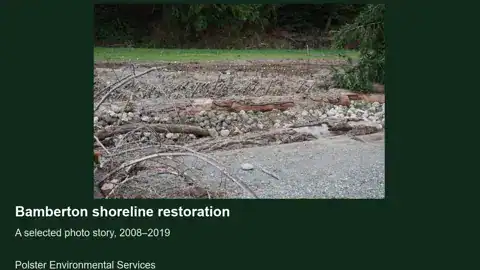
Bamberton shoreline restoration
An 82-second selected photo story of shoreline installation and later observations, 2008–2019, including erosion beside a boat ramp. On-screen text; no audio.
Live staking: root growth animation
A 3.22-second conceptual illustration. It is not a time scale or growth-rate prediction; establishment varies with site conditions.


Field footage
Rough and loose and live staking in the field
Existing Butler Bros footage showing surface treatment and live staking.