
Start with the failure mechanism
Site Assessment & Restoration Planning
Turn a difficult site into a practical restoration pathway with clear treatment selection, specifications and field support.

What may be happening
Diagnose before prescribing
The visible symptom is not always the cause. Erosion may be driven by concentrated runoff, seepage, compaction, lost root strength, an over-steepened landform or a biological filter that prevents natural recruitment. A generic treatment can spend money without changing that process.
We review the site history and conditions before recommending work. The scope may be a short written recommendation or include drawings, material guidance, field direction and monitoring. We identify where other disciplines or permits need to be part of the project.
Methods that may fit
Treatment follows site conditions
Technique selection
A practical guide from site problem to treatment.
Methods library
Review the documented field methods.
Projects
Compare similar sites and long-term outcomes.
Resources
Read the papers and field notes behind the recommendations.
Field evidence
See the method in context
Projects by problem
Use completed field examples to compare settings, treatments and recovery.
View the evidence →Before & After
Evaluate living systems over years rather than at installation day.
View the evidence →David Polster's research legacy
Follow the papers and practical ideas that shaped the approach.
View the evidence →Read the source material
PES starts with a practical question: what is stopping this site from recovering? The treatment should address that limiting condition and support the next stage of succession.
Where this service fits
Common site types and project needs
These are starting points, not a substitute for assessment. A project may combine several service areas.
- Early feasibility and treatment selection
- Restoration concepts and specifications
- Construction or installation field support
- Monitoring criteria and adaptive recommendations
From first look to field follow-through
A practical four-part path
Assess
Review the site, disturbance history, forces, constraints and desired outcome.
Select
Match methods, species, materials and timing to the limiting process.
Support
Provide specifications, installation guidance and field decisions where required.
Learn
Monitor trajectory and adjust when field evidence shows a better path.
Questions clients ask
Assessment & Planning FAQ
What should I send before an assessment?
A location, several current photos, a short site history, the observed problem, known constraints and the outcome you need are enough to begin the conversation.
Can PES work with engineers and other consultants?
Yes. Soil bioengineering often sits within a larger geotechnical, hydrological, environmental or regulatory scope. Roles and interfaces should be clear from the outset.
Will the assessment recommend one standard detail?
Not automatically. The purpose is to identify the limiting process and choose a treatment suited to the site, including where soil bioengineering is not the right tool.
Bring the site problem into focus
Send the location, current photographs, known history and the outcome you need. PES will help identify the right next step.
Native plant gardens as a recovery pathway
A native plant garden can be the visible first stage of ecological recovery, not just an ornamental planting.
We start with water, soil, exposure, compaction, existing vegetation, and the process that is holding the site back. Locally appropriate pioneering plants can occupy safe sites, slow surface flow, hold soil with roots, add organic matter, and create conditions that help later species establish. The garden is designed to change with the site rather than freeze it at installation day.
Explore planting examples and monitoring guidance
The 2003 Somenos Garry Oak ecosystem plan treated restoration as a sequence of site-specific work, monitoring, and adjustment. It separated implementation, effectiveness, and validation monitoring, then called for repeated plots and photo points to track change. The plan supports the monitoring framework below. The public field image documents monitoring equipment in use, but it is not proof that every proposed treatment was completed or successful.
A separate David Polster field record at the Battle Lake former gas plant shows the same logic in a different setting: after remediation and rough-and-loose preparation, willow, balsam poplar, and red-osier dogwood cuttings were installed and observed as woody cover and later species developed. It is a historical example, not a standard recipe for every garden.
David's Honeymoon Bay Ecological Reserve record shows why recovery can depend on hydrology, not only on a planting list. The source links Pink Fawn Lily habitat to periodic floodplain flooding that removed maple leaves and seeds and deposited fine silt, creating conditions that favoured bulb-forming species. It also records down-cutting and bank loss after a bridge constriction changed flow, and discusses restoring flood conveyance and annual overbank conditions. This is a historical ecological record, not a current project assessment or a prescription to plant lilies.
David Polster's Faro Mine succession record adds a second recovery lesson: native and locally appropriate pioneering plants need the right microsites before they can do the work of succession. The source describes willow seedlings establishing in wet pockets, pioneering herbs on disturbed ground, and later spruce appearing beneath willow cover as vegetation and soil conditions changed. For a garden or reclamation site, that supports designing for water, roughness, and safe establishment sites rather than promising that a fixed plant list will produce the same outcome everywhere. This is a historical mine-reclamation example, not a current PES project assessment.


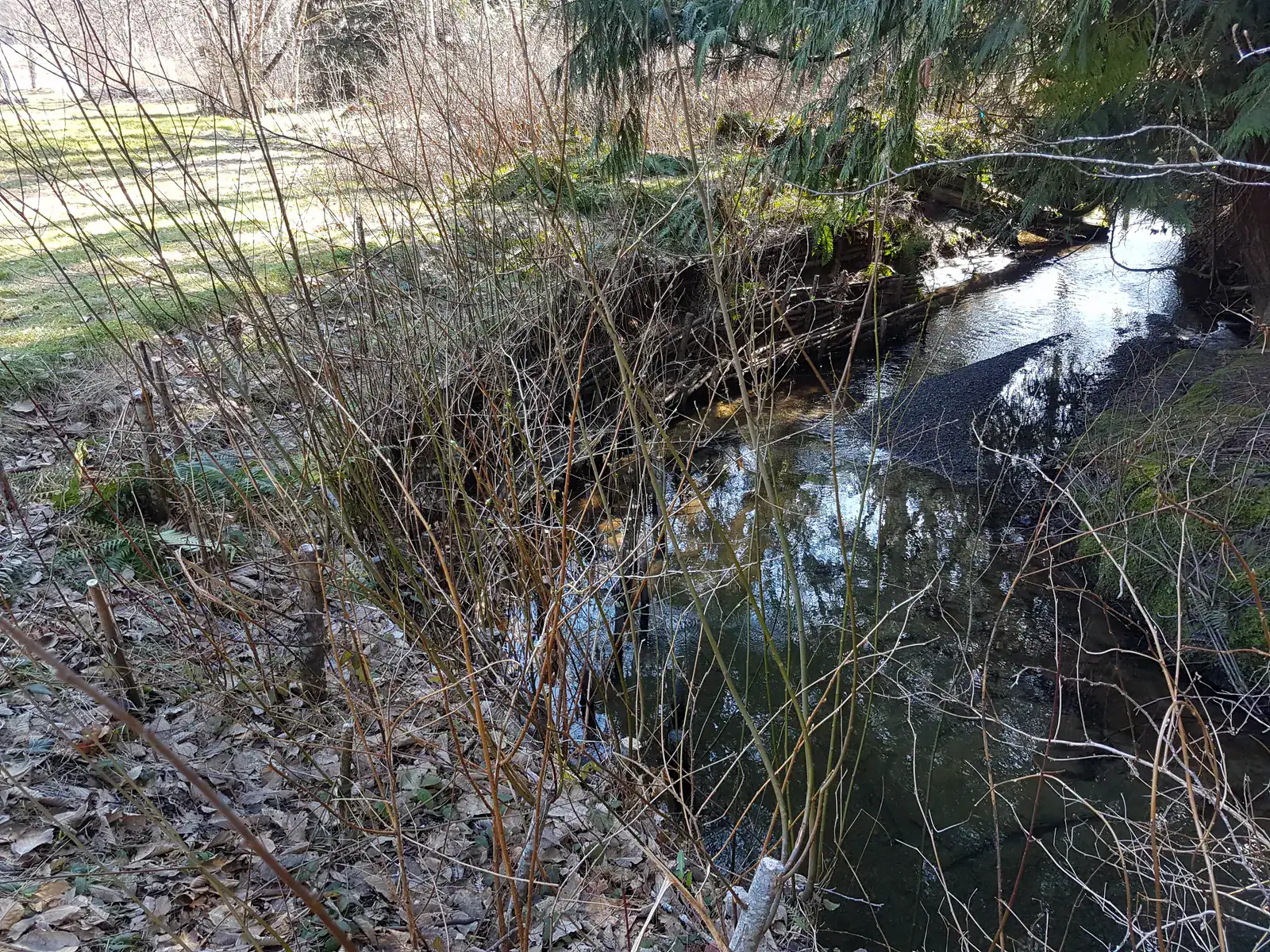
David Polster's Sandy Pools restoration plan also shows why plant choice belongs inside the site process. At the Cowichan River bank, live staking using primarily Balsam Poplar was intended to rebuild a dense root complex and re-establish a species that had been lost from the post-logging conifer stand. Live gravel-bar staking was planned to slow flow and encourage sediment accumulation. This historical plan describes site-specific living stabilization, not a universal planting prescription or a measured outcome for every native garden.

Assess the site
Find the constraint first: runoff, seepage, compaction, browse, invasive pressure, or missing soil structure.
Create safe sites
Use roughness, small terraces, woody debris, mulch, or living structures where planting needs protection before it can take hold.
Plant for sequence
Match locally appropriate pioneers to moisture and exposure, then plan for later shrubs, trees, and ground-layer species.
Protect and learn
Plan for establishment care, browse protection, invasive control, and monitoring so the next decision follows field evidence.
Questions to ask before planting
Can native planting solve an active slope failure?
Not by itself. Deep-seated movement, active seepage, concentrated runoff, or a failing landform may need structural, drainage, or soil-bioengineering measures selected through a site assessment.
How do you choose the plants?
We match locally appropriate species to moisture, exposure, soil, browse pressure, access, and the role each plant can play in succession. A native species is not automatically suitable for every site.
Is a native garden maintenance-free?
No. Establishment care, browse protection, invasive control, monitoring, and occasional replanting should be planned around the site's conditions and the recovery trajectory.
How should progress be shown?
Use a same-project, date-labelled sequence when the source and image permission are verified. Otherwise, label a single field image as historical or illustrative and describe only what can be observed.
A native plant garden does not replace structural treatment for a deep-seated failure, active seepage, or a site that needs a different intervention. Planting, soil preparation, drainage, and bioengineering should be selected together when the assessment calls for it.