
Live Staking
Live staking uses dormant willow and cottonwood cuttings to stabilize eroding slopes and streambanks across BC. A living erosion-control technique whose performance depends on species, moisture, and site design. Learn how it works.
Willow and Dogwood Species
Uses locally appropriate riparian species and source material matched to the restoration site.
Streambanks and Slope Toes
Often fits moist or periodically flooded zones, but suitability depends on species, moisture, substrate, and site design.
Rapid Establishment
Cuttings can begin rooting during the first growing season when dormant material reaches suitable moisture; erosion resistance develops as roots and shoots establish.
Live staking is a widely used soil bioengineering technique in BC. Dormant cuttings are installed where they can root and reinforce eroding soil.
What Is Live Staking?
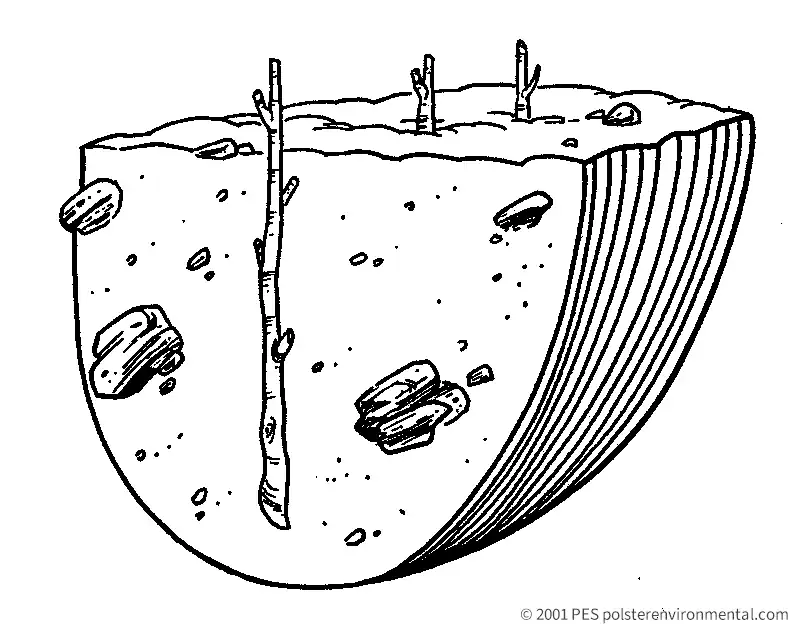
Live staking is the direct insertion of dormant willow, cottonwood, or red-osier dogwood cuttings into an eroding slope, streambank, or disturbed site. Unlike transplanting nursery-grown seedlings, live stakes are unrooted cuttings inserted directly into the ground, where they sprout roots and shoots and establish as living plants.
The technique is simple to describe, but its performance depends on species, moisture, substrate, season, and the treatment around the stake. Established cuttings can contribute roots, shade, litter, and later successional habitat.
David Polster's published and field work informs PES's use of live staking in British Columbia. It is one tool in a broader site-assessment and treatment sequence.
How It Works
Live staking works on two timescales simultaneously.
Immediately upon installation, a correctly placed stake can add roughness and some resistance to surface movement. This is not a substitute for structural treatment where a site has deep-seated failure or mass movement.
During the first growing season, stakes may produce roots from the buried section and shoots from the exposed tip. Above-ground growth can be modest while roots establish, so performance should be checked in the field.
Over subsequent years, the root systems deepen and spread. The established plants provide increasingly effective resistance to erosion, add organic matter to the soil, and create shade, retain moisture, and add litter, allowing additional native species to colonize the site. What began as a set of bare stakes develops into a functioning native plant community following the natural successional trajectory for the region.
Species Used in British Columbia
Common British Columbia species used for live staking include:
Identify the species and match source climate and moisture conditions to the treatment site. A marsh source is not automatically suitable for a dry sandy slope.
Black cottonwood / balsam poplar (Populus balsamifera) is particularly effective on mine reclamation sites and larger-scale disturbances where establishing a fast-growing pioneering canopy is a priority. Cottonwood is a fast-growing pioneer that can be useful on moist, disturbed sites when the species and source material fit the site.
Red-osier dogwood can supply dormant stem cuttings where it fits the intended plant community and moisture conditions. Check browsing pressure and source suitability; shade alone does not establish that it will perform well.
The "rule of thumb" for cutting selection: if a cutting is not as large in diameter as your thumb at its tip, it is too small. Minimum tip diameter should be 2.5 cm. Cuttings should be a minimum of 40 cm long and are typically 1 to 2 metres for slope and streambank applications.
For a full guide to harvesting and handling, see Harvesting Plant Cuttings.
Installation Process
Timing
Live staking must be done during the dormant season: late fall to early spring, before bud break. This timing is essential. Installing cuttings after buds break dramatically reduces rooting success, as the plant's energy is directed to shoot growth rather than root development.
Collect while the source plants are dormant and plan installation for workable ground. Stored material needs a suitable cold-storage and handling plan. The handbook gives a moist, sub-zero storage example; it does not prescribe 0–1°C as a universal optimum.
Cutting Preparation
- Cut at an angle at the base to facilitate insertion and to distinguish the bottom from the top (polarity matters because stakes inserted upside down will not root)
- Remove small branches and twigs, but leave the bark intact
- Soak cuttings in clean water for up to 10 days before installation to stimulate root development
Installation Steps
1. Create a pilot hole using a steel rod or rebar at 90 degrees to the slope surface. Do not hammer the stake directly into the ground because this damages the cambium
Insert at least three-quarters of the cutting below ground: at least 75 cm for a 1-metre stake. David Polster describes seven-eighths burial on drier sites, with most of the stem kept moist.
3. No more than 20–30 cm should protrude above the surface
4. The stake must be in contact with moisture. In mineral soils, this generally means reaching the capillary fringe above the water table
Spacing
Space stakes 60–90 cm apart (approximately 2–3 feet) in staggered rows. On streambanks and slopes with active erosion, closer spacing provides faster cover. On mine reclamation sites prepared with rough and loose surface treatment, stakes can be spaced more widely as the micro-topography assists natural regeneration between stakes.
Results Timeline
| Timeframe | What Happens |
|---|---|
| Installation | Physical soil anchoring begins immediately |
| First growing season | Root system establishes; modest above-ground shoot growth |
| Year 2–3 | Established plants with deepening root systems; visible canopy cover |
| Year 5+ | Maturing native plant community; monitoring and maintenance depend on site conditions |
| Year 10+ | Succession may progress toward a regional native forest or shrub community |
Initial growth may appear slow because root development is the priority in year one and is not visible above ground. This is normal and expected. By year two, differences between staked and unstaked areas may become visible, but timing varies with moisture, species, and site conditions.
Best Applications
Live staking is effective across a wide range of site conditions, but performs best where:
- Moisture is available. The stakes must reach soil moisture to root successfully. This makes riparian zones, streambanks, and sites with subsurface moisture ideal. Dry, well-drained upper slopes may require other techniques (modified brush layers) or site preparation (rough and loose) first.
- The slope is globally stable. Live staking addresses surface erosion and revegetation, not deep-seated slope failures. Sites with mass movement potential require structural treatment before staking.
- The disturbance is relatively recent. Fresh disturbances (recent grading, road cuts, streambank erosion) respond better than long-established bare ground with compacted surfaces.
Excellent applications include:
Eroding streambanks and riparian corridors
Graded slopes on construction sites and subdivisions
Road cut and fill revegetation in BC's Interior and on Vancouver Island
Mine reclamation sites (especially following rough and loose surface preparation)
Post-flood and post-landslide site treatment
Wetland and pond margin restoration
When NOT to Use Live Staking Alone
Live staking alone is not appropriate on:
- Actively scoured streambanks with high-energy flood flows (use live bank protection or live palisades)
- Deep-seated unstable slopes prone to mass movement
- Dry, desiccated slopes with no accessible soil moisture (use modified brush layers)
- Large-scale mine reclamation without surface preparation (combine with rough and loose)
Why It Works Long-Term
Live staking does more than revegetate a site. It restarts the successional process. Willows, cottonwood, and red-osier dogwood are early seral species: they are the same plants that naturally colonize disturbed sites across British Columbia, and they are adapted to thrive under the difficult conditions (bare mineral soil, fluctuating moisture, high light) that follow disturbance.
Once these pioneers establish, they modify site conditions in ways that facilitate the colonization of later seral species. Accumulated organic matter improves soil structure. Shade and moisture retention expand the range of species that can establish. The trajectory from bare disturbed ground to functional native ecosystem is underway through the region's natural successional processes, initiated by the installation of dormant cuttings.
This is the fundamental insight behind David Polster's approach: you don't have to plant the entire ecosystem. You install the pioneers, align the site with its natural successional trajectory, and let the ecosystem build itself.
David Polster field record: A 2016 Cowichan Lake and River shoreline stewardship report documenting work under restoration ecologist Dave Polster's supervision records Scouler's willow and red-osier dogwood installed on three treated shorelines to improve erosion resistance, add riparian habitat, and support juvenile salmonids. The project planted 240 stakes over 150 m2, 175 over 644 m2, and 210 over 110.5 m2, then called for follow-up monitoring for summer survival, watering, and herbivore protection as needed. These figures are a project record, not a universal spacing prescription.
Frequently Asked Questions
Q: How long does live staking take to establish?
Check for shoot growth, then follow survival through the dry part of the season. New leaves are an early observation, not proof that the root system is established.
Q: What species are used for live staking in BC?
Willows (Scouler's willow, Pacific willow, Sitka willow, Hooker's willow depending on site conditions), black cottonwood/balsam poplar, and red-osier dogwood are the primary species. Species selection should match local conditions. Willows from adjacent native populations are preferred over material trucked from a distant source. See Harvesting Plant Cuttings for a full species guide.
Q: When is the best time of year to install live stakes?
During the dormant season, from late fall to early spring before bud break. On BC's coast: November through March. In the Interior: November through early March. In northern BC: October through February. Installing after bud break dramatically reduces rooting success.
Q: How does live staking compare to hydroseeding or conventional grass seeding?
Grass and legume seed mixes do not provide the structural root systems that live staking establishes. Seeded grasses build organic matter slowly, require ongoing management, and on disturbed mineral soils often create competitive barriers that slow the colonization of native woody species. Live staking with willow and cottonwood establishes pioneering species that actively drive succession toward native forest communities. On most BC restoration sites, live staking produces better ecological outcomes at comparable or lower cost.
Q: Can live staking be done by volunteers or community stewardship groups?
Yes. The materials can be collected locally, and the tools are simple (a steel rod for pilot holes and a pair of loppers for cutting), and the installation technique can be taught in an hour. Live staking is well-suited to community restoration events and Indigenous stewardship programs across British Columbia.
Dormant Season Only
Live stakes must be cut and installed while plant material is dormant, before bud break.
Roots Grow, Stake Fuses
The buried stake sends out lateral roots and fuses with surrounding soil over its first season.
Simple but Site-Specific
Species selection, cutting diameter, and spacing are matched to slope angle and site hydrology.
Is This the Right Technique for Your Site?
We assess slope or bank moisture, locally available cuttings, access, and erosion patterns to specify the right species, spacing, and installation depth.
Sources and further reading
These references provide wider technical context. Method selection and design remain site-specific.