
Moving water and living banks
Riparian & Streambank Restoration
Rebuild woody riparian structure, reduce erosion and create conditions in which the bank can keep developing after installation.

What may be happening
Diagnose before prescribing
A bare or eroding streambank loses soil, shade, root strength and the roughness that helps slow near-bank flow. Hard armouring may protect one point while transferring energy downstream or disconnecting the channel from its riparian edge.
We match the treatment to the channel and bank. Live bank protection works at the eroding edge; gravel-bar staking introduces woody plants on suitable bars. Wattle fences and pole drains may fit problems higher on the bank. The aim is a rooted riparian margin that can develop after installation.
Methods that may fit
Treatment follows site conditions
Live bank protection
Dense living cuttings placed where bank erosion begins.
Live palisades
Rows of large cuttings for wet, depositional settings.
Live gravel-bar staking
Willow establishment on bare or mobile gravel bars.
Vegetated riprap
Living material integrated where rock protection is necessary.
Field evidence
See the method in context
Stoltz Bluffs
Slope, gully and river processes addressed together on the Cowichan River.
View the evidence →Bowker Creek
A field sequence showing wattle fences and a developing riparian edge.
View the evidence →Read the source material
PES starts with a practical question: what is stopping this site from recovering? The treatment should address that limiting condition and support the next stage of succession.
Where this service fits
Common site types and project needs
These are starting points, not a substitute for assessment. A project may combine several service areas.
- Eroding streambanks
- Riparian buffer repair
- Post-flood recovery
- Fish-habitat and watershed projects
From first look to field follow-through
A practical four-part path
Assess
Review the site, disturbance history, forces, constraints and desired outcome.
Select
Match methods, species, materials and timing to the limiting process.
Support
Provide specifications, installation guidance and field decisions where required.
Learn
Monitor trajectory and adjust when field evidence shows a better path.
Questions clients ask
Riparian & Streambank FAQ
Will live cuttings survive flooding?
Technique and species selection must reflect expected water levels, shear stress, substrate and planting elevation. Dynamic sites often need a combination of living and structural treatments.
Which species are used?
Locally suitable pioneering woody species are selected for the site and biogeoclimatic setting. Availability, harvest timing, moisture and elevation all matter.
Does this replace permitting?
No. Work in and around water may require regulatory review and qualified professionals. PES can help define the restoration approach within that larger process.
Bring the site problem into focus
Send the location, current photographs, known history and the outcome you need. PES will help identify the right next step.
Bowker Creek: woody cover and slope response
David Polster’s 2018 Bowker Creek assessment describes erosion at the Richmond Road culvert outlet as a combination of lost riparian vegetation and changed urban hydrology. It pairs dense live staking, which can slow flow and develop strong root systems, with wattle fences that retain steep slopes while living cuttings re-establish riparian cover.
This is a historical design note, not a universal specification. The assessment also records site-specific backfill requirements where material on the slope is limited, so treatment selection should follow current field conditions.
Cochrane field course: woody riverbank cover
David Polster’s May 25, 2019 field record from a Cochrane streambank course site shows dense woody stems and new leaves at the water edge. It is a teaching-site observation, not a measured treatment result or a current PES client-project claim.
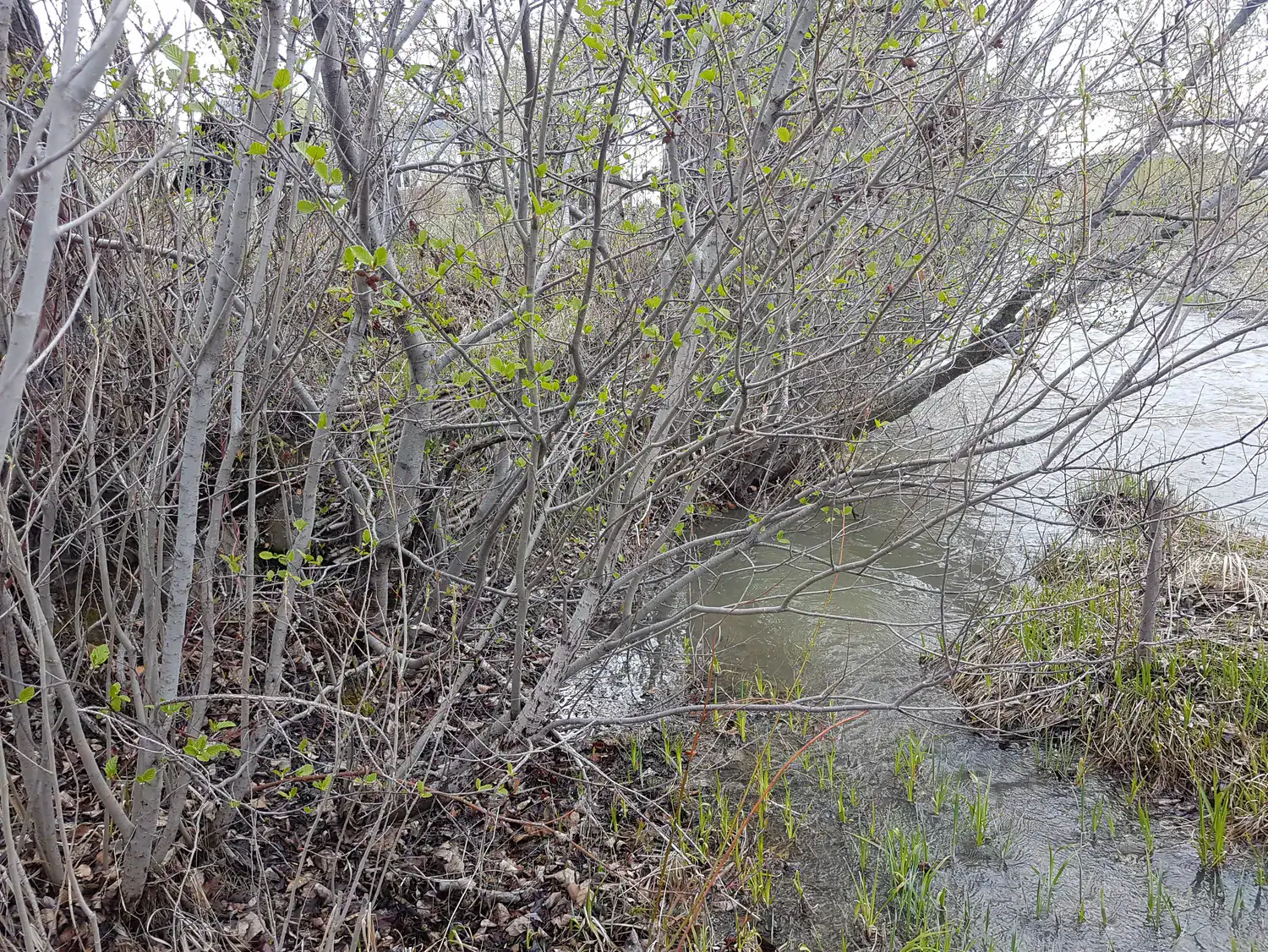
The photograph is included as a visual example of the kind of site reading used in riparian restoration training. Treatment choices remain site-specific and should be supported by current field assessment.