
Live Bank Protection
Live bank protection uses dense living cuttings to address streambank erosion where site conditions and hydraulic forces support a soil-bioengineering approach. Learn when to use it and how it is built.
Armours the Bank Toe
Live branch bundles placed at the waterline protect the vulnerable bank base from scour.
High-Flow Tolerance
Suitable for banks exposed to high flow velocities where other methods can't hold.
Habitat Integration
Creates complex bank structure that doubles as fish and invertebrate habitat.
Live bank protection re-establishes a woody riparian buffer using living willow cuttings rather than rock armour or concrete.
What Is Live Bank Protection?
Live bank protection is a soil bioengineering technique that places a dense line of living cuttings along a stream or river bank. When the treatment is correctly located and designed, the living material can protect the bank surface and contribute to riparian recovery.
Conventional streambank protection may armor the bank with riprap, gabion baskets, or concrete. Live bank protection replaces the eroded or cleared riparian vegetation with a new generation of pioneering woody plants installed in a structure dense enough to withstand the hydraulic forces of the stream. The cuttings root, sprout, and grow. As suitable cuttings root and grow, a formerly bare bank may develop roots and shoots that contribute to riparian recovery; the timing and extent depend on moisture, species, flows, and installation conditions.
Like all soil bioengineering techniques developed by David Polster, live bank protection works with natural riparian succession rather than against it. Willows, cottonwood, and red-osier dogwood are the same plants that naturally occupy streambanks across BC. The technique re-starts a recovery process the site would undertake on its own, given time and the absence of ongoing disturbance.
How It Is Built
Live bank protection is essentially a specialized application of wattle fence construction, adapted for the hydraulic demands of streambank environments.
Construction Approach
1. Install vertical stakes along the bank line at 0.5–0.75 m spacing. Stakes must be driven deep enough that the rooting zone reaches soil moisture. On streambanks, the water table is generally close to the installation. Use long cuttings (1.5–2 m) for greater structural depth and faster root establishment.
2. Place horizontal cuttings behind the vertical posts, on the bank side, working from the base upward. Keep all stems behind the posts, then backfill and lightly tamp down the soil. Follow the site design for treatments exposed to stream flow.
3. Fill gaps between cuttings with additional trimmings, smaller stems, and cut branches. This is important: any gaps in the structure provide pathways for erosion. Dense packing of trimmings and debris is standard practice.
4. Backfill behind the structure with soil from the bank to create structural support and ensure the buried stems are in firm contact with moist substrate.
5. Position the ends carefully. The termination points are critical. Where a stream is eroding laterally, an improperly terminated structure will simply be flanked. The upstream and downstream ends of the installation should be stepped back into the bank rather than terminating abruptly at the water's edge.
Brush Mats
Where flood flows carry significant sediment and create high scour forces, brush mats can be used in combination with live bank protection. A brush mat is a layer of cut branches and stems placed flat against the bank face and staked or pegged in place below the waterline. The mat dissipates the energy of flood flows and traps sediment while the live bank protection cuttings above it establish their root systems. Together, the two components address both the immediate hydraulic loading and the longer-term revegetation requirement.
When to Use Live Bank Protection
Live bank protection is appropriate when:
- The bank has been cleared of riparian vegetation by logging, road construction, farming, or development, and erosion has accelerated as a result.
- Stream flow is actively eroding the bank but the erosion is primarily in the near-bank zone, with flowing water scouring the bank face rather than a deep-seated mass failure.
- A woody riparian buffer is needed for fish habitat restoration, sediment control, or bank stabilization, with establishment timing assessed against site conditions.
- The site is accessible from the bank. Live bank protection is a hand-tool technique, though large-scale installations may benefit from machine-placed fill in the backfill phase.
Live bank protection is particularly well-suited to:
Newly constructed ditches and drainage channels where riparian vegetation has been lost
Streambanks where livestock or human activity has degraded the bank edge
Riparian restoration projects targeting fish habitat enhancement
Post-flood bank repair where the riparian strip has been scoured clean
Live Bank Protection vs. Riprap
Riprap (rock armor) is the default conventional response to streambank erosion. It is durable and immediately effective at stopping erosion of the installed surface. But it has significant limitations as a long-term solution:
It provides no ecological function: no shade, organic matter input, or bank root cohesion
It concentrates erosive energy at its margins and terminus, often simply shifting erosion to adjacent unprotected sections
It requires ongoing inspection and maintenance as rock shifts and gaps develop
It is expensive relative to the material installed
It does not recover fish habitat; it replaces it with inert rock
As suitable cuttings establish, roots can bind bank material and woody cover can add shade and organic matter. Hydraulic design and follow-up still determine whether the treatment can resist expected scour; root growth does not establish universal equivalence or superiority to riprap.
Cost and maintenance depend on access, hydraulics, materials, design, and follow-up. The ecological outcome differs from an unplanted hard surface because living treatments can add riparian habitat as they establish.
Species and Materials
The same species used throughout BC soil bioengineering work apply here:
- Willows (Salix spp.): The primary species for most streambank installations include Scouler's willow, Pacific willow, and other common willows. Species should be matched to the moisture and light conditions of the target site.
- Cottonwood / Balsam poplar (Populus balsamifera): Useful where fast-growing canopy is a restoration priority.
- Red-osier dogwood (Cornus stolonifera): Valuable for shaded locations and for adding species diversity to the riparian community.
All cuttings harvested during the dormant season. Minimum tip diameter 2.5 cm. Use the longest suitable cuttings available. Longer cuttings make stronger structures and establish roots at greater depth.
Long-Term Outcomes
Live bank protection transitions through recognizable phases:
Installation and early establishment: The installed structure provides physical resistance, while suitable cuttings may begin rooting and producing shoots. Early performance should be checked in the field.
Developing riparian recovery: Where cuttings establish, willow, cottonwood, and other site-appropriate species can add roots, shoots, and shade. The sequence varies with moisture, species, flows, and maintenance.
Longer-term condition: A denser woody buffer may develop and add root cohesion and habitat, but resistance, maintenance needs, and plant diversity remain site-specific.
Maturing corridor: Natural succession may add species diversity and eventually contribute large wood, depending on the site, surrounding vegetation, and disturbance regime.
Frequently Asked Questions
Q: Does live bank protection work on streams that flood regularly?
Yes. This is one of its important advantages. The stepped-back terrace structure of wattle-fence-based bank protection allows flood flows to pass without the destructive impact seen on vertical bank faces or riprap installations. Willows and cottonwood are adapted to periodic inundation and respond to flood disturbance by producing new shoots from buried stems. High-flow events that would damage conventional structures often stimulate the growth of live bank protection.
Q: How wide a bank disturbance can live bank protection treat?
Live bank protection addresses the bank face at the interface between the terrestrial bank and the stream. For sites where erosion extends far back from the bank edge, a combination approach using live bank protection at the water's edge and live staking or wattle fences on the eroding slope behind the bank is typically recommended.
Q: What regulatory approvals are needed for streambank work in BC?
Streambank work in BC typically requires notification or approval under the federal Fisheries Act (if fish habitat may be affected) and the provincial Water Sustainability Act. Polster Environmental has direct experience working with DFO, the BC Ministry of Forests, and other agencies on riparian bioengineering projects.
Live Bank Protection Detail
This original PES drawing makes the shoreline logic legible: living structure, backfill, and toe protection working together instead of a generic hard edge.
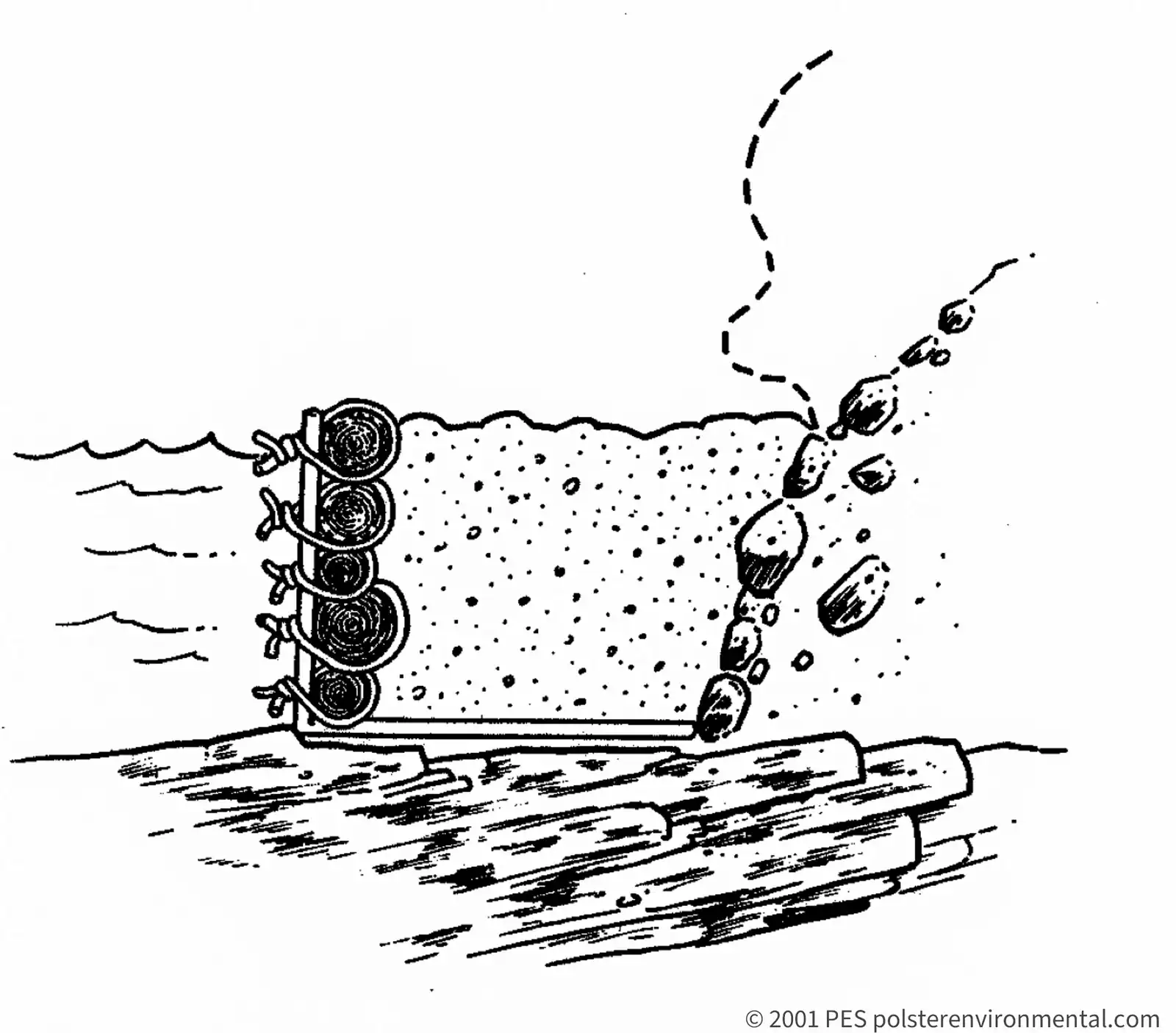
Live bank protection detail from the legacy PES diagram set.
Live Bank Protection in the Field
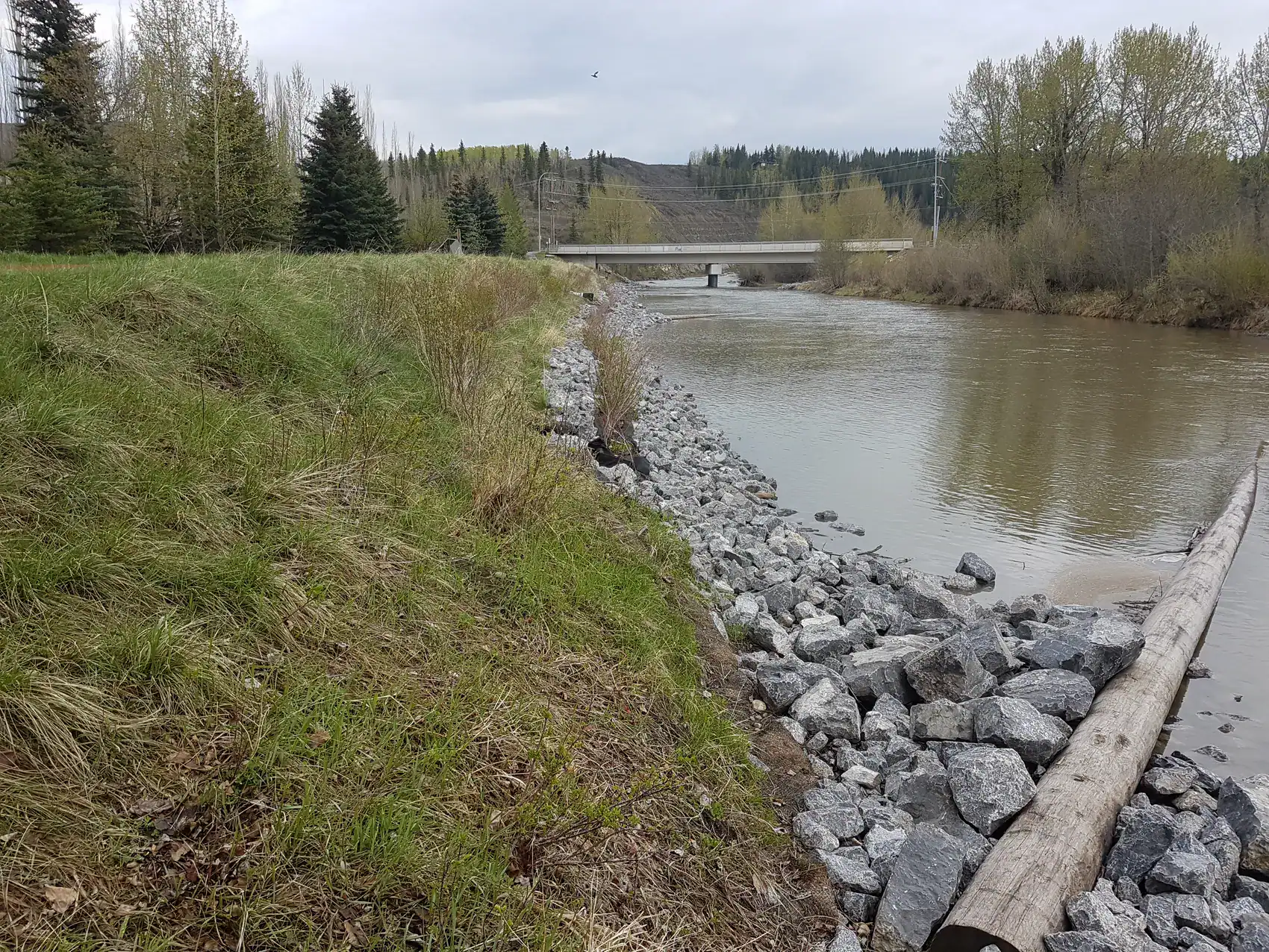
A PES crew installing live bank protection on an eroding streambank, with the living structure keyed into the toe.
Bank Toe First
Treatment starts at the most erosion-vulnerable point where water contacts the bank base.
Dormant Willow Material
Harvested during dormancy for maximum root viability and fastest establishment rates.
Tested in High-Flow
Technique designed for performance through spring freshet and flood events on BC rivers.
Is This the Right Technique for Your Site?
We assess channel energy, toe erosion, bank geometry, and live material to integrate living protection with the structural support the bank requires.
Sources and further reading
These references provide wider technical context. Method selection and design remain site-specific.