
Soil Bioengineering Techniques for Riparian Restoration
David F. Polster · BC Mine Reclamation Symposium, 2002
Riparian Techniques Documented
Methods for using living plant materials to repair and protect stream banks and riparian zones across BC.
BC Mine Reclamation Context
Originally presented at the 2002 BC Mine Reclamation Symposium and applied to mining-disturbed riparian sites.
Source-Referenced Methods
Techniques drawn from field practice with the scientific principles behind each method clearly stated.
Reader Edition and Source PDF
This web reader includes later Polster (2009) references that do not appear in the 2002 source paper. Read the original PDF below for the paper as presented at the symposium.
Citation: Polster, D.F. (2002). Soil Bioengineering Techniques for Riparian Restoration. Proceedings of the 26th Annual British Columbia Mine Reclamation Symposium, Dawson Creek, BC. The Technical and Research Committee on Reclamation.
David F. Polster, M.Sc. R.P.Bio.
Polster Environmental Services Ltd., 5953 Deuchars Drive, Duncan, B.C., V9L 1L5
Abstract
Soil bioengineering is the use of living plant materials to perform some engineering function. Treatments have been developed to solve a variety of riparian problems. Soil bioengineering treatments are modelled on the natural processes that provide solutions to degraded riparian areas (Polster 2009). Plant species that will root readily from dormant stem cuttings are used. Willows (Salix spp.), some poplars (Populus spp.) and red-osier dogwood (Cornus stolonifera) are commonly used in western North America. Live gravel bar staking can be used to stabilize excess sediment in streams and therefore speeds the process of pioneering vegetation establishing on gravel bars and starting the successional processes that eventually lead to productive riparian forests. Live bank protection provides an erosion-resistant face for eroding stream banks. As the plant materials used in the construction of live bank protection grow, the shoots from the new growth serve to slow near shore water velocities thus further reducing erosive forces and providing an opportunity for sediment in the water to be deposited. Live silt fences can be used in small ditches and drainages to slow flow velocities allowing sediment to drop out. As the plant materials used in the live silt fences sprout and grow, a wooded wetland is created that serves to capture sediment and address some pollutants that may be present. Wattle fences can be used to stabilize steep streambank slopes by creating small terraces on the slope. In addition to the growth of the cuttings used to construct the wattle fences, by stopping the constant movement of surface materials on over-steepened slopes, the wattle fences provide an opportunity for pioneering species to establish. Live pole drains can be used to address seepage areas on disturbed slopes, initiating the successional recovery of these unstable areas. Soil bioengineering methods can also be used to manage invasive species by providing successional advancement past the stagnant weedy stage. Creation of an instant canopy of woody species can suppress the growth of problem weeds such as reed canary grass (Phalaris arundinacea) and blackberry (Rubus discolor). Examples are drawn from the experience of the author.
Introduction
Soil bioengineering is the use of living plant materials to provide some engineering function. Soil bioengineering is an effective tool for treatment of a variety of unstable and/or eroding sites. Soil bioengineering techniques have been used for many centuries. More recently Schiechtl (1980) has encouraged the use of soil bioengineering with a variety of European examples. Soil bioengineering is now widely practiced throughout the world (Gray and Leiser 1982; Clark and Hellin 1996) for the treatment of erosion and unstable slopes. Soil bioengineering treatments can be used to initiate the successional processes that will sustain vegetation on the site forever. Natural successional processes provide an ideal model for the treatment of severely disturbed sites (Polster 1989). Natural successional processes are being recognized as appropriate models for ecological restoration (Walker and del Moral 2003; Walker et al 2007).
This paper presents soil bioengineering techniques that can be used to initiate restoration of riparian areas and allow natural processes to provide a sustainable vegetation cover on the treated site (Polster 2009). A discussion of plant materials that can be used in soil bioengineering projects is presented initially followed by information on the various techniques that can be used and the situations in which they are appropriate. Although some of the techniques are common to those practiced in Europe (Schiechtl and Stern 1996 and 1997), many of the soil bioengineering methods that are presented have been developed specifically for situations that are found in British Columbia. The frequent occurrence of marginally stable glacial and glacio-fluvial deposits throughout British Columbia combined with areas of high rainfall, frost sensitive soils, saturated soils during snow melt, fast flowing rivers and streams and a host of other circumstances make British Columbia a province where surface stability and erosion problems abound. Soil bioengineering can provide excellent solutions to these problems.
Plant Selection, Collection and Handling
Soil bioengineering methods use living plant materials to build structures to stabilize the problem site. As such, the construction materials must be strong enough to withstand the forces acting on them prior to growth. In addition, since the intention of building the structures of living materials is that these materials will sprout and grow, the materials must be in a condition that will promote their subsequent growth. The plant materials are typically stem cuttings and must therefore be capable of forming new roots and shoots without special hormonal treatments, mist tents and bottom heat used in nurseries for plant propagation. Willows (Salix spp.), cottonwood (Populus balsamifera L.) and red-osier dogwood (Cornus stolonifera Michx.) are the only woody native British Columbian species that have been found to reliably root from stem cuttings.
Willows are most commonly used for soil bioengineering projects although cottonwood is becoming more frequently used due to its aggressive growth on disturbed sites. The nomenclature of willows is notoriously difficult and the exact identification of the willows used in a soil bioengineering project is not necessary. Typically common willows such as Scouler’s willow (Salix scouleriana Barratt in Hooker), Pacific willow (Salix lucida Muhlenberg), pussy willow (Salix discolor Muhlenberg) and glaucous willow (Salix glauca L.) are used. Although the nomenclature of the willows that are used is not important, it is essential that species be selected from habitats that approximate those found on the reclamation site. For instance, treatment of a dry ravelling slope composed of sandy gravel would not be very effective with willows that were collected from around a marsh. Red-osier dogwood is particularly useful where the treatment site is under the canopy of other vegetation and not in direct sun.
Cuttings used in soil bioengineering projects should follow the “rule of thumb”: if a cutting is smaller in diameter than your thumb, it is too small. Minimum diameter of the cuttings at the tip end should be at least 2.5 cm, and larger cuttings tend to work better than smaller ones as long as they are not old and decadent. In terms of length, cuttings should be at least 50 cm long and where structures such as wattle fences are being built, the cuttings should be as long as possible. Cuttings that are 6 or 7 m in length can be used to make very strong structures. Trim all of the small branches and twigs from the cutting before using it in a structure as the buds on the small twigs will sprout and grow before there are root systems to support them. Where live pole drains are being built, trim smaller twigs but pencil sized twigs can be left on the cutting as long as they do not have leaf buds on them.
The cuttings that are collected for soil bioengineering projects need to be handled in such a way that they will retain their viability. Keeping the cuttings cool and moist and avoiding excessive damage to the cambium will help to retain viability. In addition, soaking the cuttings in water for up to 10 days has been found (Becker 2002) to stimulate root development in unrooted cuttings. Cuttings should be collected during the dormant period for the plant (late fall to early spring) and where timing does not permit immediate use of the cuttings, they can be stored in a cold storage facility (0 to 1 degree C) for several months as long as they are kept moist. Storage of collected cuttings in snow-banks has been found to be very effective.
Soil Bioengineering Techniques
Wattle Fences
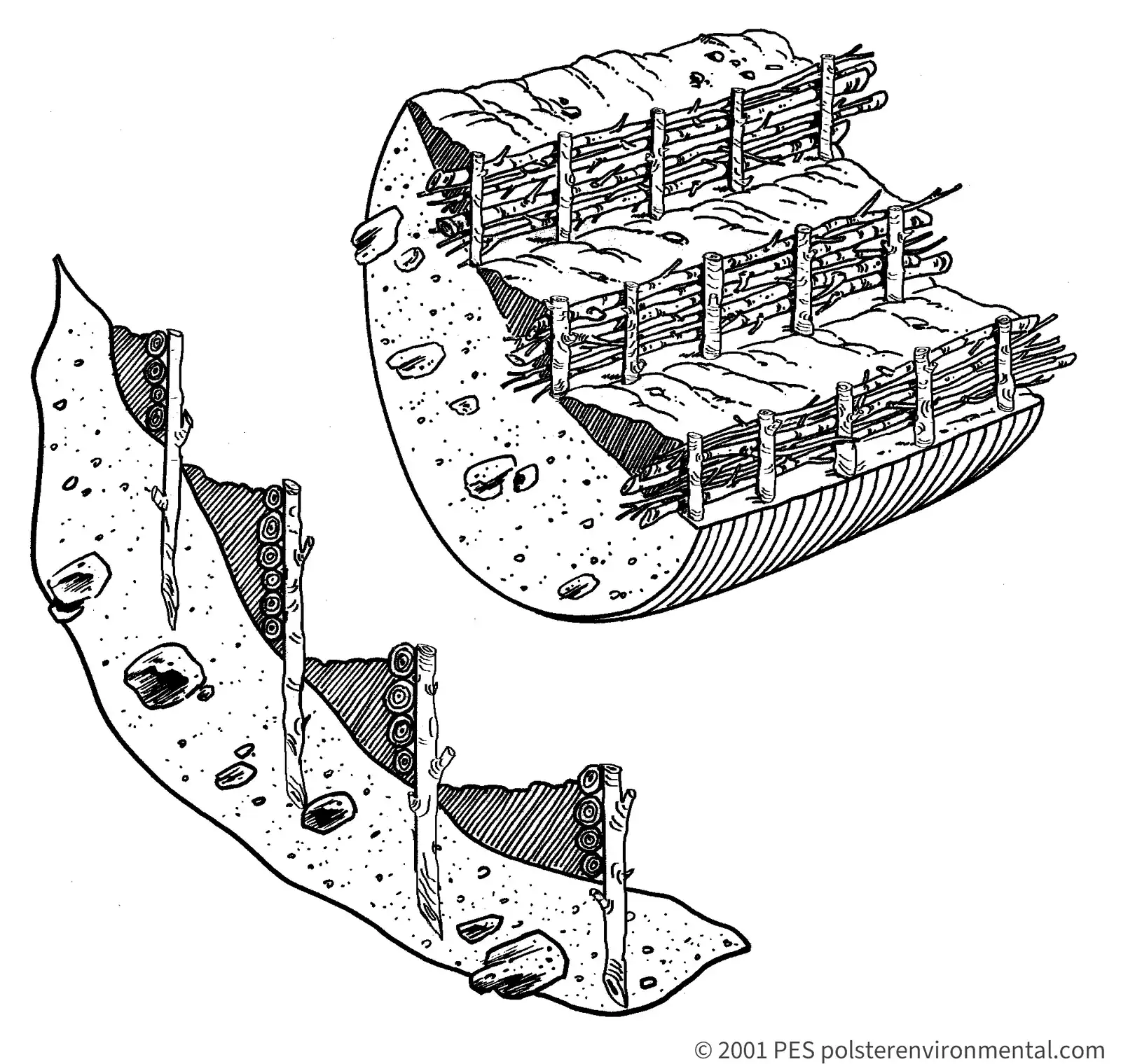
Wattle fences are short retaining walls built of living cuttings. Wattle fences are used on sites where over-steepened slopes are preventing growth of vegetation. As the cuttings are well exposed, wattle fences work best where there is ample moisture available to sustain the growth of the cuttings. Other techniques such as modified brush layers can be used where sites are drier. Wattle fences can be used on very steep slopes as long as the slope itself is globally stable. At the University of British Columbia wattle fences have been effective at revegetating the sand cliffs with an average slope of the in-situ materials of 70°. Wattle fences can be particularly useful where moisture sensitive soils are sliding down the slope as they will hold the soil and allow the moisture to drain, improving the stability of the soil.
The support for wattle fences can be either stout cuttings or 15 mm steel concrete reinforcing bars (rebar). Where rebar is used care must be taken to avoid the hazard created with steel bars protruding from the slope. Where cuttings are used, care must be taken while installing the cuttings to ensure they are not damaged too much. Creation of pilot holes using specially designed steel bars and tapping the cuttings in lightly can prevent excessive damage. When cuttings are used instead of rebar the cuttings as well as the cross pieces grow and contribute to the vegetation on the slope.
Live Bank Protection
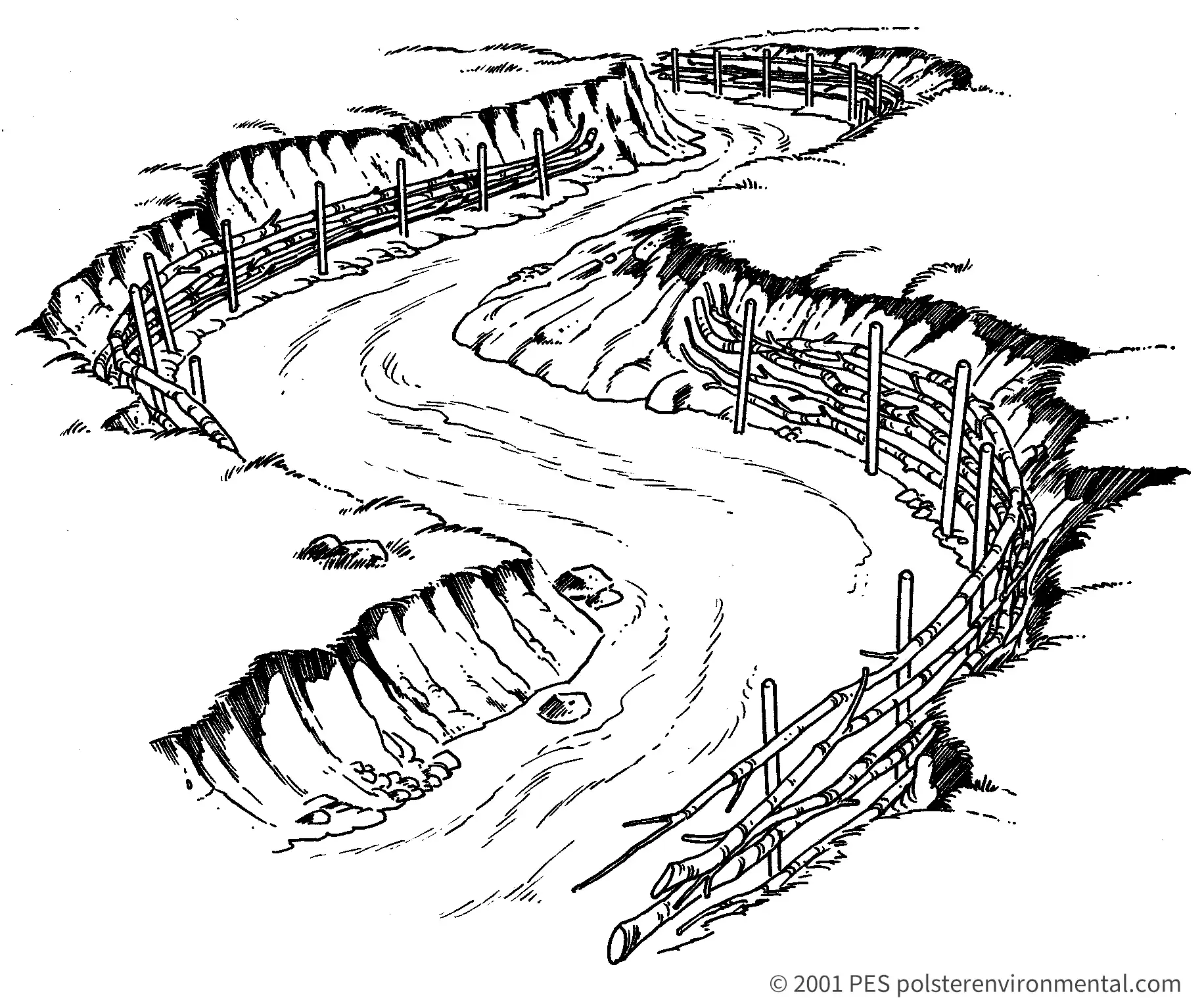
Live bank protection consists of wattle fences along the bank of the stream to create a woody buffer against further erosion. The construction of the live bank protection must be sufficiently dense so that erosion is avoided. Sometimes twigs and trimmings from the cuttings can be used to fill in gaps between the cuttings and thus avoid erosion. Once the cuttings used in the live bank protection sprout and grow, the resulting vegetation provides good protection against erosion. Live bank protection can be particularly effective along the edges of newly constructed ditches. Brush mats can be used with live bank protection where erosion is excessive.
Live Palisades
Live palisades consist of large cottonwood posts installed in trenches adjacent to the eroding stream or river where the natural riparian vegetation has been lost due to clearing or erosion. The key is to get the cottonwood posts down into the water table so that the trees will grow even during dry weather. Large cottonwood posts (15 to 20 cm diameter by 3 to 4 m long) are inserted into a trench dug by an excavator a few meters away from the actively eroding bank. The cottonwood post will root along its entire below ground length and thus produce a dense cylinder of roots that will protect the bank from erosion as the stream encroaches on the palisade. The large cottonwood posts are placed about 50 cm apart so that the growth of the roots will overlap within one growing season. Cottonwood roots can grow as much as 1 cm per day during the growing season (Braatne and Rood 1998). Riparian cottonwood trees provide significant riparian benefit when they mature.

Live Gravel Bar Staking
Excess gravel deposits in streams and rivers can occur in areas of resource development from erosion of upslope areas. These in turn cause avulsions in the stream that result in greater accumulations of sediments downstream. This cycle continues until the stream ends up as a broad expanse of bare gravel with a braided channel and no fish habitat. Live gravel bar staking is designed to establish the natural successional processes that would revegetate the gravel bars and eventually lead to a single channel with well-vegetated banks. The key to live gravel bar staking is to get the cuttings well into the substrate. Use of an excavator is essential. Cuttings should be a minimum of 1 m long and should not protrude from the gravel bar surface more than 20 cm. Large diameter cuttings (4 to 10 cm) appear to work better than smaller stock. Work from the downstream end of the site being treated so that the cuttings will be angled downstream so that they do not catch logs, ice or other material that moves downstream during high flows.

Live Shade
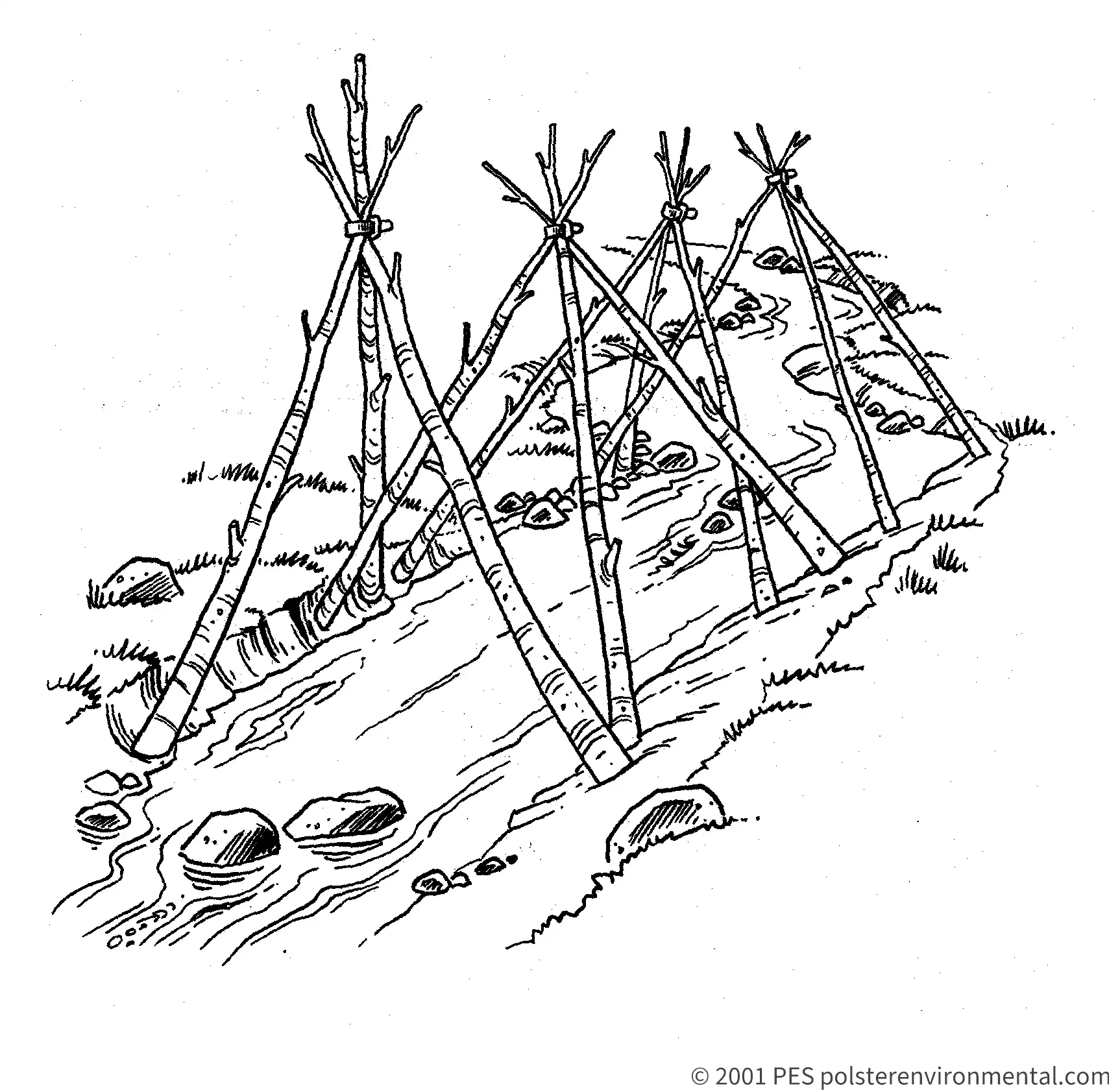
Live shade is designed to provide an immediate vegetation cover over newly constructed off-channel fish habitat and small streams where the riparian cover has been lost. Live shade consists of tripods of living cuttings placed over the stream with the feet sunk into the banks at about 50 cm so that ample moisture is assured. The cuttings need to be large enough and strong enough to easily span the stream and to support the weight of the new growth plus whatever snowfall might be expected in the region where they are applied.
Other Soil Bioengineering Techniques
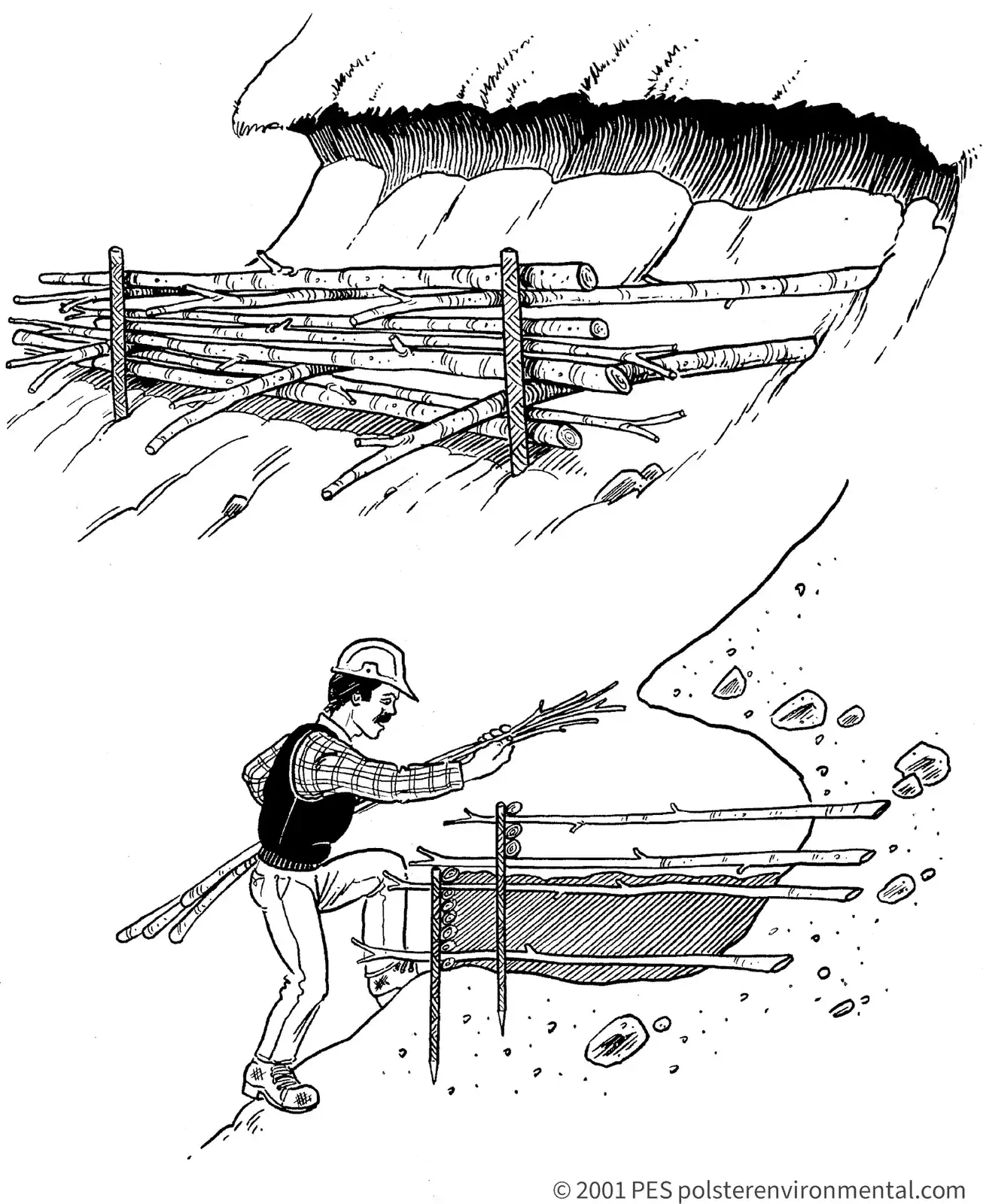
There are a variety of other soil bioengineering techniques that are typically applied to slopes. Modified brush layers are used to create small terraces on dry raveling slopes where conditions are too dry for wattle fences. Live smiles are used where flowing mud pushes linear structures over. Sites must be relatively moist year-round to sustain live smiles. Live pole drains are used to drain excess moisture from seepage zones causing slope problems. They act like living French drains. Live reinforced earth walls perform like traditional soil reinforced structures except the construction elements sprout and grow. Brush layers in a fill act to prevent circular failures of the fill surface by providing sheer resistance while brush layers in a cut create a wall of vegetation to prevent ravelling of the cut slope material.


Conclusions
Soil bioengineering techniques can be used to treat a variety of problems that may arise in the restoration of riparian sites. Soil bioengineering treatments also provide a foundation for the natural successional processes that will maintain a healthy riparian vegetation cover. These techniques can provide protection from erosion and effective riparian vegetation that is congruent with the natural vegetation in the riparian zone. In most cases these techniques are easy to install and can be constructed by relatively untrained crews or volunteer groups. The diversity of techniques available allows soil bioengineering to address a wide array of problem sites. Soil bioengineering fits nicely between traditional engineering and normal revegetation programs.
References
Becker, H. 2002. Soaking willow cuttings helps them protect streambanks. USDA Agricultural Research Service National Sedimentation Laboratory. Oxford, Mississippi.
Braatne, Jeff H. and Stewart B. Rood. 1998. Strategies for promoting natural recruitment and restoration of riparian cottonwoods and willows. Paper presented at Ecosystem Restoration: Turning the Tide. Society for Ecological Restoration Northwest Chapter Conference and Annual Meeting. Tacoma, Washington.
Clark, J. and J. Hellin. 1996. Bio-engineering for Effective Road Maintenance in the Caribbean. Natural Resources Institute. The University of Greenwich. United Kingdom.
Gray, D.H. and A.T. Leiser. 1982. Biotechnical Slope Protection and Erosion Control. Van Nostrand Reinhold Company Inc. Scarborough, Ontario, 271 pp.
Polster, D.F. 1989. Successional reclamation in Western Canada: New light on an old subject. Paper presented at the Canadian Land Reclamation Association and American Society for Surface Mining and Reclamation conference, Calgary, Alberta, August 27-31, 1989.
Polster, D.F. 2009. Natural Processes: The Application of Natural Systems for the Reclamation of Drastically Disturbed Sites. Paper presented at the B.C. Technical and Research Committee on Reclamation, BC Mine Reclamation Symposium. Cranbrook, B.C. September 14-17, 2009.
Schiechtl, H. M. (Trans. N.K. Horstmann, 1980). Bioengineering for Land Reclamation and Conservation. University of Alberta Press. Edmonton. Alberta. 404 pp.
Schiechtl, H.M. and R. Stern. 1996. Ground Bioengineering Techniques for Slope Protection and Erosion Control. Trans. By L. Jaklitsch. Blackwell Scientific. Oxford, U.K. 146 pp.
Schiechtl, H.M. and R. Stern. 1997. Water Bioengineering Techniques for Watercourse, Bank and Shoreline Protection. Trans. By L. Jaklitsch. Blackwell Scientific. Oxford, U.K. 185 pp.
Walker, L.W. and R. del Moral. 2003. Primary Succession and Ecosystem Rehabilitation. Cambridge University Press. Cambridge UK. 442 pp.
Walker, L.W., J. Walker and R.J. Hobbs. 2007. Linking Restoration and Ecological Succession. Springer. New York, N.Y. 190 pp.