Live Gravel Bar Staking
Live gravel bar staking restores braided channels and bare gravel bars by establishing willow cuttings that trap debris, accumulate sediment, and initiate natural succession. Learn how it works in BC streams.
Braided Channel Restoration
Establishes vegetation in active gravel bars to redirect flow and trap sediment over time.
Willow-Driven Succession
Initial willow cover shelters soil, accumulates organic matter, and enables further colonization.
Low-Cost, Low-Impact
Requires cuttings and labour, without soil amendment or irrigation infrastructure.
Live gravel bar staking initiates natural succession on bare gravel. Over time, an eroding, braided channel can develop into a stable, vegetated stream with good fish habitat.
The Problem: Braided Channels and Bare Gravel
Placer mining, logging, road construction, wildfire, and other large disturbances can dramatically increase sediment delivery to a stream system. Gravel and cobble accumulate faster than they can be transported, filling the channel and forcing the stream to spread across a broad, shallow, braided course.
A braided channel is an unstable, self-reinforcing problem. The shallow, wide flow cannot generate the velocity to transport accumulated gravel. The bare gravel bar surface is too mobile and too nutrient-poor for most vegetation to establish. Without vegetation, there is nothing to trap organic debris or bind sediment. Without sediment accumulation, there are no growing conditions for vegetation. The cycle continues: bare gravel, braided channel, no fish habitat, no riparian function.
Natural recovery from this condition can take decades, or may not occur at all if the sediment supply continues. Live gravel bar staking interrupts the cycle by establishing the initial plant cover that triggers the succession process.
What Is Live Gravel Bar Staking?
Live gravel bar staking installs large-diameter, long willow and cottonwood cuttings deep into bare gravel bars, creating the initial vegetation cover that triggers a cascade of natural successional processes.
David Polster, M.Sc., R.P. Bio., developed the technique for disturbed stream systems in BC where coarse alluvial gravel and cobble have replaced fine-grained substrates and conventional revegetation methods repeatedly fail.
The key to the technique's effectiveness is understanding the succession it initiates. The installed cuttings do more than grow into plants. They change the site conditions in a way that makes further vegetation establishment possible, which in turn creates further changes, and so on. It is a cascade, not just a planting.
Why an Excavator Is Essential
On bare gravel bars, the substrate is coarse, mobile, and often dry at the surface even when the water table is relatively close. Hand installation, which is commonly used for streambank live staking, is generally inadequate here for two reasons:
1. Depth. Cuttings must reach moisture in a coarse, well-drained gravel substrate. This may require penetration depths of 1 m or more. Hand tools cannot reliably achieve this in coarse cobble and gravel.
2. Disruption. The excavator's bucket can open a slot or cavity in the substrate to the required depth, allow precise placement of the cutting, and then firm the surrounding material against the cutting to ensure good contact.
The standard tool for live gravel bar staking is an excavator equipped with a digging bucket rather than a clean-up bucket.
Cutting Specifications
Gravel bar staking requires large-diameter cuttings that are significantly larger than those used in standard streambank live staking:
- Diameter: 4–10 cm. Larger-diameter cuttings perform markedly better than smaller stock in coarse gravel substrates. The greater cambium area and structural mass support faster root development and better physical resistance to movement during flood flows.
- Length: Minimum 1 m. Cuttings should be long enough that when installed to the required depth, no more than 20 cm protrudes above the gravel bar surface. A cutting protruding too far above the surface is vulnerable to being dislodged by flood flows before it has rooted.
- Species: Willow (Salix spp.) and cottonwood/balsam poplar (Populus balsamifera). Species selection should match local conditions. Willows from stream margins near the project site are appropriate.
All cuttings harvested and installed during the dormant season.
The Succession Cascade
The ecological mechanism by which live gravel bar staking restores a braided stream is a multi-step process that David Polster described in detail in his technical work:
Step 1: Cuttings establish. The installed cuttings root into the gravel substrate and produce initial shoot growth. The low-profile shoots (20 cm above the surface) present minimal resistance to flood flows and are unlikely to be dislodged.
Step 2: Small woody debris is trapped. As shoots grow and the flow encounters them during subsequent flood events, small woody debris (twigs, leaves, small branches) is trapped against the base of the stems. This is the first accumulation of organic matter on a substrate that previously had none.
Step 3: Flow disruption and sediment deposition. The trapped debris creates a local flow disruption. Fine sediment that was previously transported through the site in suspension begins to deposit in the quiet zone behind the debris accumulation.
Step 4: Sediment accumulates. As sediment builds up at the base of the growing cuttings, the local substrate conditions improve. Finer particles retain moisture, provide anchorage for roots, and support a broader range of plant species.
Step 5: Growth accelerates. The established willows and cottonwoods, now rooted in an improving substrate, produce vigorous above-ground growth. Taller stems trap larger debris and create more extensive flow disruptions.
Step 6: Limits are reached and the cycle resets. David Polster noted an important dynamic: once sediment has built to the point where the sprouts can no longer trap small woody debris effectively, sediment capture pauses. It resumes the following year when growth of the sprout again creates effective debris trapping. The succession proceeds in annual pulses rather than continuously.
Outcome (years to decades): The braided, bare gravel channel contracts. Gravel bars are progressively colonized by willow and cottonwood. The stream re-establishes a single, meandering channel with stable, vegetated banks. Pools, riffles, overhanging vegetation, and large wood return as fish habitat.
Applications
Live gravel bar staking is appropriate for:
- Post-placer-mining stream restoration : where mining operations have dramatically increased sediment loads and destroyed riparian vegetation
- Post-logging or road-construction stream recovery : where sediment delivery to the stream has created gravel deposition problems
- Fish habitat enhancement in streams where gravel bar colonization would significantly improve spawning and rearing conditions
- Watershed restoration programs targeting recovery of degraded stream systems for salmon, trout, and other fish species
The technique is not appropriate for streams where sediment delivery from upstream disturbances is ongoing. Fresh material will repeatedly disrupt an installation in an active sediment source area. Addressing the upstream source and stabilizing the sediment supply is a prerequisite for effective gravel bar staking.
Frequently Asked Questions
Q: How many cuttings are needed to treat a gravel bar?
Staking density depends on the size of the bar and the degree of disturbance, but live gravel bar staking does not require complete coverage of the bar surface. The mechanism relies on the successional cascade triggered by the initial cuttings. Enough pioneer plants must establish to begin trapping debris and accumulating sediment; natural processes can then fill the spaces between them. A site-specific assessment will determine appropriate staking density for your site.
Q: Can live gravel bar staking work on large rivers?
The technique has been applied successfully on both small streams and larger river systems in BC. On larger rivers, the scale of the excavator operation increases, and the structural demands on the cuttings are greater. This is why large-diameter (4–10 cm) cuttings are specified. Water table depth, flood frequency, and sediment grain size determine feasibility.
Q: How does live gravel bar staking differ from live bank protection?
Live bank protection treats the interface between land and water and is designed to resist active bank erosion. Live gravel bar staking treats exposed gravel surfaces within or beside the active channel. Both techniques use similar materials and dormant-season installation requirements, but they address different aspects of stream degradation.
Field Sequence: Gravel Bar Recovery
Live gravel bar staking works because the cuttings reach permanent moisture below the gravel surface. Once the first stems survive, they trap debris, retain sediment, and begin rebuilding a functioning riparian bar.
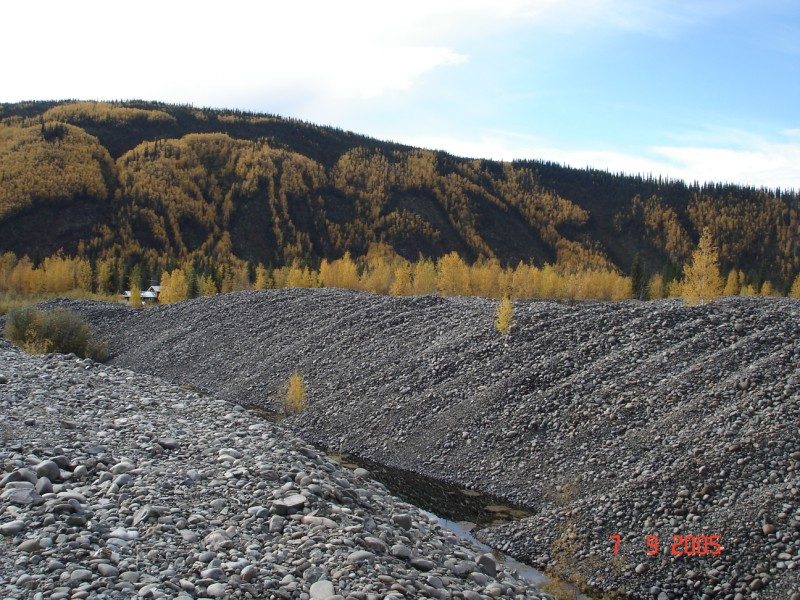
Bare mined bar before treatment.

Early willow establishment on the treated bar.
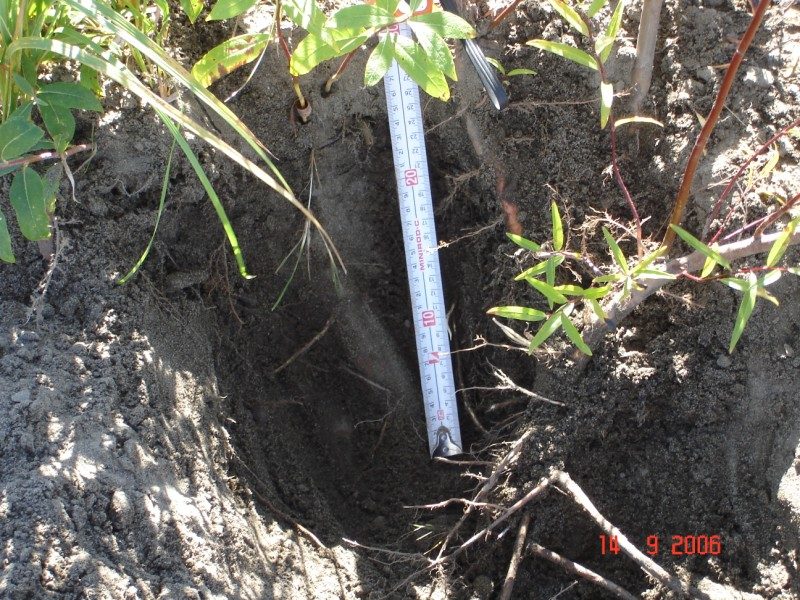
Root-depth detail confirming moisture access beneath the coarse gravel surface.
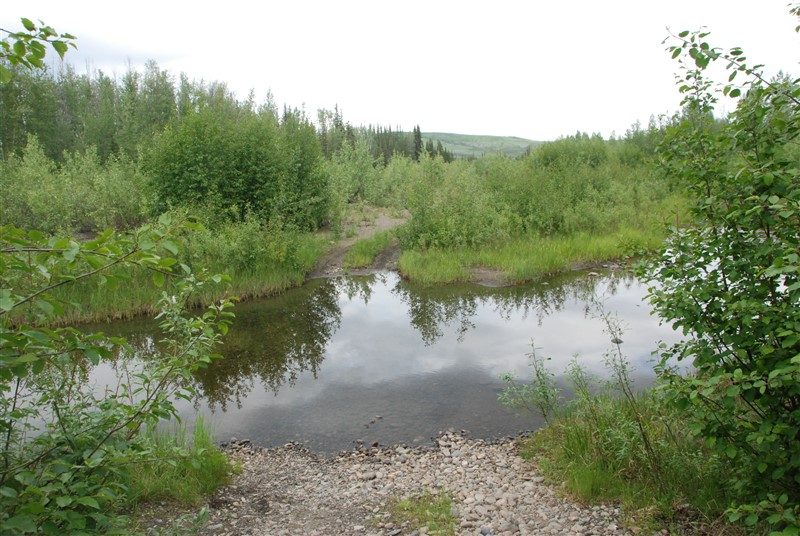
Mature riparian condition after the treated bar had years to organize sediment and vegetation.
From David Polster’s Course: Live Gravel Bar Staking in the Field
Drawn from David Polster's bioengineering course, using his account of live gravel bar staking on the San Juan River, where planted cuttings catch woody debris, trap sediment, and rebuild a vegetated bar.

This is a project that we did on the San Juan river a few years ago. Cuttings were inserted into the sandy bars along a stretch of the river. Note this tree for location.
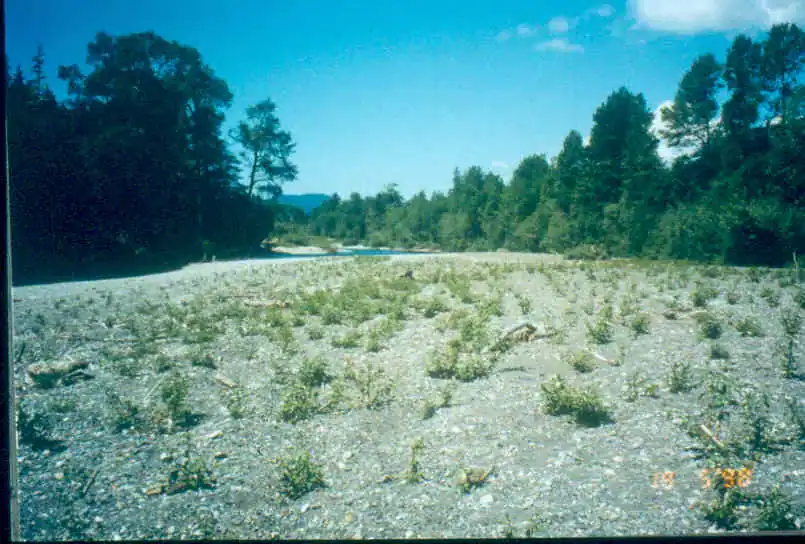
The cuttings grow and start to vegetate the bar, here is that same tree, but the amazing thing is.

That these little sprouts collect small woody debris. The woody debris provides turbulence in the normal flow, and.
Sediment starts to collect in drifts in behind the woody debris jams. Over the first winter the cuttings were in place over 80 cm of sediment was collected.
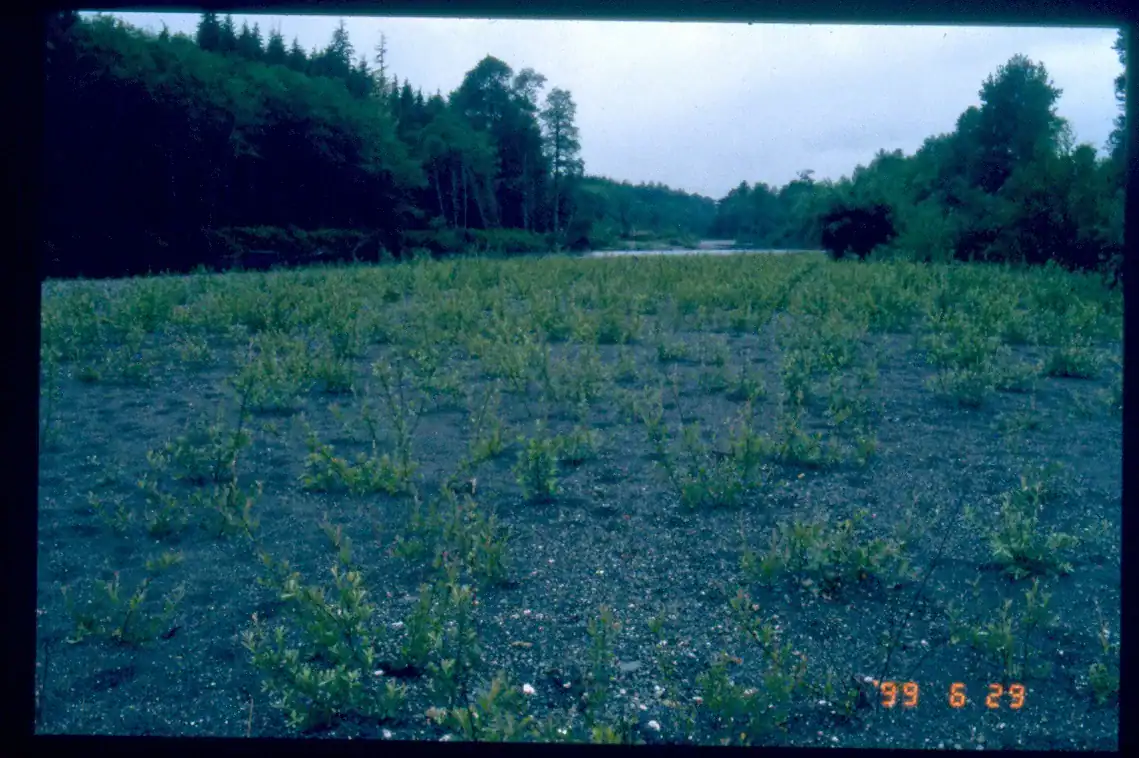
But in the spring, the plants sprout and continue to grow. As you can see in this photo, the sprouts now consist of many stems.
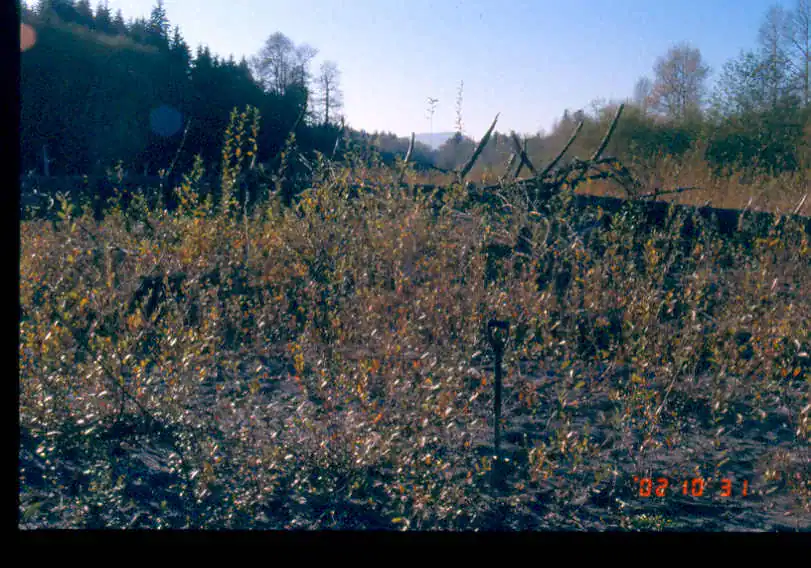
A couple of years ago we caught a huge spruce log and now there are a bunch of other species moving in.
Germaine Creek, Klondike River: A Gravel Bar Rebuilt Over a Decade
On a side channel of the Klondike River at Germaine Creek, David Polster staked live willow cuttings into a bare gravel bar and then photographed it for the next decade. The cuttings survive spring ice and high water, catch sediment, and slowly turn a shifting gravel bar into a stable, vegetated island. This is his own record of that process, in his words.

2004: On the Klondike River, home of the famous gold rush, cuttings 2–3 cm across at the tip were bundled and soaked in a local pond for about ten days before planting.

2004: Planting is done with an excavator; digging by hand in gravel bars is not fun.

Break-up 2005: The cuttings are angled downstream so that spring ice does not pry them out of the gravel bar or break them off.
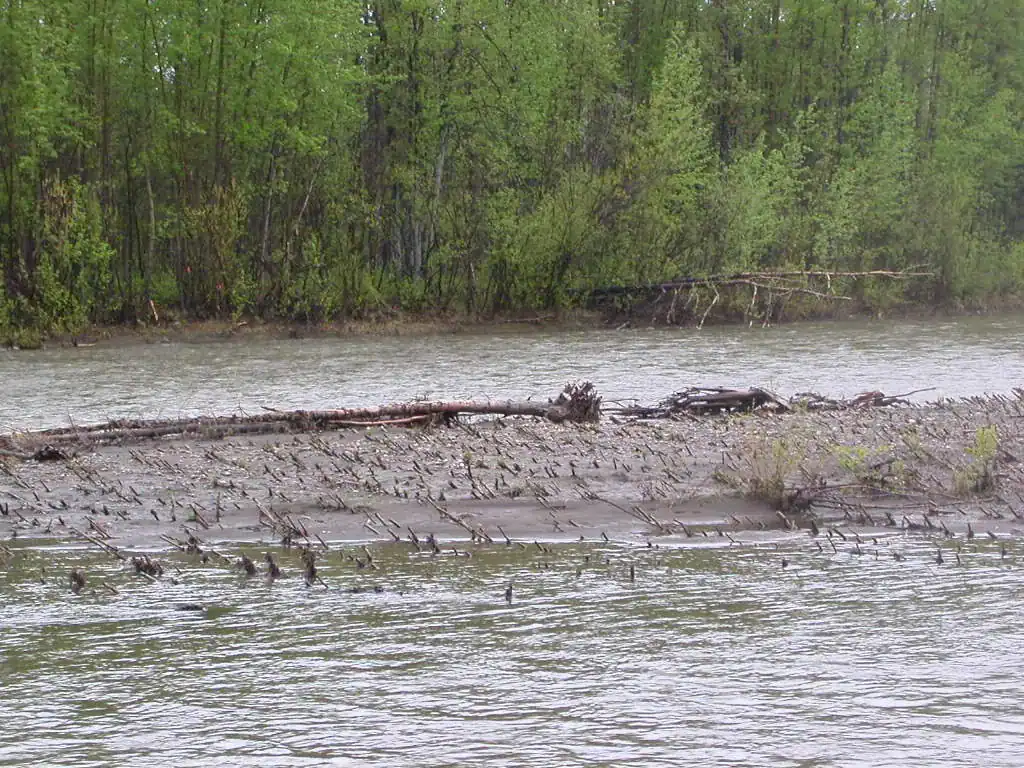
June 2005: As high water passes over the staked bar, drifts of sediment begin to collect around the cuttings.

September 2006: In places more than 30 cm of sediment had collected; the gravel bar builds up while the thalweg deepens.
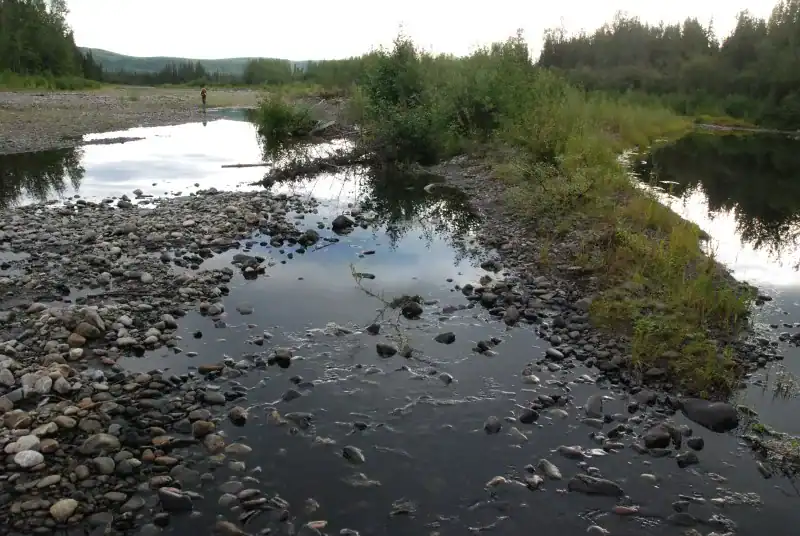
August 2014: Over the years the vegetation gets larger, new plants move in, and the island becomes more terrestrial as the natural gravel-bar recovery process continues.
Is This the Right Technique for Your Site?
We assess bar elevation, scour and deposition patterns, flood exposure, and willow sources to place stakes where they can establish and persist.
Sources and further reading
These references provide wider technical context. Method selection and design remain site-specific.
Oktwanch River: live gravel bar staking
A David Polster field record from bare gravel through installation and early willow establishment.
A bare gravel bar before the staking trial.
Source: David Polster’s Oktwanch River live gravel bar staking course records. Viewpoints vary between dates, so this is a dated field progression rather than a fixed-camera survey comparison.