Live Gravel Bar Staking, San Juan River, BC
San Juan River, Vancouver Island · 1998–2014 observations · First-year sediment estimate
80,000 m³ Sediment Captured
David Polster’s presentation estimates 80,000 cubic metres of sediment collected in the first year. Later photographs follow succession from 1998 to 2014.
San Juan River, BC
Gravel bar bioengineering on an active braided channel in the San Juan River watershed, Vancouver Island.
16-Year Succession Record
1998 to 2014 monitoring captures the full arc from bare gravel to established riparian vegetation.
The Challenge
The San Juan River gravel bars had been depleted of their natural riparian vegetation, leaving the bars exposed to ongoing reworking by high flows. Bare gravel bars are ecologically impoverished: without rooted vegetation to trap sediment and debris, the bar surface remains mobile, preventing succession and failing to provide the riparian habitat functions that support salmon-bearing rivers.
Approach
Live gravel bar staking was installed on the San Juan River gravel bars in March 1998. Dormant willow and other pioneering riparian species were installed directly into the bar substrate, an approach that uses the water table available in river bars to sustain cuttings through establishment, even in the dry-draining gravel environment.
The mechanism of sediment accumulation that follows installation is systematic: sprouting cuttings intercept small woody debris carried downstream by freshets; the debris creates slack water zones immediately downstream of the plants; suspended sediment drops out of suspension in these slack zones and accumulates behind the debris jams. Sediment capture depends on stems and debris remaining exposed. The source notes describe deposition stopping when too little twig remained above the new surface to collect debris.
Results
David Polster’s source presentation records the following observations and first-year sediment estimate:
- First year (March 1999): Woody debris jams had formed behind the sprouted cuttings; sediment began accumulating in the slack water behind them
- 80 cm of sediment accumulated over 10 ha of staked gravel bars in the first year, 80,000 m3 of sediment retained
- The accumulated sediment buried the lower portions of the cuttings, leaving enough stem exposed to continue growing the following season, a self-reinforcing cycle of bar building
- October 2002: Established plants with large woody debris accumulation; bar surface substantially elevated and vegetated
- June 2006: Continued successional development; understory diversifying; thalweg deepening as bar builds
- June 2011: Dense stand of willows and other species established on the built bar; root-infused sand described in the presentation as relatively erosion resistant
- June 2014: Sitka Spruce establishing naturally under the canopy of pioneering willow and cottonwood, the late successional species of the natural forest beginning to colonize the restored bar
The appearance of Sitka Spruce as natural understorey regeneration by 2014 is a significant ecological marker: it demonstrates that the restoration has advanced beyond early-successional willow/cottonwood scrub and is tracking toward the native coniferous forest community that characterizes mature San Juan valley riparian zones.
The San Juan River project is a textbook demonstration of live gravel bar staking producing bar-building sediment dynamics, habitat recovery, and natural forest succession, all from dormant willow cuttings installed in a single season.
Live gravel bar staking, from bare gravel to forest in sixteen years. Request a Site Assessment →
San Juan River: How a Gravel Bar Became Riparian Forest
The San Juan River deck is one of the clearest records of live gravel bar staking doing its work: cuttings installed on a bare bar in March 1998, first-year debris and sediment capture, roughly 80 cm of sediment retained across 10 ha, and eventual succession toward riparian forest with Sitka spruce establishing beneath the pioneering canopy.

March 12, 1998: installing cuttings on the San Juan River bar.
The March 1998 photograph documents cuttings being installed into the San Juan River gravel bar. The source sequence follows the subsequent growth and changes around those stems.
By March 1999, sprouts were collecting small woody debris. This photograph records debris around the living stems, an early part of the process described in the presentation.
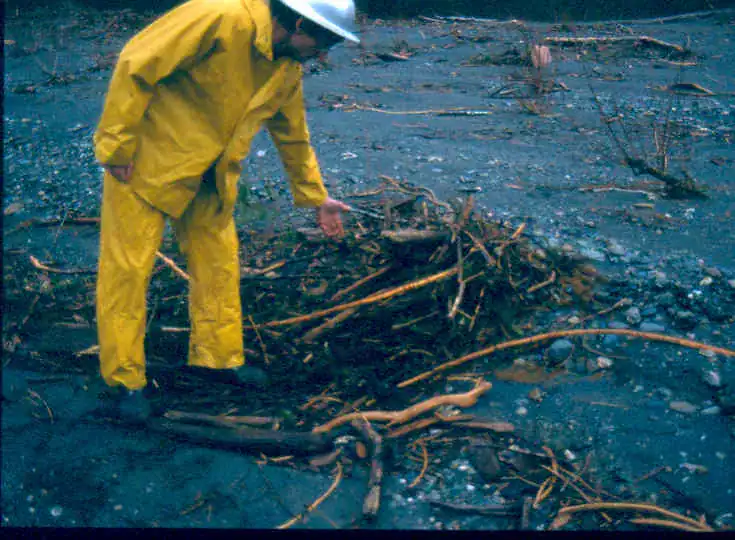
March 12, 1999: sprouts collect small woody debris.
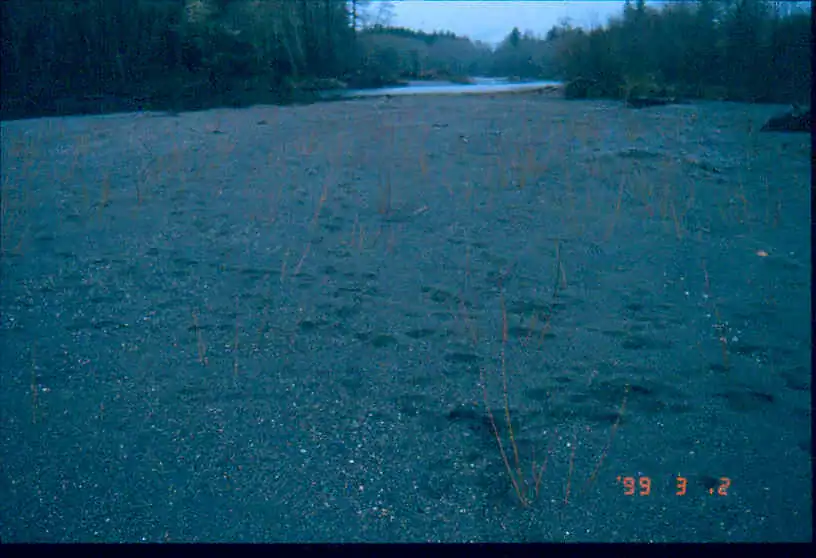
March 12, 1999: sediment collects in slack water behind small woody debris jams.
The March 1999 source caption identifies sediment collecting in slack water behind small woody debris jams. The image illustrates this local deposition process at the photographed site.
The June 1999 photograph shows cuttings remaining above the deposited surface. The source notes that sufficient stem remained exposed for growth during the following summer.
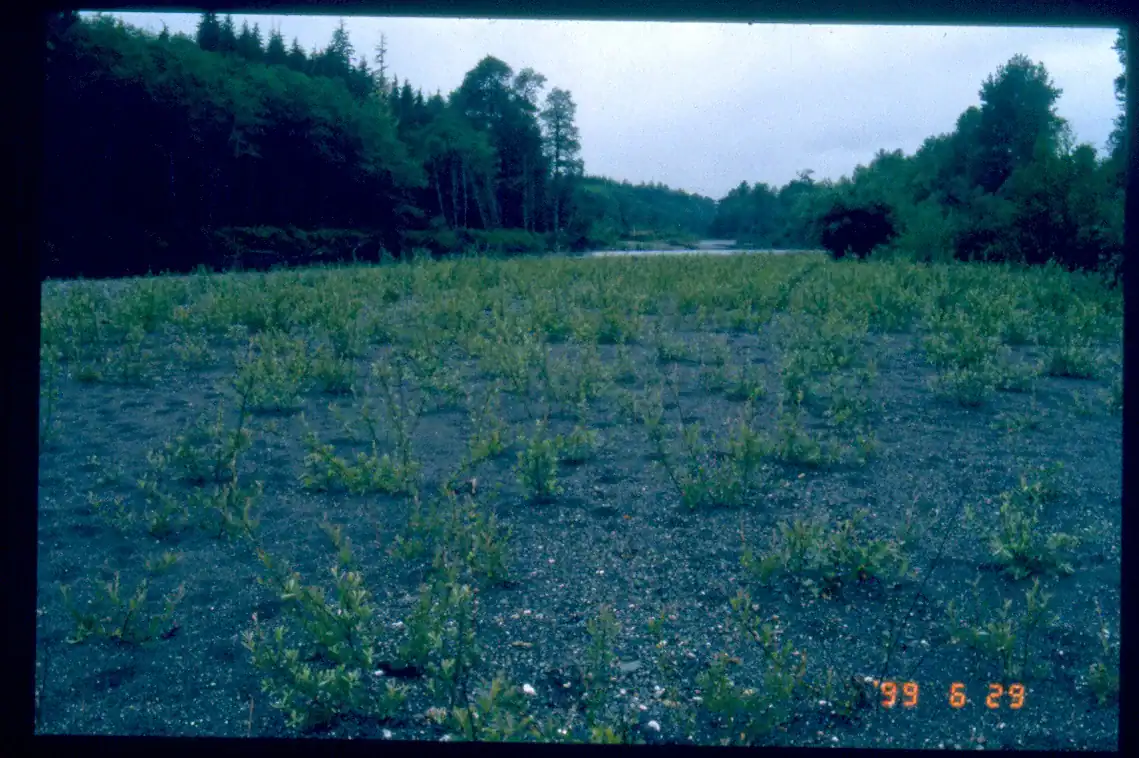
June 29, 1999: enough of the cuttings remains above the surface to grow again during the summer.

June 2, 2006: continued successional development on the San Juan River bar.
The June 2006 photograph records continued successional development on the bar. Woody vegetation is visible across an area that had earlier been treated with cuttings.
A second June 2006 photograph shows the understory beginning to diversify, another step in the succession documented at this site.

June 2, 2006: the source presentation records the understory starting to diversify.

June 19, 2011: the source presentation describes the root-infused sand as relatively erosion resistant.
The June 2011 source describes root-infused sand as relatively erosion resistant. The photograph shows the roots extending through the deposited material.
The June 2014 photograph shows Sitka spruce establishing beneath pioneering vegetation. It documents one step in the developing riparian plant community.

June 10, 2014: Sitka spruce establishing under the canopy of pioneering species.
References
- Source deck: David Polster, Live Gravel Bar Staking - San Juan River, 1998-2014 field sequence.
- Live Gravel Bar Staking method
- Klondike River live gravel bar staking case study
- Soil Bioengineering Techniques for Riparian Restoration
Learn more
San Juan River: dated field photographs
Compare installation documented on March 12, 1998 with successional vegetation photographed on June 2, 2006.
A same-bar field sequence photographed from different positions; the control is for visual comparison, not dimensional measurement.

San Juan River, March 1998
Installing cuttings on a San Juan River gravel bar, March 12, 1998. The field sequence follows the cuttings through debris capture, sediment accumulation and later riparian succession. These observations show how establishing live stems can begin changing a mobile gravel-bar surface.
Related Methods and Resources
Facing a Similar Challenge?
We can evaluate channel movement, flood exposure, and willow availability to place live gravel-bar staking where it can persist.