
Pocket and Joint Planting, Seaton River, BC
Seaton River, British Columbia · Rocky talus · 2002–2014
Rocky Talus Site
Pocket and joint planting established native vegetation in rock crevices where conventional revegetation methods cannot reach.
Seaton River, BC
Bioengineering applied to a challenging rocky riparian environment in the Seaton River watershed.
12-Year Monitoring Record
2002 to 2014 documentation shows vegetation colonizing fractured rock using this targeted planting technique.
Technical Specifications and Installation Details
Pocket planting and joint planting are distinct in one key respect: the presence or absence of added soil. In pocket planting, soil is placed into the void spaces between large rip-rap boulders before or after placement,most practically during construction of the rip-rap slope, when excavators and access equipment are already on-site. Where rip-rap has already been placed, soil can be introduced using five-gallon pails or hand tools, though this is considerably more labour-intensive. Any filter fabric installed beneath the rip-rap layer must be breached at each planting pocket to allow roots to penetrate the underlying substrate; roots confined to the pocket soil alone will not sustain the plant through summer drought.
Joint planting requires no added soil. Cuttings are inserted through the interstitial spaces of the rip-rap directly into the substrate below using a pointed planting bar. This makes it practical on shallower rip-rap installations where the spacing between boulders is sufficient for a cutting to pass through. On droughty or well-drained sites, large-diameter cuttings,the largest that can be worked into the available joint space,give significantly better establishment results than smaller material, as the greater stem mass reduces desiccation risk before rooting occurs.
In both techniques, cuttings must be buried at least 75% of their length to maintain adequate soil contact and moisture access. The structural value of the treatments extends beyond revegetation: established willow and cottonwood stems slow water velocity across the rip-rap face, reducing scour at the toe; the intertwining root systems help lock boulders in position against displacement during high flows; and leafing canopy and accumulated litter contribute invertebrate production and organic matter inputs to the adjacent channel,functions that bare rip-rap cannot provide.
The Challenge
Talus and rocky slopes present a specific set of revegetation problems:
Little or no soil on the surface, conventional container or bare-root planting has nowhere to go
Coarse, free-draining substrate, rapid moisture loss in dry periods
Variable micro-environments within the rock matrix, deep shade in some voids, high heat and exposure on rock faces
Natural colonization is slow, the same conditions that make revegetation difficult also slow natural seeding and establishment
The Seaton River site involved coarse talus requiring vegetation establishment without the benefit of any prepared soil surface.
Approach
Pocket planting was developed by observing how plants naturally establish on talus: seeds and organic matter collect in the pockets and depressions between rocks, where moisture is retained and fine soil accumulates over time. The technique accelerates this natural process by identifying suitable pockets in the rock surface, adding a small quantity of soil or organic amendment if needed, and planting directly into these natural micro-habitats.
The approach requires reading the site carefully, identifying which pockets retain moisture, which have adequate depth for root development, and which are sheltered enough from desiccation for establishment. Plants are selected for the specific conditions in each pocket, not applied uniformly across the surface.
Joint planting is a related technique applied to fractured rock faces and rock walls, where plants can be established in the joints and cracks between rock units. Willows, sedges, and other species with flexible root systems and tolerance for restricted rooting volumes are inserted into rock joints, where they exploit any soil or moisture present and eventually contribute root biomass that stabilizes the rock surface and begins building organic matter.
Results
The Seaton River project documents the effectiveness of pocket planting on coarse talus over a twelve-year period:
- August 2002: Installation complete; plants established in pockets across the talus surface
- June 2006: Four years post-installation; vegetation community developing across the site
- May 2013: Eleven years post-installation; substantial plant community established on what was bare talus; natural successional processes underway
- March 2014: Continued establishment; the structural relationship between rocky substrate and developing vegetation community clearly visible
The progression from bare coarse talus to a developing native plant community demonstrates that even the most difficult rocky terrain is amenable to vegetation establishment when techniques are matched to the specific conditions of the site.
Pocket and joint planting, vegetation establishment where conventional planting cannot work. Request a Site Assessment →
Pocket and Joint Planting: Greening Rock
Riprap banks, cobble bars and coarse rock fills can be difficult to plant. Pocket planting and joint planting use openings in the rock to reach soil and moisture.
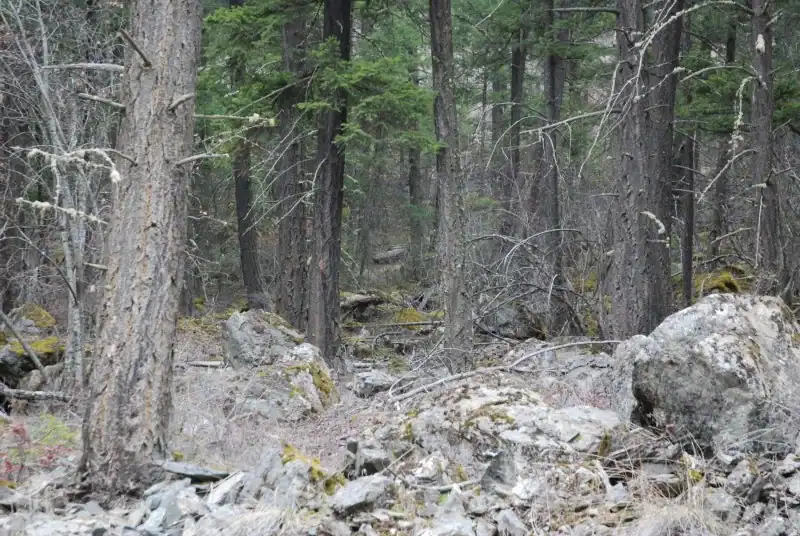
The genesis: plants colonize pockets of fine soil between rocks.
Pocket planting uses the fine soil and moisture that collect between rocks on coarse talus. Plants are placed into suitable pockets rather than across the surface uniformly.
Pocket planting sets cuttings or rooted plants into pockets of finer material between coarse rocks where soil and moisture can support establishment.
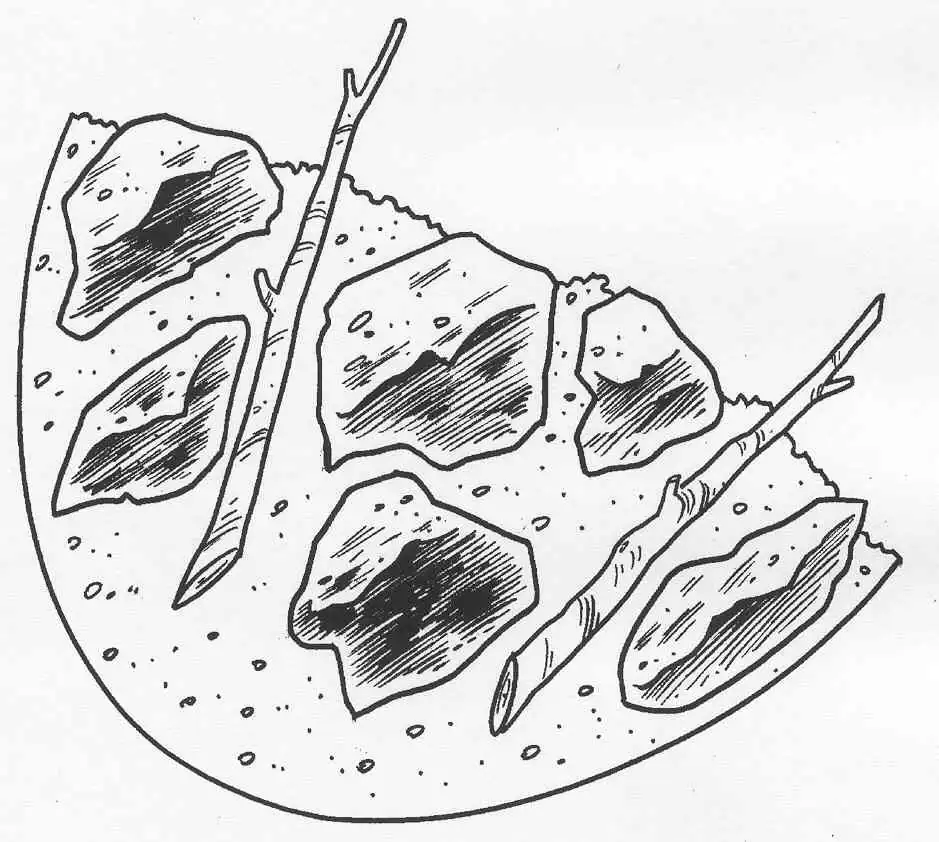
Pocket planting, in David's own cross-section.

Pocket planting at Seaton River, March 24, 2014.
Along the Seaton River, pocket-planted cuttings were followed from 2002 to 2014. Over that time a bare, rocky bank grew into a woody riparian fringe, holding the bank, shading the water, and feeding the stream, all from cuttings tucked into pockets among the rock.
Joint planting places cuttings through openings in riprap so they can reach soil and moisture behind the rock. The rock retains its structural role while vegetation establishes.
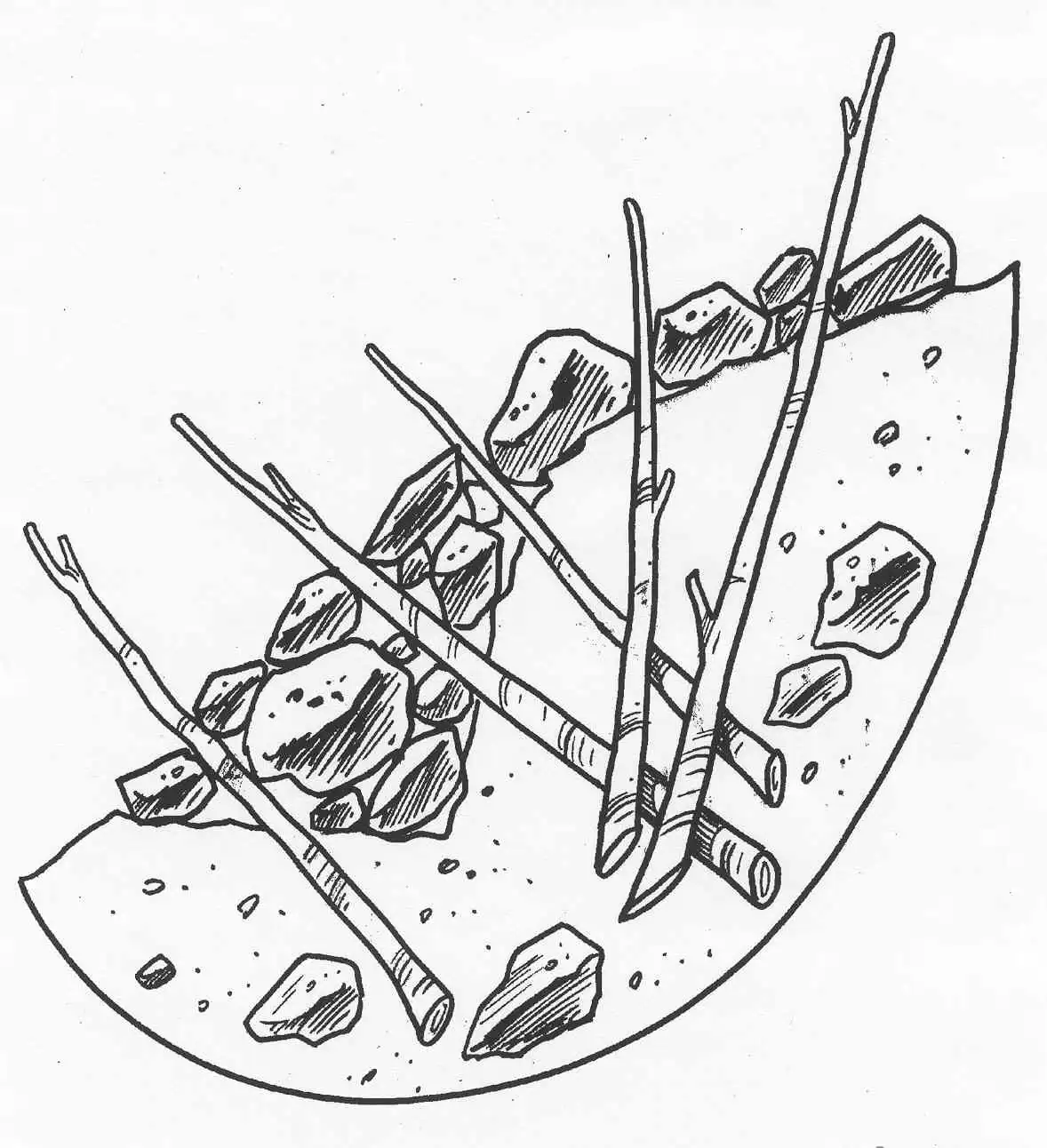
Joint planting: cuttings driven into the joints between large rocks.

Joint planting detail from the source presentation; separate from the dated Seaton pocket-planting sequence.
The source presentation treats joint planting separately from its dated Seaton River pocket-planting sequence. The detail shows the arrangement of live material among rock; the Seaton photographs document pocket planting from 2002 to 2014.
References
- Polster, D.F. 2006. Soil Bioengineering for Riparian Restoration. Canadian Land Reclamation Association Conference, Ottawa, ON.
- Polster, D.F. 2021. Living on the Edge: A Manual for the Restoration of Drastically Disturbed Sites. Polster Environmental Services Ltd.
Learn more
Seaton River: pocket planting through time
Rooted plants were set into openings between rock so their roots could reach finer, moist material behind the armoured face.
A same-bank sequence assembled from field documentation, not a registered fixed-camera comparison.
Related Methods and Resources
Field details from the archive
These dated field views show how the method reads at two different scales. They are teaching examples, not a fixed-camera comparison.


Source: David Polster's Segment Pocket and Joint Planting deck and the associated dated field archive. The photographs are presented as separate examples, not as a matched before-and-after sequence.
Facing a Similar Challenge?
We can map rock joints, soil pockets, and moisture pathways to establish native vegetation where conventional planting will not hold.
Seaton River pocket planting: a dated field record
This David Polster archive sequence follows pocket planting on coarse river talus across four dated field records. It shows how a living treatment is observed over time without turning one site into a universal performance promise.
The first dated frame shows pocket planting along the Seaton River talus edge.
Source: David Polster's Segment Pocket and Joint Planting deck. The deck labels the location as Seaton River and dates the sequence from August 15, 2002 through March 24, 2014. This is a historical field record, not a fixed-camera survey comparison or a current client project.