West Kelowna, Powers Creek Delta Erosion
Powers Creek delta, Okanagan Lake, West Kelowna · Riparian restoration
Delta Mouth Erosion
The Powers Creek delta example examines missing riparian vegetation, bridge constriction and wave erosion, then considers a woody-vegetation response.
West Kelowna, Okanagan
Site at the Powers Creek delta on Okanagan Lake in the dry Interior Okanagan Valley.
Dry Interior Adaptation
Species selection and planting design adapted for Interior BC's hot, dry summer conditions, which differ from coastal BC.
The Challenge
The Powers Creek delta showed a pattern of wave-driven erosion characteristic of shorelines where the natural riparian buffer has been removed. Several interacting factors were at work:
Missing riparian forest. The delta lacked the dense stand of willows and cottonwood that would naturally occupy the riparian zone at a healthy creek delta. Without this vegetation, the bank had no root mass to resist erosion, no above-ground structure to dissipate wave energy, and no canopy to moderate water temperature and provide habitat.
Hard armour counterproductively placed. Riprap and other armouring placed to protect the shoreline was deflecting wave energy rather than absorbing it, a well-documented problem with hard armour on irregular shorelines. Instead of protecting the bank, the armour was concentrating wave energy and causing erosion at unprotected adjacent areas.
Bridge constriction effects. The bridge crossing Powers Creek constricts the channel during high flows, increasing velocity and erosive energy at the outlet into the lake, exacerbating delta erosion during freshet events.
The site could be summarized simply: no trees, compounding erosion despite armouring.
Approach
The diagnosis pointed clearly toward a bioengineering solution: re-establishing a dense stand of willows and cottonwood along the Powers Creek delta and the eroding shoreline margin.
This approach would address the erosion through multiple mechanisms simultaneously:
Root mass in the bank resisting wave and current erosion directly
Above-ground vegetation structure dissipating wave energy before it reaches the bank face
Canopy providing shade and organic matter to the creek and lake margins
Beyond erosion control, the re-established riparian forest would provide habitat for a diversity of bird, mammal, and aquatic species, as well as sequestering carbon, co-benefits that no hard armour option can provide.
The Bioengineering Prescription
A dense riparian planting of willows and cottonwood along the delta and eroding shoreline, using live staking and live bank protection techniques, would:
1. Establish root mass in the erosion zone within one to two growing seasons
2. Provide wave-breaking above-ground structure as the stand develops
3. Develop into a self-sustaining native riparian forest with no ongoing maintenance requirement
4. Restore aquatic and terrestrial habitat function to the degraded shoreline
The prescription does not require the removal of all existing armour, in some locations, armouring at the base of a planted bank can be appropriate during the establishment period. But the long-term solution is biological, not mechanical.
Riparian erosion, the solution is usually the trees that are missing. Request a Site Assessment →
Powers Creek: The Missing Riparian Forest
The Powers Creek deck is a compact diagnosis of a shoreline problem: lake waves, creek flows, hard armour, bridge constriction, and the missing riparian forest all interact at the delta.
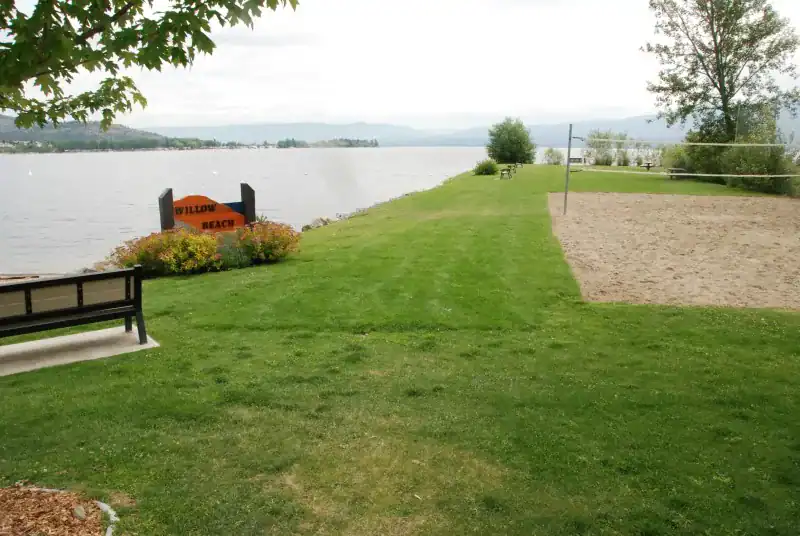
Willow Beach shows the missing riparian edge.
A mown lawn to the lake looks tidy, but it has removed the dense woody edge that would normally absorb energy, bind soil, shade water, and provide habitat.
The channel context matters because creek flows and lake waves both act on the same shoreline. The repair has to handle moving water from both directions.
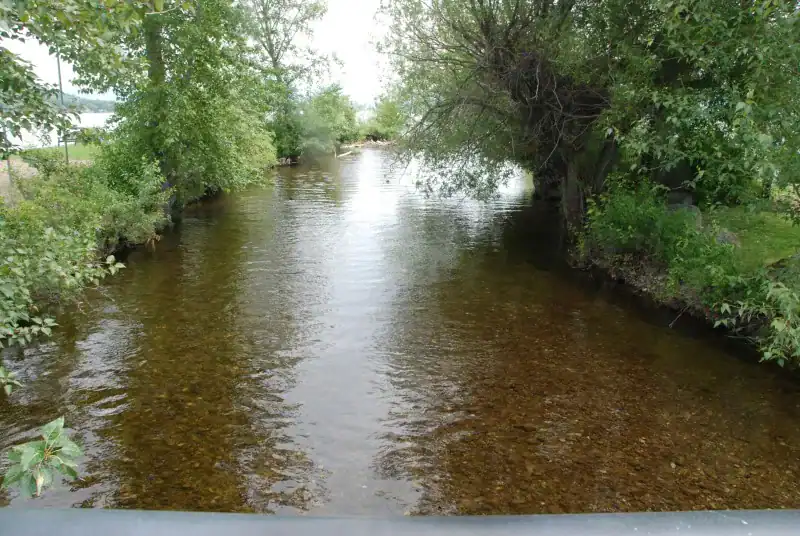
Powers Creek enters Okanagan Lake through a constrained delta setting.

Hard armour tries to compensate for missing riparian forest.
The deck asks the right question: what is missing? Riprap is present, but the riparian forest is not. Armour can protect one edge while deflecting energy toward another.
A constricted bridge can increase velocity and turbulence during high flows. That energy reaches the delta and adds to the erosion problem at the lake margin.

The bridge constriction changes high-flow energy.
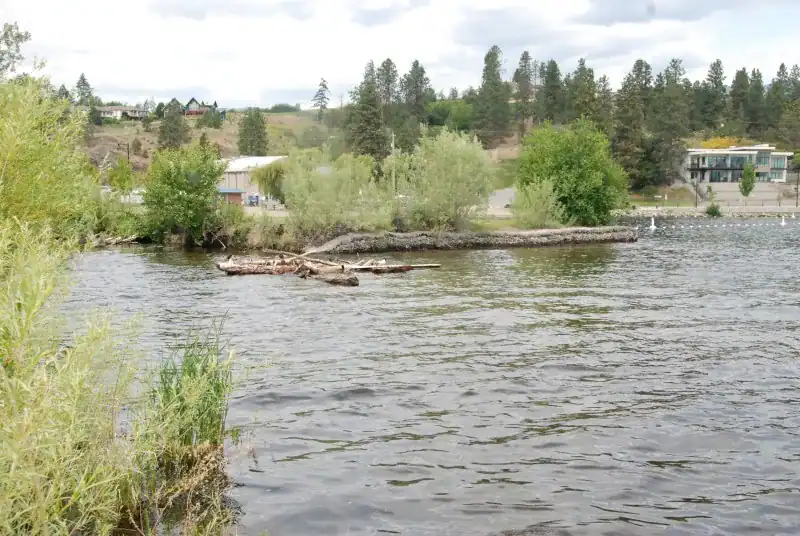
Armouring can deflect wave energy and erode adjacent shoreline.
Wave erosion is not solved by simply hardening one line. When waves reflect or wrap around armour, the unprotected margins can erode more aggressively.
The blunt field diagnosis was 'no trees.' Without willows and cottonwood, the bank lacks the living roughness and root mass that would dissipate energy and hold the soil together.
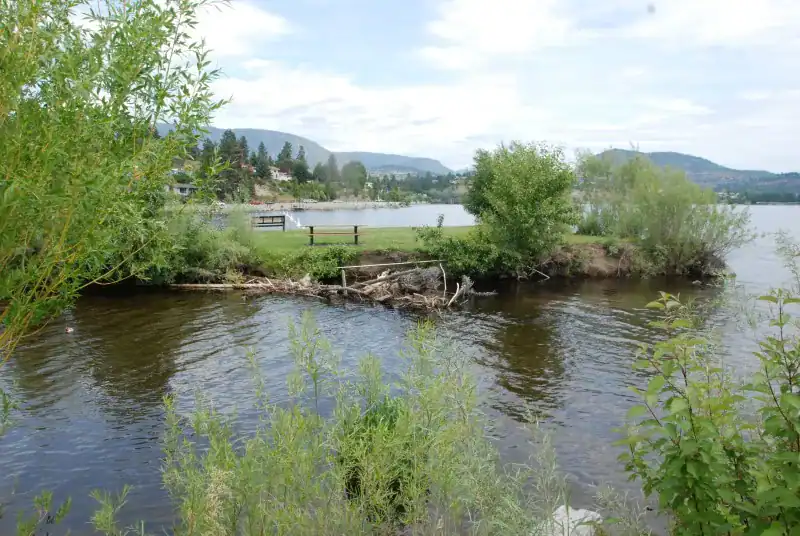
The erosion area is exposed because the woody edge is missing.
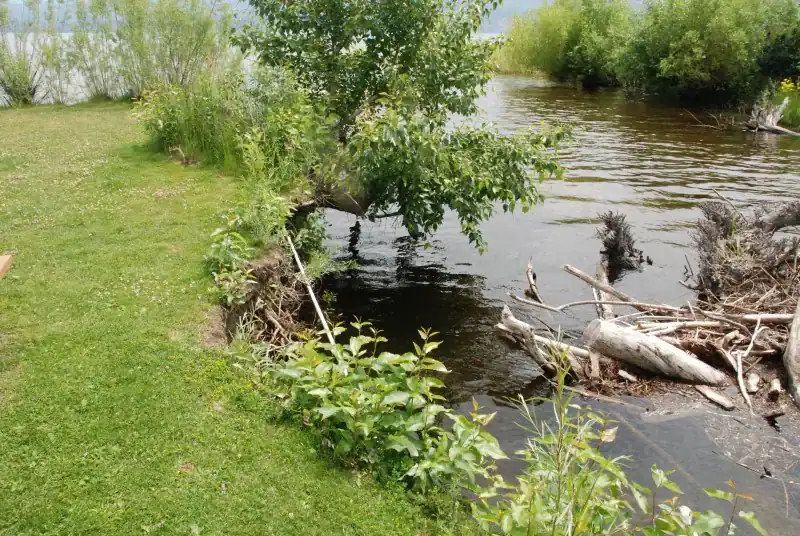
Dense willow and cottonwood are the repair mechanism.
The proposed response was a dense stand of woody riparian vegetation, with flexible stems above ground and roots below ground.
The co-benefits are the point. The same vegetation that protects the bank also shades water, traps organic matter, supports birds and insects, and stores carbon.

Living shorelines control erosion and rebuild habitat at the same time.
References
- Source deck: David Polster, West Kelowna Willow Beach Erosion.
- Live Bank Protection
- Live Staking
- Cowichan Bay Shoreline Repair
Learn more
Related Methods and Resources
Facing a Similar Challenge?
We can assess delta processes, flow concentration, and bank exposure to match erosion controls with locally adapted vegetation.
Powers Creek: from hard edge to living shoreline
These two field views make the design contrast visible: a rock-armoured lawn edge beside a woody riparian edge that can slow water, hold soil, and add habitat structure.
Hard armour and lawn edgeThe photographs are different field views used to explain shoreline context, not a fixed-camera treatment comparison or a claim that one image documents the change in the other.