
Rough and Loose Biodiversity Notes from Brenda Mine
Field notes distilled from David Polster's Brenda Mine biodiversity presentation, showing how rough and loose treatments, live staking, and habitat features improved ecological recovery on drastically disturbed sites.
These notes distill David Polster's Brenda Mine biodiversity presentation into a short field reference: why traditional reclamation stalls, what rough and loose changes physically, and how a few targeted habitat treatments can shift a mine site onto a far healthier trajectory.
The Core Problem
Traditional mine reclamation often creates large, smooth, seeded surfaces dominated by grasses and legumes. These areas may look green from a distance, but they frequently remain successionally stagnant. They support little shrub cover, limited structural diversity, poor habitat complexity, and low ecological resilience.
David Polster's Brenda Mine presentation frames this clearly: a site can meet the appearance of reclamation while still functioning like a biological desert.
What Rough and Loose Changes
Rough and loose surface treatment introduces immediate topographic heterogeneity. Instead of a smooth graded plane, the site gains holes, mounds, loose substrate, and protected microsites that:
hold moisture
capture seed
retain organic matter
reduce concentrated runoff
create easier conditions for live staking and natural colonization
The presentation also highlights a practical planning insight: treating even a limited portion of a large mine surface can create meaningful biodiversity benefits while reducing cost compared with blanket conventional seeding.
Why the Brenda Mine Material Matters
The Brenda Mine slides show more than a method. They show a restoration philosophy:
rough and loose patches create immediate diversity
treatments placed in different locations create spatial heterogeneity
treatments repeated over time create temporal heterogeneity
pioneering species accelerate successional recovery
alder and other facilitative species improve site productivity
The result is not just vegetation cover. It is the beginning of ecological structure.
Practical Add-Ons That Strengthened Recovery
The Brenda Mine material also emphasizes complementary measures:
Live staking in loosened substrate to establish woody pioneers quickly
Fencing where herbivory pressure suppresses shrub recovery
Brush piles and woody debris to create habitat complexity
Nest boxes and other habitat features where broader biodiversity goals matter
These are relatively simple additions, but they change the site from a treated slope into a developing ecosystem.
Main Takeaways for Practitioners
1. Smooth seeded mine surfaces are often ecologically weak even when they appear "reclaimed."
2. Rough and loose creates the physical complexity that native recovery depends on.
3. Biodiversity gains do not always require treating every hectare identically.
4. Habitat structure matters as much as plant cover.
5. Rough and loose is strongest when combined with live staking and targeted ecological features.
Where This Fits in the PES Library
Use this resource alongside:
Substrate Texture Matters
Rough, loose substrate provides the microsites that seed capture and seedling establishment require to succeed on disturbed ground.
Disturbance as Opportunity
Managed roughness at seeding time mimics natural disturbance regimes and accelerates biodiversity recovery on degraded sites.
Field-Documented in BC
Data gathered across BC biogeoclimatic zones confirms substrate preparation is a primary driver of species diversity outcomes.
Need a Site-Specific Recommendation?
We can help interpret the conditions on your slope, streambank, shoreline, or disturbed site and recommend the right combination of soil bioengineering methods.
Rough and Loose in the Field
Making disturbed sites rough and loose is achieved using excavators, which break up the smooth, compacted surface into irregular mounds and hollows. This topographic heterogeneity creates a diversity of micro-environments, some wet, some dry, some north-facing, some south-facing, that together support a far greater range of native pioneering species than a uniform surface. The treatment creates potential establishment sites for naturally arriving plants. These Fort Shephard Conservancy Area images document disturbed ground and the treatment; they do not by themselves establish the speed or diversity of subsequent colonization.
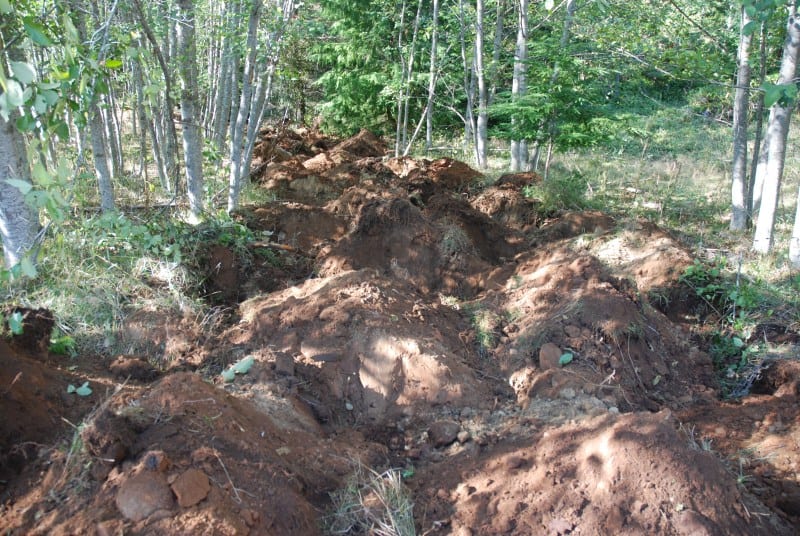
Excavator making road surfaces rough and loose, Fort Shephard Conservancy
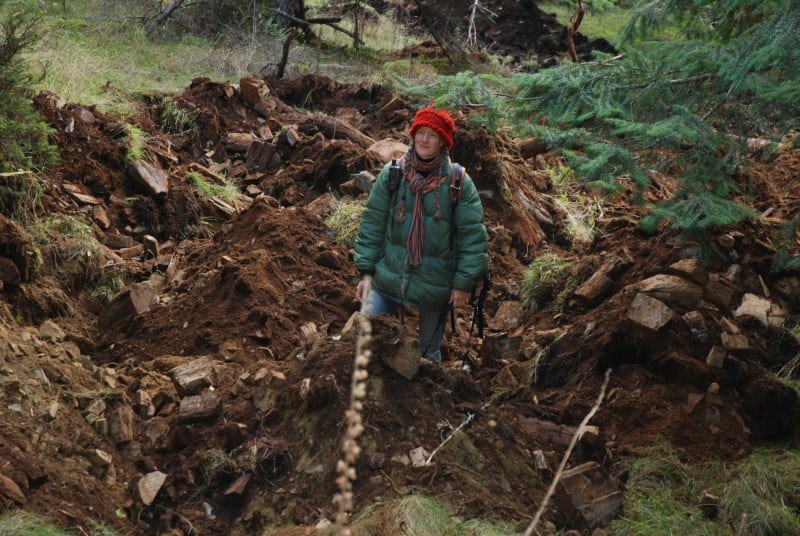
Disturbed trail surface at Fort Shephard Conservancy

Rough and loose topography creates diverse moisture conditions fostering native plant diversity