Qualicum Beach Slide Restoration
Qualicum Beach, Vancouver Island · February–April 2020
Active Slide Treated
Bioengineering applied rapidly to a freshly active landslide to stabilize the surface and begin ecological recovery.
Winter Installation Window
February–April installation took advantage of dormant cutting viability and softened slope conditions.
Coastal BC Site
Native BC coastal species selected for the wet Maritime climate and high-precipitation conditions on Vancouver Island.
The Challenge
The Qualicum Beach slide presented a bare, unstable slope face requiring treatment before the 2020 growing season. Slope failures of this type, with exposed mineral soil and no residual vegetation cover, are vulnerable to further erosion by rainfall impact and surface runoff until plant cover and root development can provide protection and structural reinforcement.
The site prior to treatment (documented in February 2020) showed the characteristic bare scar of an active slide: exposed slope face, no established vegetation, and the risk of additional erosion and instability during and after spring rainfall events.
Approach
Installation began March 24, 2020, and proceeded systematically up the slope, a standard approach for bioengineering steep slide terrain, which ensures that each section is treated before the crews move above it, reducing the risk of surface disturbance on worked areas.
Progress was documented on April 7, 2020, with work nearing the top of the slope and a remaining section to complete along the edges.
Soil bioengineering techniques appropriate to steep, freshly failed slopes typically include:
- Live staking of dormant willow and cottonwood cuttings driven directly into the slope, rapid to install, immediately intercepts seepage moisture, and provides root reinforcement from the first growing season
- Wattle fencing across the slope face where terrace structures are needed to intercept surface runoff and trap fine sediment
- Brush mattress or modified brush layer on broader slope sections requiring more comprehensive surface protection
Results
The April 7 photographs record work near the top of the slope, with some edge work still to complete. They document installation progress before the 2020 growing season.
The dated sequence runs from a pre-treatment view on February 19 to installation photographs on March 24 and April 7, 2020.
Surface treatment on a freshly exposed slope. Request a Site Assessment →
Qualicum Beach: Building Up the Slide Face
The Qualicum Beach deck is short, but it is a strong installation record. It shows a bare slide face in February and the systematic movement of live structures up the slope through March and April 2020.

February 19, 2020: bare slide face before treatment.
The first photo shows the problem plainly: a steep exposed scar with little surface protection. Before vegetation can help, the slope needs physical structure that can slow erosion and hold live material in place.
The work starts from the bottom because each installed row creates a more stable place to work above. This sequencing matters on active slide terrain where loose material can move down over finished work.

March 24, 2020: treatment begins at the lower slope.

March 24, 2020: crews work systematically up the slope.
As the pattern moves uphill, the treated face changes from a bare chute into a series of small benches and live structures. The goal is not just coverage; it is repeated stable microsites across the whole scar.
By early April, the installation has connected the lower and upper portions of the failure. This is where the sequence becomes useful as a construction record: it shows the slope being solved in lifts, not patched in isolated spots.
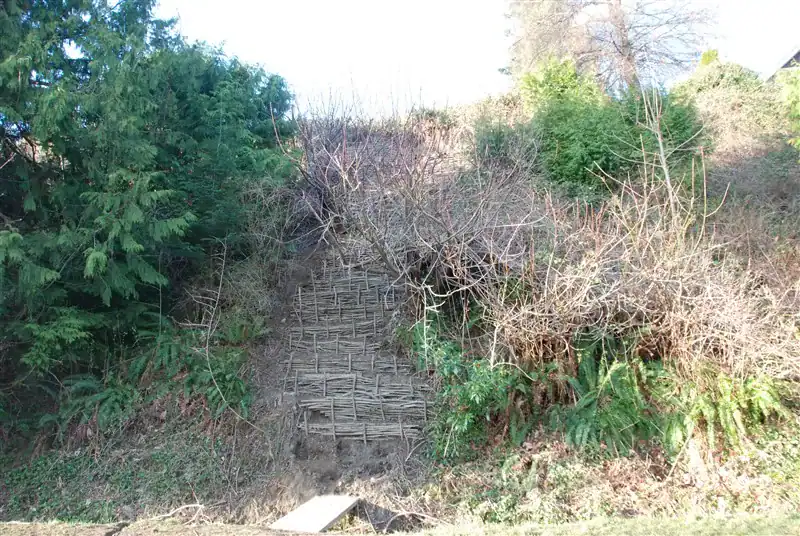
April 7, 2020: the installation reaches near the top of the slide.
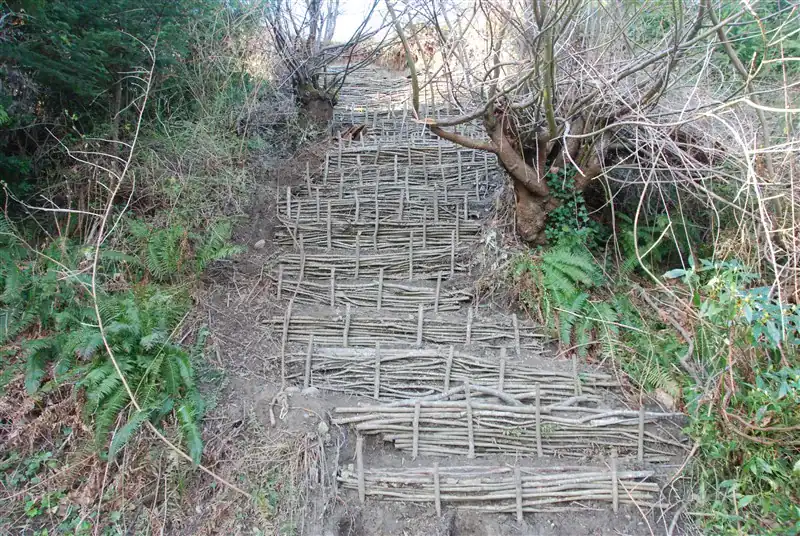
April 7, 2020: a small amount of edge work remains.
The final view shows the importance of tying treatments into the edges. A slide repair is only as strong as its margins, where runoff and loose side material can otherwise restart erosion around the completed face.
References
- Source deck: David Polster, Qualicum Beach Slide, February-April 2020.
- Wattle Fencing
- Modified Brush Layers
- Living Structural Systems
Learn more
Qualicum Beach: building the slide face back up
Five dated field photographs follow the installation from a bare slide face through work at the lower slope, progress upslope, and the final edge work.
Before treatment - Feb 19, 2020This is a dated installation sequence, not a fixed-camera before-and-after comparison. The photographs document the work as it moved up the slide.
Related Methods and Resources
Facing a Similar Challenge?
We can assess slide geometry, groundwater, and toe conditions to build a living stabilization sequence suited to the coastal slope.