
Highway Living Systems in the Field
Field example for corridor and highway bioengineering work, showing how living retaining and bank systems perform on steep transportation and creek-side sites.
Steep Transportation Sites
Living systems applied to highway corridors, road cutbanks, and creek-side slopes in BC's rugged terrain.
Performance Under Load
Field photographs of living treatments beside roads and creek-side slopes.
Lower Cost Than Hardworks
Living treatments can fit some corridor slopes where the failure mechanism, moisture and available material support them. Compare their scope and costs with other protection only after assessing the site.
Transportation and creek-side examples show soil bioengineering performing under real structural constraints rather than cosmetic restoration goals.
What These Examples Demonstrate
These corridor examples highlight a side of the PES toolkit that deserves to be easier to find:
wattle fences used where over-steepened slopes need stepped living support
live reinforced earth walls used where a stronger retaining system is required
living bank and edge treatments used where creek corridors and transportation infrastructure overlap
Why Corridor Work Matters
Infrastructure settings are useful proof because they remove the idea that soil bioengineering is only for low-risk naturalized sites. These are places where:
slope movement has real consequences
access and geometry are constrained
performance matters over multiple seasons
a harsh hard-engineered response is often the default expectation
The examples show that living systems can still be the better long-term choice.
What Makes These Good Field Examples
These corridor examples are valuable because they show treatments after establishment, not only during construction. That is essential for evaluating soil bioengineering honestly. The method should be judged by how it roots in, stabilizes, and matures.
Related Reading
Takeaway
The photographs show a roadside failure, live reinforced earth walls used for gully filling and later vegetation at Bowker Creek.
For corridor projects, PES assesses drainage, slope conditions, access and plant establishment requirements before selecting a treatment. These field examples illustrate construction methods and visible vegetation.
On highway and corridor sites, the cut slope face is exposed, compacted, and prone to concentrated runoff. Three stacked wattle fences intercept sheet flow at successive terraces, each trapping sediment and creating a protected microsite where native vegetation can establish and root into the bank. Within two to three seasons, the living root mass replaces the structural function of the wattle itself.
Technical Diagram, Highway Cut Slope: Wattle Fence Terracing
Intercept runoff
Each wattle fence terrace interrupts sheet runoff flowing down the slope face, reducing velocity and the energy available to detach and transport soil particles. Without interception, a single flow event can remove the entire exposed surface layer.
Trap sediment
Sediment carried in the intercepted runoff deposits immediately upstream of each wattle, progressively filling the terrace with fine material and creating a growing platform of soil that supports plant root systems.
Establish roots
Willow cuttings woven into the wattle fence root directly from the structure into the slope. By season two the root mass provides mechanical reinforcement to the bank independently of the wattle, which has typically begun to degrade by that point.
Corridor Installation and Establishment
Legacy corridor slides show both the construction detail and the early establishment window that matters most in highway and creek-side work.
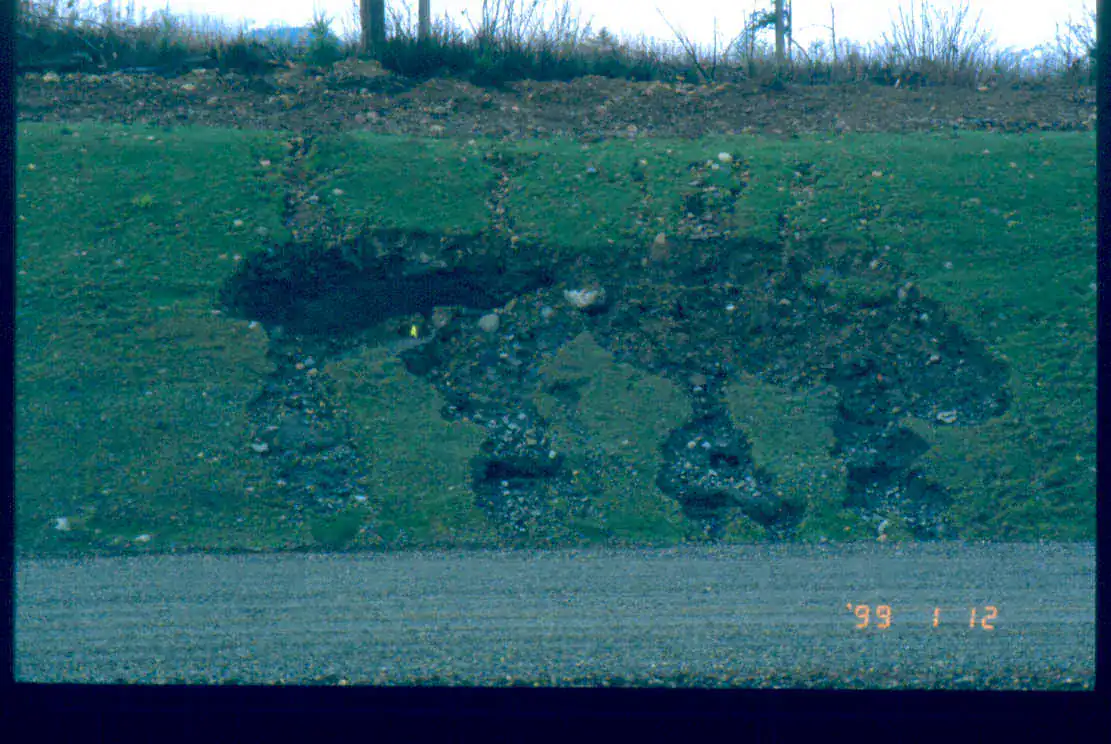
Before treatment: active roadside erosion and gully formation.
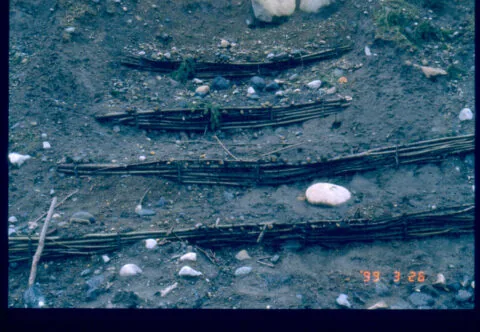
Live reinforced earth walls (LaREWs) used for gully filling, as identified in the source presentation.
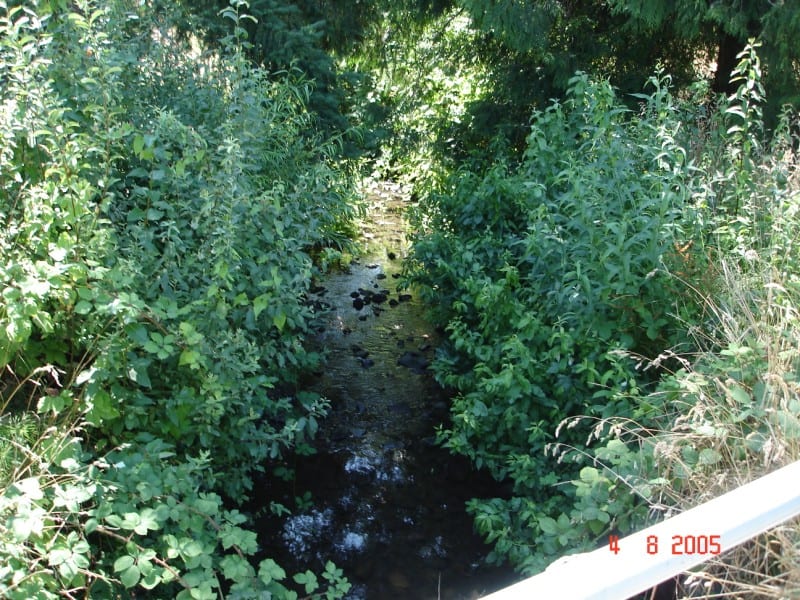
Vegetation along Bowker Creek, August 4, 2005.
Need a Site-Specific Recommendation?
We can assess the conditions on the ground and match the right living system to your slope, streambank, shoreline, or disturbed site.