
Live Reinforced Earth Walls
Learn how live reinforced earth walls combine structural reinforcement with living plant material to stabilize steep slopes while improving long-term ecological performance.
Reinforced Bank Armour
The PES method combines a wattle-fence face, backfill and long live cuttings extending into the fill.
Steep Riverbank Application
Designed for near-vertical cut banks where conventional methods cannot provide the structural hold needed.
Reduces Long-Term Maintenance
As roots establish, they may add reinforcement and reduce some maintenance requirements; inspection, repairs, and replanting remain site-specific.
Structural Logic
Live reinforced earth walls were developed specifically to treat piping failures,the subsurface erosion channels that form in fine-grained or poorly compacted fills when water moves through them under pressure. Piping creates overhanging cavities that cannot simply be backfilled with loose material; any fill placed against an unsupported overhang is vulnerable to rotational or translational failure before it consolidates.
In Living on the Edge, printed pages 58–59, David Polster describes a wattle-fence face retaining backfill, with long live cuttings extending through the fill to the back of the cavity. Cutting length and the wall layout depend on that geometry. The living material must remain in suitable contact with moist soil to establish.
The face and reinforcing cuttings need suitable moisture to establish. Check survival, seepage and movement as the wall develops. Where significant seepage is present, pole drains may be part of the treatment.
Live reinforced earth walls are one of the clearest examples of the structural side of soil bioengineering. They are not just plantings on a slope. They are retaining systems that combine soil, reinforcement, and living material into an assembly that provides initial structural resistance while root development can add reinforcement as suitable plants establish.
What Makes Them Different
Unlike a purely hard retaining wall, a live reinforced earth wall is designed to do two things at once:
- provide structural support to the slope
- establish living root systems throughout the face and body of the wall
That combination matters because the living component is not ornamental. It changes drainage, improves long-term binding, and helps the structure become more integrated with the surrounding landscape over time.
Where They Fit
Live reinforced earth walls are particularly well-suited to situations where:
corridor slopes are steep but space is limited
a rigid retaining wall would be expensive or visually harsh
long-term vegetation performance matters
the site needs a system that performs mechanically while still supporting restoration goals
The photographs below show the system at different stages, the structural form just after installation, and later-condition examples where root growth and canopy have taken over the stabilizing function from the initial structure. The cuttings extend into the slope body and help prevent the circular failures that can occur at the base of reinforced walls.
Why They Belong in the PES Toolkit
Live reinforced earth walls fit the larger Polster logic:
solve the immediate stability problem
use pioneer species that can establish under difficult conditions
allow the living treatment to improve performance over time
Continue inspecting both the structural and living components as conditions change.
Relationship to Other Structural Methods
Live reinforced earth walls sit in the same broader family as:
other living structural systems summarized in Living Structural Systems in Soil Bioengineering
They are not interchangeable, but they share the same principle: build with living material so that structure and ecological recovery are not treated as separate tasks.
Early-Stage and Established Conditions
The field examples below illustrate the system across its installation and growth stages:
diagram logic explaining how the cuttings work within the slope
early installed examples where the stepped structural form is visible
later-condition examples where vegetation starts taking over more of the work
a gully-filling application showing that the system can be adapted to specific failure geometry
That is the right way to judge them. The point is not only that they can be built. The point is that they can root in, hold, green up, and continue improving.
Why Choose a Living Retaining Wall
Live reinforced earth walls are often mistaken for conventional retaining walls with plants added to the face. A live reinforced earth wall is structurally different. The cuttings are integrated into the fill material, and root growth from the embedded stems provides real mechanical reinforcement of the slope mass, not surface vegetation applied after the structural work is done. Developing roots can add reinforcement where the material establishes. Check wall condition and drainage as the treatment develops.
Takeaway
A live reinforced earth wall combines immediate support with living material within the fill. Its layout must address the actual failure and seepage conditions, with follow-up to check establishment and movement.
Structural Living Systems in the Slide Record
For sites where budget or corridor constraints rule out large hard retaining structures, live reinforced earth walls offer a cost-effective alternative that performs mechanically in the short term and ecologically over the longer term.
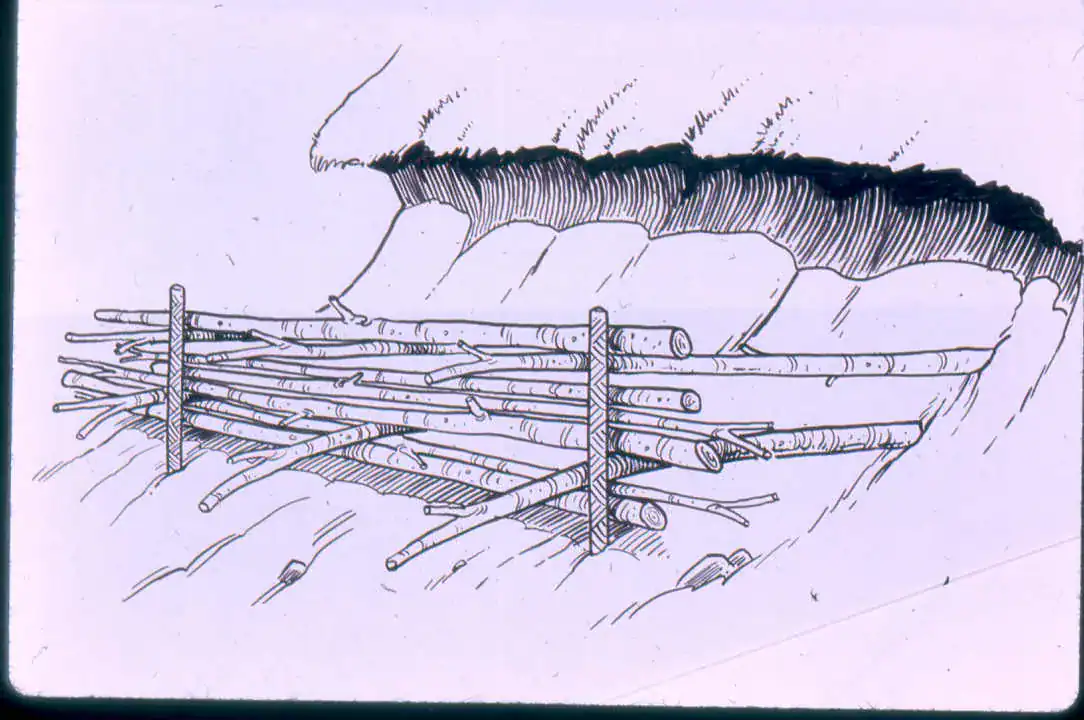
Legacy PES diagram showing how cuttings extend into the slope to help prevent circular failure.

Close field detail of a LaREW arrangement used for gully filling rather than a generic slope face.

Early-condition LaREW example where the stepped structural form is still clearly visible.
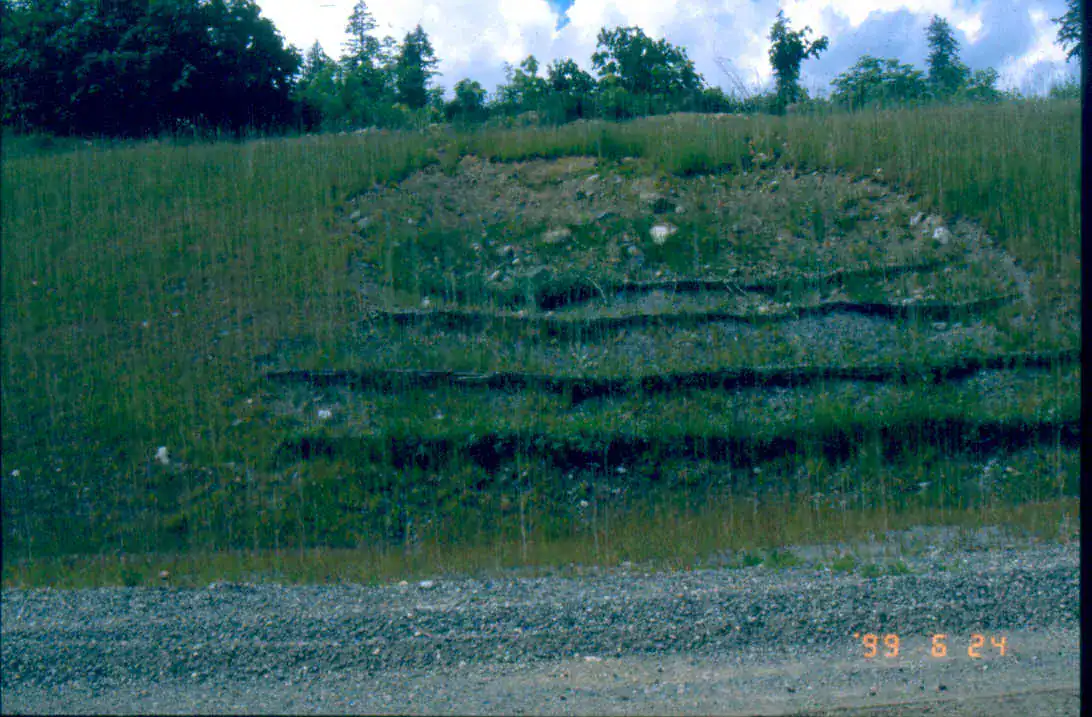
Later-condition view showing the structural system beginning to green up and root into the slope.
Structural and Living
Combines mechanical support (logs, stakes) with live rooting material for dual-function walls.
Root Depth Over Time
Check plant establishment, drainage and wall condition as the treatment develops.
Steep Slope Application
Designed for slope angles where conventional bioengineering techniques cannot be safely installed.
Need a Site-Specific Recommendation?
We can help interpret the conditions on your slope, streambank, shoreline, or disturbed site and recommend the right combination of soil bioengineering methods.
LaREW field record: structure to living cover
This David Polster field record shows how a live reinforced earth wall can remain visible as a structural form while living material establishes across the slope.
Early condition · 1999Early-condition LaREW slope with the stepped structural form still visible.
These are related views from the 1999 LaREW field record, not a registered fixed-camera comparison. The diagrams and method explanation on this page provide the technical context.
Sources and further reading
These references provide wider technical context. Method selection and design remain site-specific.