
Live Smiles and Specialty Mudflow Controls
Curved bundles of living willow stabilize confined gullies and small drainage channels where straight bank treatments do not fit, while trapping sediment and establishing plant cover.
Arc-Shaped Live Structures
Live smiles retain flowing silty material in a catenary form. The cuttings act in tension and the porous face provides drainage; this is a slope treatment, not a generic high-velocity riverbank deflector.
Curved Flow Management
The arc geometry slows lateral erosion by deflecting high-velocity water away from vulnerable bank faces.
Succession in the Channel
As plants establish inside the arcs, natural succession can add longer-term vegetation where moisture, species, and disturbance conditions support recovery.
Why the Catenary Form Works, and How to Size the Structure
The tension form can resist loads differently from a straight fence. Size the structure for the moving material and anchorage; the method description does not establish a safe retained mud volume.
The porous character of the structure provides a second mechanism: the bundle drains the flowing silt rather than simply holding it. Saturated fine-grained material has almost no shear strength; as that moisture dissipates through the cutting bundle, the deposited silt stiffens and begins to hold itself. The good contact between flowing silt and cut stems also promotes rapid root initiation, so the structure begins gaining biological strength during the same season it is installed.
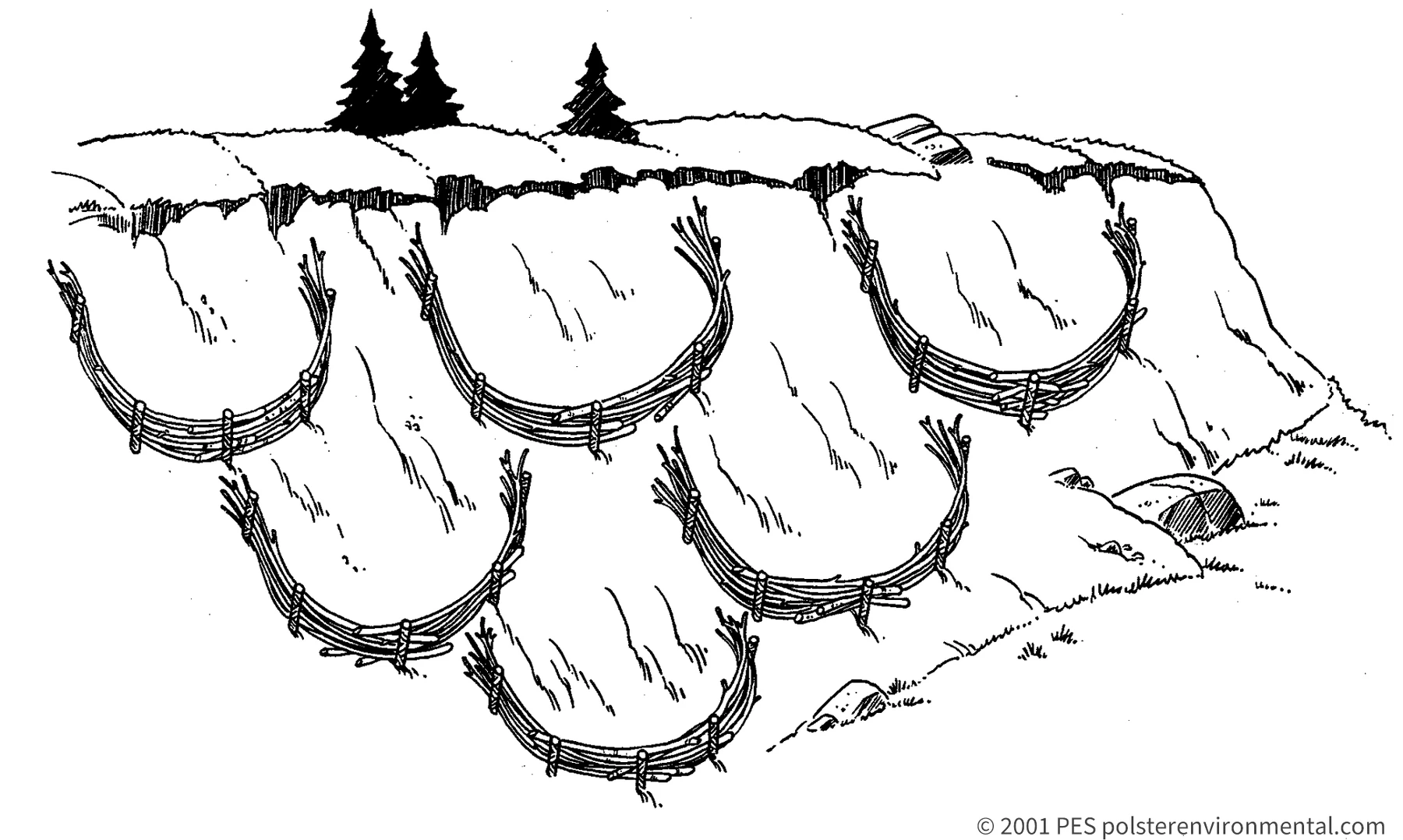
Sizing follows from slope gradient and available cutting diameter. On steeper slopes or with smaller-diameter cuttings, keep structures in the 2–3 m width range; on more moderate gradients with large cuttings, up to 5 m is feasible. The centre of the arc should not exceed 40 cm above the anchorage points, and end stakes should be firmly set into undisturbed in-situ material at 50–60 cm centres. Space successive structures close enough that no significant silt can accumulate between them in a single flow event.
Not every disturbed slope can be solved with one of the core high-frequency methods. The old PES material makes that clear. Some sites have flowing mud, confined erosional pathways, or mixed failure mechanisms that require a more specialized response. Live smiles sit in that part of the toolkit.
What Are Live Smiles?
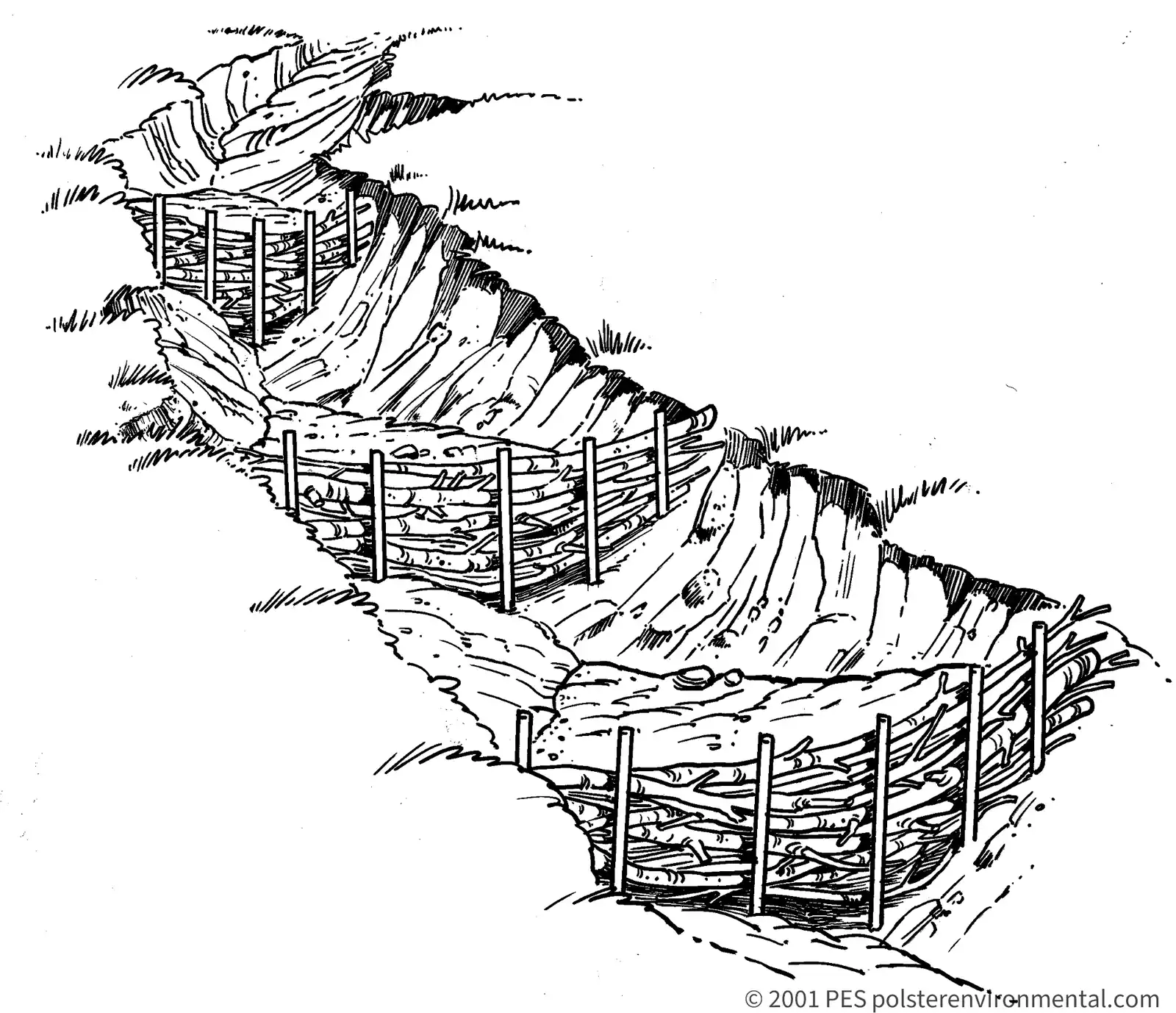
A live smile uses living cuttings arranged in a catenary curve to support flowing silts. The ends and joints must be secured so the cuttings act in tension, while water can drain through the face.
As the cuttings root into the streambed and banks, the structure strengthens with each growing season. Standard inert barriers deteriorate with repeated flow events. A live smile improves.
Live smiles are named for their appearance from above: the catenary arc of the bundle, anchored to both channel banks, curves upward at each end. The shape is structural, the arc distributes load from flowing water along the full span of the bundle rather than concentrating it at a single point.
The Problem They Solve
Live smiles address confined failure zones, small drainages, active gullies, and slope paths where moving water carries muddy or silty sediment and where shallow instability is reshaping the channel with each flow event. In BC, the most common applications are headwater drainages and disturbed gully systems in fine-grained terrain: silty glacial till slopes, disturbed riparian margins, logged drainage paths.
A straightforward eroding streambank responds well to live bank protection or live staking. A small, confined, actively-transporting gully needs a structure that resists flow uplift, intercepts sediment, and establishes living cover, all in a space too narrow for standard linear techniques. Live smiles were developed for exactly this condition.
Installing live smiles across an active reach arrests the incision cycle and begins rebuilding living structure from the base of the drainage upward. As the channel fills with trapped sediment and the willow coppice establishes, the drainage path gradually stabilizes and begins supporting successional recovery.
Installation
Fresh willow cuttings are bundled and placed across the drainage, spanning bank to bank. The bundle ends are staked firmly into both banks. The cuttings sag naturally into the catenary arc under their own weight, no shaping or forming required.
Spacing along the active reach depends on channel gradient. Steeper channels need closer spacing to step down the energy grade line incrementally. Supplement with live staking on the adjacent banks to extend vegetation establishment beyond the immediate channel margin.
When to Use Live Smiles
Use live smiles where a small drainage has active muddy sediment transport, where a confined gully is incising with each flow event, or where multiple failure conditions, flow, saturation, shallow instability, converge in a narrow space. For simpler erosion on accessible streambanks, live staking or live bank protection will usually be a better fit. Live smiles are a specialty tool for confined, complex failure zones where a living structure that improves with establishment is needed in a space where standard bank protection techniques cannot be installed.
When to Reach Out
If a site has active muddy movement, confined gully instability, or multiple overlapping failure conditions, that is usually the point where a generic restoration recipe starts to break down. Those are the situations where a site-specific assessment matters most.
How Live Smiles Work: Catenary Curve Installation
Live smiles use the catenary curve, the natural hanging arc of a rope or cable, to anchor a bundle of live cuttings across a small stream or drainage channel. The curved form allows the bundle to act in tension against flow, resisting uplift while the cuttings root into the streambed and banks. The result is a self-reinforcing living structure that grows stronger with time.
Field References for Live Smiles
These references describe live smiles as catenary willow structures for flowing mud, saturated silts, and confined gully failures, including the tension mechanism that distinguishes them from straight wattle fences and modified brush layers.
Arc-Shaped Log Frame
Curved log structures follow natural flow lines, creating sediment deposition zones on steep terrain.
Mudflow Interruption
Designed to interrupt channelised debris and mud movement specific to steep unstable slopes.
Vegetation Follows
Once flow energy is reduced by the structure, plant establishment and root development follow naturally.
Need a Site-Specific Recommendation?
We can help interpret the conditions on your slope, streambank, shoreline, or disturbed site and recommend the right combination of soil bioengineering methods.
Mowhokam Creek slide: a cautionary field record
David Polster's Mowhokam Creek sequence shows a slide before treatment, live material installed in 1997, and mud-flow stress recorded the following spring.
A bare Mowhokam Creek slide above the road before the first treatment record.
Source: David Polster's 3 RRNW Cautionary Tales and Segment Live Smiles new records. The sequence is intentionally shown as a cautionary field example: wattle fences and modified brush layers can be stressed or toppled by mud flows, and a site-specific design is essential. Viewpoints vary, so this is a dated record rather than a fixed-camera survey comparison.
Buckley Bay live smiles: a dated field record
This David Polster archive sequence shows curved live-smile structures during installation and early vegetation development on a Buckley Bay slope.
The northern ramp frame records the newly installed live-smile structures on the Buckley Bay slope.
Source: David Polster's Buckley Bay working-photo archive and the matching Segment Live Smiles deck. The viewpoints change between ramp sections, so this is a dated field record rather than a fixed-camera survey comparison or a current client performance claim.