
Natural Processes for the Restoration of Drastically Disturbed Sites
David F. Polster, M.Sc., R.P.Bio. | Proceedings of the 33rd Annual Meeting of the American Society of Mining and Reclamation, Spokane, WA, 2016
Download the published JASMR edition (2016)
Published journal source: JASMR, Volume 5, Issue 2.
Natural-process restoration
From recovery model to restoration strategy
The paper frames restoration as a sequence: understand how comparable disturbances recover, find what is blocking that recovery, address the limiting conditions, then help succession resume.
Study local recovery
Look at how comparable natural disturbances recover and which pioneering species establish under local conditions.
Identify the filters
Separate physical limits from biological limits. Several filters may act together.
Change the conditions
Reduce the filters and create conditions that natural recovery can use. One treatment may address several filters.
Support succession
Allow local pioneers to arrive, or provide locally suitable seeds, plants or cuttings when the nearest source is too far away.
How to use this diagram: it is a diagnostic sequence, not a site prescription. Site conditions determine which filters matter and which treatments or pioneering species are suitable.
Abstract
Natural processes have been revegetating naturally disturbed sites (landslides, volcanic explosions, earthquakes, etc.) since the advent of terrestrial vegetation about 400 million years ago. Understanding the way these natural processes operate to restore disturbances provides a framework for the design of restoration programs for anthropogenic disturbances (mines, industrial disturbances, etc.). The first step in the design of a natural process based restoration program is to identify what it is that is preventing the natural recovery from occurring (filters). Common abiotic filters are steep slopes, adverse texture, nutrient status, adverse chemical properties, soil temperature extremes, compaction, adverse micro-site conditions and excessive erosion (Polster 2015). Biotic filters include herbivory, competition, propagule availability, phytotoxic exudates, facilitation and adverse species interactions (Polster 2015). Once the filters that are preventing recovery are identified and addressed, the natural processes will operate to restore the site. Care must be taken not to solve one problem by creating another. Traditional grass and legume seeding has been used to control erosion on many reclamation sites. However, the seeded cover has been found to restrict the growth of woody species so if a forest is what the restoration program is directed at then seeding with grasses and legumes is a poor idea. Making sites rough and loose (Polster 2015) can address a number of filters (compaction, excess erosion, lack of micro-sites, soil temperature extremes) and costs about a third of the cost of traditional hydroseeding. In many cases, there are ample seed sources nearby and making a mine site rough and loose with the application of large woody debris at a rate of 100 m 3 /ha can initiate the recovery process. Pioneering species often have effective seed dispersal mechanisms so creating the right habitat can result in the establishment of the pioneering species that are adapted to the local conditions. Natural processes such as making sites rough and loose (like trees in a forest turning up the soil) and scattering large woody debris on the area can initiate recovery on drastically disturbed sites. Natural processes can provide cost-effective strategies for the restoration of large disturbances such as mines, landslides and industrial sites. By creating conditions (rough and loose with woody debris) that foster invasion by pioneering species as well as controlling erosion means that generally the need for seeding or planting is eliminated. Large bulldozers can be used to reslope waste dumps. The incorporation of wrap around dumps in mine design reduces the cost of resloping (Milligan and Berdusco 1978). Large excavators can be used to make the resloped waste dumps rough and loose and to scatter the woody debris. Using natural recovery processes reduces the costs associated with traditional restoration of large disturbances. ___________________________ 1 David Polster, M.Sc., R.P.Bio. is a restoration ecologist with Polster Environmental Services Ltd., 6015 Mary Street, Duncan, BC, V9L 2G5 CANADA. d.polster@telus.net
Introduction
Historically mine reclamation has developed from the fields of forestry and agriculture (including soil science) (Polster, 1989). More recently, restoration ecology has offered strategies for the reclamation of large disturbances (Tongway and Ludwig, 2011). Unfortunately, these strategies continue to be based on historical treatments that do not necessarily work. Natural processes have been restoring natural disturbances since the advent of terrestrial vegetation over 400 million years ago (Holmes 1965). Understanding how these natural recovery processes operate allows new systems for mine reclamation to be established and researched (Polster, 2013). These systems are based on the idea that the most effective recovery systems are those that assist the natural recovery processes. Ecological restoration is defined as the process of assisting the recovery of an ecosystem that has been degraded, damaged or destroyed (SERI, 2004). The trick then becomes one of determining what things can be done to assist the recovery and what things should not be done to avoid preventing recovery. This is much like a small cut on your hand – there are things you can do to help your hand heal, put on antiseptic, a bandage and keep it clean, and there are things that you can do that will prevent or hinder the recovery of your cut hand, i.e. shovel out the chicken coop and get the cut infected. However, we cannot force our hand to heal, and neither can we force an ecosystem to recover.
Understanding the processes of ecosystem degradation can provide clues for treatments that can be used to assist in the recovery. Hobbs and Suding (2009) suggest that degradation can be divided along two lines, abiotic and biotic. Abiotic degradation is defined as those degrading processes that are associated with the physical aspects of the ecosystem. A large bulldozer, rock drills and dynamite, loaders and haul trucks are abiotic degrading elements. Grazing elk or invasive species are biotic degrading agents. These degrading forces are discussed in Section 2 of this paper.
Degrading processes can be thought of as filters (Temperton et al., 2004) to recovery. That is, they may prevent the recovery of a full suite of species, but allow some species to establish. For instance a compacted waste rock dump surface (abiotic filter) may prevent the growth of a healthy forest, but allow weedy species such as Mullein (Verbascum thapsus L.) to grow freely. Similarly, hungry elk or deer (biotic filter) may prevent the growth of Western Red Cedar (Thuja
2 plicata Donn ex D. Don) but may allow Red Alder (Alnus rubra Bong.) to thrive. Some species are filtered out while others can establish.
Natural processes have evolved systems for dealing with ecological filters. By looking at how these processes operate ideas for the restoration of drastically disturbed sites can be generated. For instance, soils and plant communities can develop on glacially compacted basal tills with the accumulation of organic matter and the loosening of the soils by weathering and root systems of pioneering species, particularly nitrogen fixing woody species (e.g. Alnus spp.). Eventually soils on these sites can support forests. Natural processes such as trees blowing over in storms with large root masses coming up with the stump can move non-mobile nutrients such as potassium and phosphorus to the surface for subsequent use by growing plants. In addition the soils brought up by the fallen tree are loose. By following the systems that natural processes have evolved for the treatment of disturbed sites solutions to anthropogenic disturbances can be identified.
This paper is organised to present the common filters that are found at most mine sites and the natural solutions to these filters. The paper provides strategies for implementing these solutions on large industrial disturbances, either as post-mining treatments or as ongoing processes during active mining. The paper presents strategies for the establishment of suitable vegetation covers that will build soils and create self-sustaining ecosystems on the disturbed ground. Examples are drawn from the author’s experience.
Natural Recovery Processes
Polster (2013) listed eight abiotic and six biotic filters to recovery. The mining industry typically
3 encounters the following abiotic constraints to recovery; compaction (haul roads and dump platforms), steep slopes (dump slopes), adverse texture (toe of waste rock dumps), adverse chemical properties (pH extremes), low nutrient status (most mining wastes), soil temperature extremes (dark coal wastes), excessive erosion (many sites), and lack of micro-sites (smooth surfaces). Some of the biotic filters are also found at mines; excess herbivory (from high deer and elk populations), competition (from seeded agronomic grasses and legumes), propagule availability (with large disturbances); phytotoxic exudates (from weedy species like Knapweed), facilitation and species interactions (adverse ecological interactions). Many of these filters may act together to limit recovery so for instance, steep slopes and adverse textures may be found on waste rock dump slopes. Similarly, treatments that can ameliorate one filter may also help with another. These are discussed below.
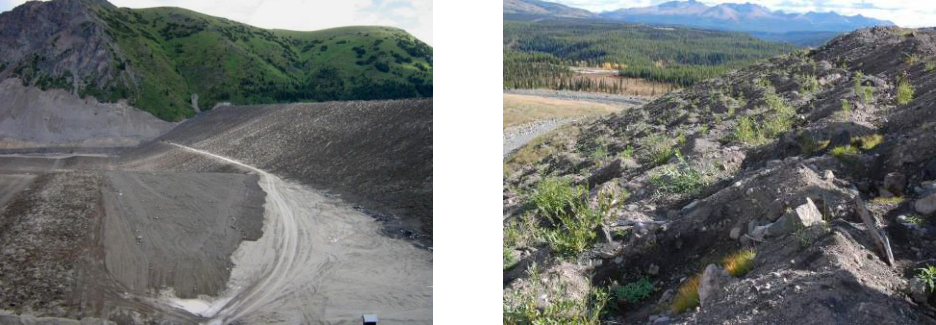
Compaction is probably the most common filter found at mines. Spreading materials with bulldozers creates compaction in the soils and prevents healthy growth of vegetation. Using an excavator to prepare the surface of the compacted area can be an effective way of alleviating compaction. The excavator can make rough and loose (see Figures 1 and 2) configurations by opening holes on the site, dumping the material that is generated from the holes in mounds between the holes. The excavator, using a digging bucket (not a clean-up bucket), takes a large bucket full of material and places it to the left of the hole that was just opened; half a bucket width from the hole so it is half in and half out of the hole. Rocks are fine to include as these tend to create additional heterogeneity. A second hole is then excavated half a bucket width to the right of the first hole. Material from this hole is then placed between the first and second holes. A third hole is now opened half a bucket width to the right of the second hole, with the excavated soil placed between the second and third holes. Care should be taken when excavating the holes to shatter the material between the holes as the hole is dug. The process of making holes and dumping soil is continued until the reasonable operating swing of the excavator is reached. The excavator then backs up the width of a hole and repeats this process, being sure to
4 line up the holes in the new row with the space between the holes (mounds) on the previous row. Rough and loose surface configurations can be used on re-contoured dump slopes to control erosion and provide suitable sites for vegetation establishment. Making a former coastal hydroelectric dam and penstock site rough and loose and scattering woody debris resulted in the natural establishment of an average of 5,412 alder plants the first year after treatment (50 plots, SD = 57.08 seedlings) while in the second year an average of 8,550 seedlings were found (repeated sampling of same plots, SD = 94.50 seedlings) with 67 other species. In 2015, the number of alder plants dropped to 5,392/ha (SD = 40.92) suggesting a balance of larger plants is being achieved. In 2016, there was an average of 6,162 alder with a SD of 45.77. Cost at a large northern mine for making sites rough and loose were found to be about $700/ha.
Steep slopes are common at many mines. Waste rock dumps are constructed by dumping wastes around or over the rim of the dumps and then pushing these materials over the edge of the dump slope, forming angle-of-repose slopes. The natural analogue of waste rock dumps are talus slopes (Polster and Bell, 1980). These slopes tend to revegetate very slowly as most of the material on the slope is too coarse to support plants. The materials at the top of the slope are fine textured and will support plant growth, but this area is continually bombarded by materials from above. In the middle of the slope, the materials are too coarse to hold moisture and therefore will not support vegetation. At the bottom of the slopes, the spaces between the large rocks slowly fill with bryophytes and organic matter and eventually will support the growth of higher plants. The slow erosion of the fine textured materials from the top over the middle portion of the slope will eventually allow vegetation to establish. Eventually, the areas of adverse texture are addressed by either organic matter collecting between the large rocks or by fines washing down from above. This process can be greatly expedited at mine waste dumps by pushing the fines from the top of the slope over the face and down to the toe of the slope.
Designing mine waste dumps to foster resloping and subsequent restoration is an important part of the design process. Wrap-around dumps can greatly reduce the costs associated with resloping (Milligan and Berdusco 1978). Incorporating restoration considerations in the mine design process can reduce costs and build social license. By using natural processes that will re-establish the successional trajectories that operate in the region, the restoration of mine waste dumps can be cost-effective.
The low nutrient status of most mining wastes can limit the growth of some plants. However, pioneering species, including those that are associated with nitrogen fixing bacteria have evolved to grow in areas of low nutrients. The use of early pioneering species as the principle
5 revegetation species on mining sites (Polster, 1989) eliminates the need for fertilizers while providing a vegetation cover that will build healthy soils on the relatively inert materials left from mining.
Adverse chemical properties of waste materials (tailings and waste rock) at some mines require that these materials be isolated from the environment. Acid rock drainage and metal leaching is a problem at some mines that requires that cover systems be established (O’Kane et al., 2001). The key to the design of waste rock covers is to ensure that there is ample clean material on top of the material that is used to seal the wastes to allow vegetation to grow freely. The idea that woody species can be prevented from growing on a thin cover thereby reducing the immediate cost of the cover is false. There is a risk that the integrity of the cover will be breached by the eventual growth woody species in these areas and the costs of not providing a proper cover will be passed on to the future mining industry either as a direct cost or as the loss of social licence and the refusal of society to permit the opening of new mines. Most woody species in western North America need at least two meters of growth medium to support woody vegetation. This is on top of the materials that are used to seal the wastes.
Dark substrates are a common problem at many coal mines. In the hot summer sun these materials may reach temperatures that are too extreme for plant growth. Excess erosion and a lack of microsites are other common problems at many mines. Making the surface rough and loose and covering the surface with 100 m
6 3 /ha of woody debris (Vinge and Pyper, 2012) can control erosion and create ideal sites for vegetation establishment while providing a long term nutrient source for the new forest. Woody debris can provide an important habitat for a variety of animals as well as plants (Craig et al., 2014).
Biotic filters are not as common at mines as the abiotic filters. However, competition by seeded agronomic grasses and legumes can severely restrict woody species growth (Polster, 2010). Seeded grasses and legumes have historically been part of the mine reclamation tool kit (Ziemkiewicz, 1977). However, long-term studies at mines throughout the Western Canada have shown that seeding mining wastes with agronomic grasses and legumes provides habitat for small mammals that eliminate woody species (Green, 1982). Making sites rough and loose, adding woody debris and seeding or planting in pioneering woody species avoids the problems of seeded agronomic grasses and legumes. In addition, the cost of making sites rough and loose and scattering woody debris is about one third of the cost of traditional seeding with agronomic species.
Restoration Strategies
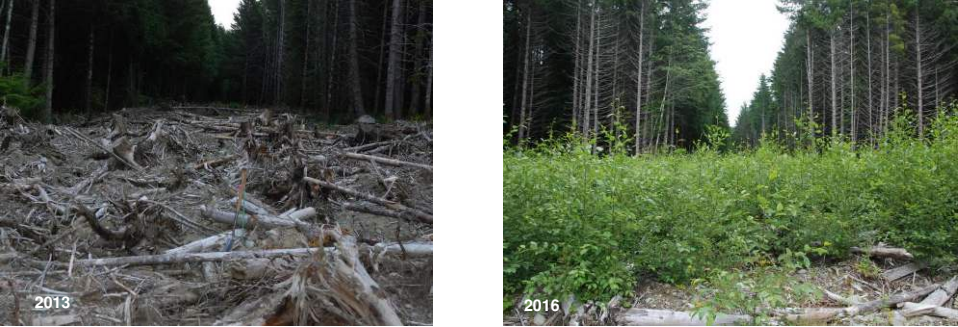
Following the natural recovery processes that have evolved to address naturally disturbed sites is the most effective strategy for treatment of mining disturbances. By working with the natural systems that have evolved to restore natural disturbances such as landslides, volcanic eruptions, glaciation and other major disturbances, the restoration program can take advantage of the work that is done by these natural recovery processes. At a dam site where the dam and related infrastructure (penstock) was removed. Large disturbed areas were left. The site was treated with woody debris and the rough and loose technique and no other treatments. Now, four years after the treatment there are 6,162 Red Alder (a pioneering species that fixes nitrogen) established plants per hectare along with 75 other species including Western Hemlock Western Red Cedar and Douglas-fir (see Figures 3 and 4). All of these have established without any planting work by humans. By taking advantage of the erosion controlling attributes of the rough and loose ground covered with woody debris (a waste material that would have had to be disposed of) the project saved hundreds of thousands of dollars of planting work as well as the costs associated with the slash disposal. Rough and loose surface configurations cost about $700/ha of machine time (4 hours/ha) to install.
Where large distances are involved between the seed producing pioneering species and the areas needing restoration propagules (seeds, plants, cuttings, etc.) of the pioneering species need to be provided. Seeding with pioneering woody species such as alder can be a very effective way to cover large areas at low cost. Pioneering species such as alder produce abundant seeds so collection of seeds locally is generally easy. The seeds of poplars and willows are wind-blown and may not retain viability for long. Although these species may start to grow naturally on a site, establishing these species from cuttings can be very effective. The important aspect of this process is to use the pioneering species for the region, even if eventually a late successional forest is the desired outcome. Later successional species will establish under the protection of the pioneering species. The successional sequence of deciduous over conifer is very common in Western North America.
7 The growth of later successional forest species is enhanced by the presence of pioneering species. Pioneering species are often associated with nitrogen fixation as this tends to be a limited element in early successional ecosystems. Lichens may be the first plants to establish on recent lava flows and other areas where nitrogen is lacking (Henriksson and Simu, 1971). In forest ecosystems, alder plays an important role in creating conditions that will encourage the future forest (Sanborn et al., 1997; Peterson et al. 1996). The canopy of alder allows the conifers underneath to grow significantly better than without the canopy (Polster and Dubois, 2007). The canopy of alder keeps the understory cooler and moister on hot summer days as the transpirational loss of moisture from the photosynthesising alder is evaporated from the stomata of the alder, taking the latent heat of vaporisation from the surrounding air thus allowing the conifers to maintain photosynthetic activity during the hot days of summer. In the winter, the deciduous pioneering species lose their leaves, allowing the winter sun to drive photosynthesis in the evergreen conifers. Following the natural successional patterns in the establishment of vegetation on mine sites allows the vegetation to take advantage of the improved growth associated with the patterns.
Erosion is a common problem at many mines. Elaborate (and costly) sediment ponds and erosion control measures are employed to limit the discharge of sediment to local water bodies. Understanding how natural systems manage erosion can provide clues for the management of erosion at mine sites. Erosion is an ongoing natural process, however when bare sites are exposed to the erosive elements (water, wind, frost, etc.) increases in erosion can occur. Soil loss through erosion has been studied for many years. The universal soil loss equation (Wischmeier and Smith, 1965) provides a listing of the factors that go into erosion and can provide clues to managing erosion.
Compaction is one of the main causes of erosion. Water flowing down a compacted haul road can pick up sediment and transport it down the slope. Slope length and steepness are other factors as is the soil texture (cohesionless fine silts are the most highly erosive soils). The soil surface configuration is also important. All of these factors can be managed by using the rough
8 and loose surface treatment. Rough and loose ground encourages water to soak in rather than run across the surface. Coarse woody debris (100 m 3 /ha) also controls the movement of water across the surface. Slowing the flow of water in ditches can remove the erosive energy of the water, again promoting the movement of surface water into the groundwater system. Stem cuttings of willow can be used in ditches to slow water flows and allow sediment to drop out. It is useful to note that in most natural ecosystems water soaks into the soils and does not flow across the surface. Springs and seeps occur where this water exits the groundwater system. Creating situations where surface waters have the opportunity to soak into the soil is one of the most effective erosion control strategies. Many plants are funnel shaped so that rain that falls on the leaves and stems is naturally directed to the base of the plant and into the soil.
Competition can be a problem at mine sites where seeded grasses and legumes have been applied. In most cases, natural successional processes do not include a cover of herbaceous species as dense as the seeded cover found at many mines. This seeded cover can prevent the recovery of the pre-disturbance ecosystems at the mines where they have been established. Using seeded grasses and legumes to control erosion is not a good idea as it precludes the ongoing vegetation development on the site.
Natural processes can provide effective strategies for the restoration of mines and other large disturbances. Treatments such as making the surfaces rough and loose and scattering woody debris (Figure 3) on the rough and loose surface can assist with the control of erosion, reduction of compaction, providing small north and south facing slopes (to avoid high temperatures associated with dark substrates) and creating conditions that foster the establishment of vegetation (Figure 4). By following the natural successional patterns in the establishment of vegetation the right species will establish at the right time in the right place. By creating a diversity of habitats through the rough and loose surfaces a diversity of species will establish. Species that require moister locations might establish in the hollows between the hills while the species that favour drier conditions could be found on the hills. There are species that grow on rotting wood. These would be found on the scattered woody debris. Similarly, species that require passing through the gut of a bird to germinate (scarified) will be found near the woody debris areas where there are perches for birds that eat those seeds. By creating a diversity of habitats a diversity of species will establish and make the established habitats their home.
Creation of heterogeneous reclaimed areas will provide diverse ecosystems that will help to build resilience (Holling 1973) in the former mine site area. This will ensure that the established ecosystems are self-sustaining since there will always be a progression of appropriate species on the sites. By using pioneering species to initiate the recovery processes (as natural systems do) the right subsequent species will show up in the right location. The ability of natural recovery processes to create the conditions for the establishment of the species that are best suited for the conditions of the site being vegetated should not be overlooked in the development of restoration strategies for drastically disturbed sites. The ability of natural systems to recover from disturbances such as fires, floods, landslides and lava flows can be applied to the recovery from mining disturbances.
Natural systems can be directed to recover in specific ways to foster human uses of the land. For instance, if a reclaimed mine is to be returned to a forestry use, observing how forests recover from natural disturbances is an excellent first step in defining the appropriate restoration strategy for the site. On Vancouver Island, the Quinsam Coal Mine is located in one of the best climatic areas for growing Douglas-fir. The end land use for the mining disturbances was determined to be forestry. Test plots that were established in 1982 and re-evaluated in 2007 showed that the growth of Douglas-fir trees with a canopy of Red Alder was significantly better than in the adjacent cut blocks where the alder was discouraged (Polster and DuBois, 2007). A strategy of growing a 50:50 mix of Douglas-fir and Red Alder at a rate of 2,400 stems /ha (normal stocking rate in the region is about 700 stems/ha of Douglas-fir) was selected to create a profitable 2013 2016 reclamation program. The Douglas-fir and Red Alder will be allowed to grow for about 25 years at which time the stems will be about 30 cm in diameter. At that point, the Douglas-fir that has been growing below the canopy of Red Alder will start to get above the alder and will over the next 10 to 15 years shade out the alder. However, the Douglas-fir trees will be at a density of 1,200 stems/ha and will start to compete with each other. Both the Douglas-fir and Red Alder will have straight, unbranched stems because of the dense stocking. All of the alder will be harvested at year 25 and used for flooring and furniture making while half of the Douglas-fir will be harvested and sold as veneer logs (for making plywood). The remaining Douglas fir will be allowed to grow for another 125 years so that the benefits of an “old growth” forest can be enjoyed. The stems of these trees will be knot free and will command a high price for flooring and other high value uses. By mimicking the natural recovery processes with the alder providing the habitat for the young fir trees, the benefits of improved growth can be translated into profit for the mining company.
Conclusions
Natural processes have been rebuilding damaged ecosystems for millions of years. These processes provide the best available model for the restoration of large mining disturbances. By addressing the filters that would prevent recovery (compaction, steep slopes, adverse textures, etc.) and providing the pioneering species (either naturally, if seed sources are available, or by planting) that start the recovery processes, the establishment of sustainable restored ecosystems on the mining disturbances can be assured. The natural processes that are at the foundation of this approach are available for free by creating the right conditions for their development. Natural successional processes will ensure an appropriate vegetation cover on the degraded sites, building soils and replacing species as the ecosystems mature. By using pioneering species to start the process the high cost of topsoil replacement is not needed. Pioneering species will build suitable soils directly on waste rock as long as the soil textures are suitable. These same pioneering species will create the habitat needed for later successional species (generally conifers in most of boreal Canada). These species will generally establish naturally, although in some
11 cases where seed sources are distant from the restoration sites, planting may be needed. Providing the context for natural processes to operate is the primary objective of the restoration practitioner. Generally fancy seed mixes, elaborate fertiliser regimes or soil replacements (except for prairie restoration) are not needed. The natural recovery processes can do the work.
Literature Cited
Craig, M.D., Grigg, A.H., Hobbs, R.J. and Hardy, G.E. St. J. (2014) Does coarse woody debris density and volume influence the terrestrial vertebrate community in restored bauxite mines? Forest Ecology and Management, Vol. 318, pp. 142−150.
Green, J.E. (1982) Control of vegetation damage by small rodents on reclaimed land, in Proceedings 6 12th Annual British Columbia Mine Reclamation Symposium, Vernon, BC, Technical and Research Committee on Reclamation, Ministry of Energy Mines and Petroleum Resources, and The Mining Association of British Columbia, Victoria, BC.
Henriksson, E. and Simu, B. (1971) Nitrogen fixation by lichens, Oikos. Vol. 22(1), pp. 119-121.
Hobbs, R.J. and Suding, K.N. (2009) New models for ecosystem dynamics and restoration, Washington, DC: Island Press. 352 pp.
Holling, C.S. 1973. Resilience and stability of ecological systems. Annu. Rev. Ecol. Syst. 4: 1-23.
Holmes, A. 1965. Principles of Physical Geology. Thomas Nelson and Sons (Canada) Ltd. Don Mills, Ontario. 1288 pp.
Milligan, A.W. and R. J. Berdusco. 1978. Waste dumps – design, contouring, and vegetation Kaiser Resources Ltd. Operations. Proceedings of the 2nd Annual British Columbia Mine Reclamation Symposium. Vernon, B.C. Technical and Research Committee on Reclamation. BC Ministry of Energy, Mines and Petroleum Resources, Victoria, BC.
O’Kane, M., Januszewski, S. and Dirom, G. (2001) Waste rock cover system field trials at the Myra Falls operations – a summary of three years of performance monitoring, in Proceedings 25th annual British Columbia Mine Reclamation Symposium, 24-27 September, Campbell River, BC, Technical and Research Committee on Reclamation, BC Ministry of Energy, Mines and Petroleum Resources, Victoria, BC. Peterson, E.B., Ahrens, G.R. and Peterson, N.M. (1996) Red alder managers’ handbook for British Columbia, Canadian Forestry Services and BC Ministry of Forests, FRDA II Report No. 240, Victoria, BC.
Polster, D.F. (1989) Successional reclamation in Western Canada: new light on an old subject, paper presented at the Canadian Land Reclamation Association and American Society for Surface Mining and Reclamation Conference, 27-31 August, Calgary, Alberta.
Polster, D.F. (2010) Long term reclamation monitoring of vegetative covers at the Island Copper Mine, Port Hardy, BC, paper presented at the BC Technical and Research Committee on Reclamation, BC Mine Reclamation Symposium and the Canadian Land Reclamation Association Meeting, 20-23 September, Courtenay, BC.
Polster, D.F. (2013) Processes and functions: a new approach for mine reclamation, paper presented at the BC Technical and Research Committee on Reclamation, BC Mine Reclamation Symposium, 16-19 September, Vancouver, BC. BC Ministry of Energy, Mines and Petroleum Resources, Victoria, BC.
Polster, D.F. and Bell, M.A.M. (1980) Vegetation of talus slopes on the Liard Plateau, British Columbia, Phytocoenologia, Vol. 8(1)., pp. 1-12.
Polster, D.F. and Dubois, C. (2007) Quinsam Coal Mine reclamation 25 years of reclamation experience, in Proceedings of the 31 13st Annual British Columbia Mine Reclamation Symposium, 17-20 September, Squamish, BC, Technical and Research Committee on Reclamation, BC Ministry of Energy, Mines and Petroleum Resources, Victoria, BC.
Sanborn, P. Brockley, R. and Preston, C. (1997) Ecological role of Sitka alder in a young lodgepole pine stand, Forest Research Note #PG-10, British Columbia Ministry of Forests, Prince George, BC. SERI (2004) The SER Primer on Ecological Restoration. Version 2. October, 2004. Science and Policy Working Group, October, 2004. Society for Ecological Restoration International. Washington DC, viewed 12 January 2015 (http://www.ser.org/resources/ resources-detail-view/ser-international-primer-on-ecological-restoration). Temperton, Vicky M., Hobbs, Richard J., Nuttle, Tim and Halle, Stefan (2004) Assembly rules and restoration ecology, Washington, DC: Island Press. 439 pp.
Tongway, D.J. and Ludwig, J.A. (2011) Restoring disturbed landscapes: putting principles into practice, Washington, DC: Island Press. 189 pp.
Vinge, T. and Pyper, M. (2012) Managing woody materials on industrial sites: meeting economic, ecological and forest health goals through a collaborative approach, Department of Renewable Resources, University of Alberta, Edmonton, Alberta. 32 pp.
Wischmeier, W.H. and Smith, D.D. (1965) Predicting rainfall-erosion losses from cropland east of the Rocky Mountains, Agr. Handbook No. 282, Washington, DC: US Govt. Printing Office. 47 pp.
Ziemkiewicz, P.F. (1977) A comprehensive reclamation research program on coal mining disturbed lands, Proceedings of the 1 14st Annual British Columbia Mine Reclamation Symposium, 16-18 March, Vernon, BC. BC Ministry of Energy, Mines and Petroleum Resources, Victoria, BC.
Put these methods to work on your site
Polster Environmental Services designs and installs soil bioengineering and natural-process restoration across British Columbia, including mine reclamation, riparian restoration, and slope stabilization.