
Brush Layers for Slope and Bank Repair
Long willow cuttings laid in horizontal slope trenches reinforce soil through their buried length, while new shoots protect the surface from rainfall and runoff.
Layered Branch Installation
Live branches placed horizontally in a slope, alternating with compacted soil to armour and revegetate simultaneously.
Steep Slope Application
Brush layers work best on grades where other techniques fail due to surface movement or shallow soil instability.
Root and Canopy Together
The technique establishes both protective surface cover and lateral root systems in a single installation.
Installation Principles
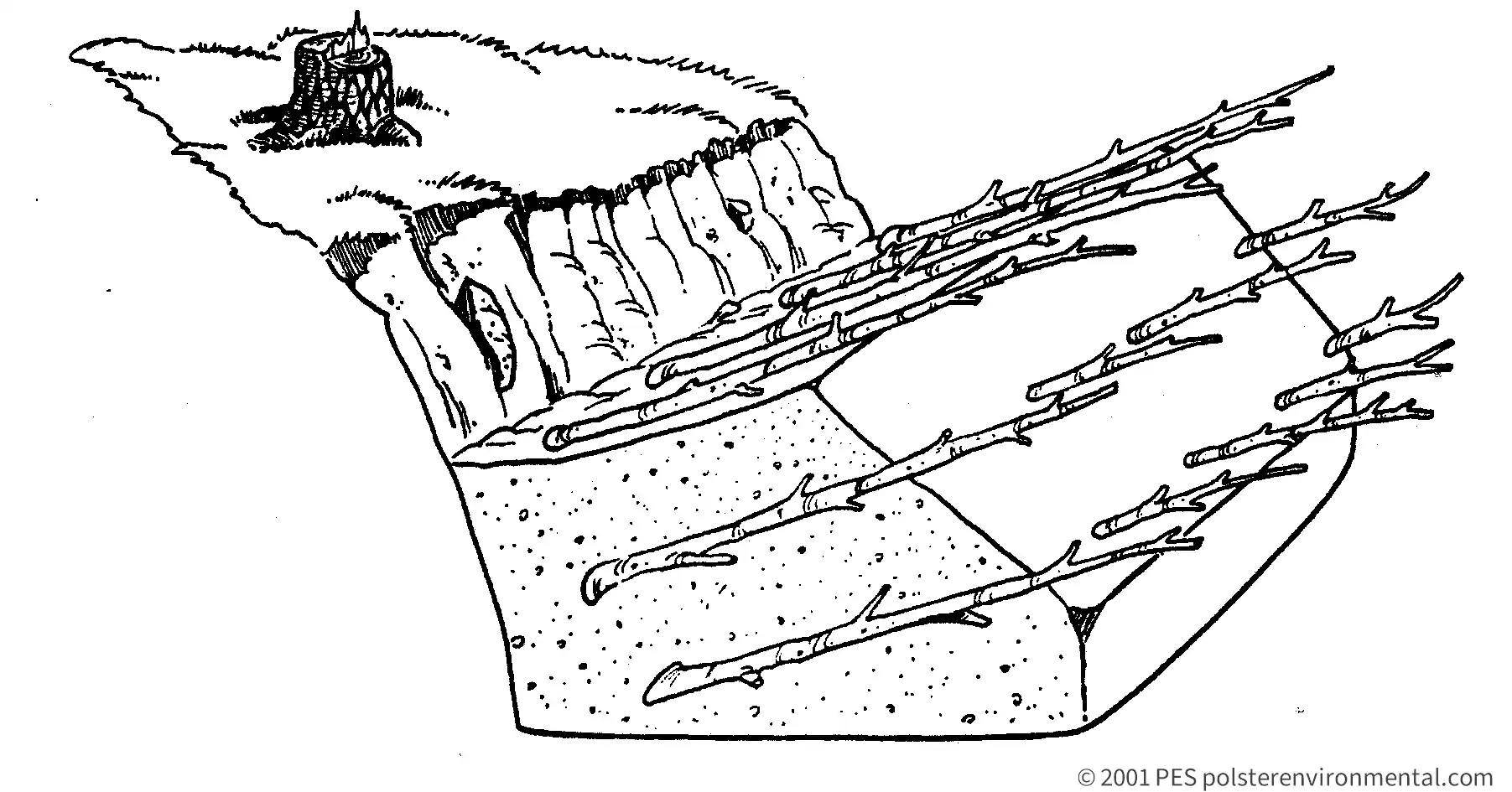
Brush layers on cut slopes are built from the bottom of the slope upward: a trench or bench is dug across the slope face, cuttings are laid in perpendicular to the trench, and the excavation spoil from the next trench up is used to backfill the one below. This sequential approach maximises soil contact along the buried length of each cutting and produces a series of small terraces that interrupt surface runoff and reduce rill development between rows.
On fill slopes, the technique is considerably more powerful. Full-length cuttings (typically 1.5– to 4 m) are inserted horizontally into the fill as it is being constructed, running deep into the slope mass rather than just the surface layer. These cuttings act in a manner analogous to the steel or geosynthetic bands used in mechanically stabilized earth structures, providing tensile resistance that increases the shear strength of the fill and reduces the likelihood of rotational or translational failure. Before the cuttings begin to root, they are already contributing to fill stability through this mechanical reinforcement.
Once rooted, willows and cottonwoods in a brush layer continue to deepen and spread, knitting fill material into an increasingly cohesive mass. Where site conditions support it, rooted nitrogen-fixing species such as Sitka or red alder can be interplanted within the brush layer to create a hedge brush layer, a combined revegetation and soil-building system suited to sites where soil development is a long-term restoration objective.
Brush layers are one of the classic living structural systems in soil bioengineering. They place living cuttings in horizontal layers within a slope or bank so that the cuttings root outward while the surrounding soil mass is physically supported and gradually revegetated.
What Brush Layers Do
At their core, brush layers do three jobs:
interrupt downslope movement
introduce living material through the body of the slope
create conditions for further stabilization and revegetation
They are especially useful where a treatment needs to work both as a structural measure and as a revegetation system.
Brush Layers vs. Modified Brush Layers
The PES method library already explains modified brush layers, which are adapted to drier, raveling slopes and often use logs to create immediate terrace structure.
Classic brush layers sit a little differently:
they are more tied to slopes or banks where embedded live material can root through the soil mass
they often fit where moisture and bank conditions are stronger than on a dry raveling face
they are a more general living-layer concept, while modified brush layers are the adapted dry-slope version in the PES toolkit
Where They Fit Best
Brush layers are useful where:
shallow instability is active in a slope or bank
a living treatment is needed through the soil mass
revegetation and structural support need to happen together
the site is too dynamic for simple planting but does not call for a rigid hard wall
Relationship to Riparian Work
Brush-layer logic also connects closely to live bank protection, where layered and embedded live material helps rebuild the edge of a damaged riparian system.
That is one reason the method matters. It is not just a slope technique. It is part of the wider PES approach to rebuilding living structure where conventional solutions often simplify the site further.
Takeaway
Where standard live staking does not provide enough structural support and a full wattle fence system is not warranted, brush layers fill an important middle ground. They work equally well on slopes and streambanks. The horizontal cuttings interrupt downslope movement while establishing root mass through the full depth of the treatment zone. On cut slopes, cuttings are laid in from the face; on fill slopes, cuttings can run the full depth of the fill, reinforcing the slope matrix as they root.
See also the Modified Brush Layers method page for the adapted version of this technique suited to drier sites, where the log-based terrace system replaces the woven willow structure when sustained soil moisture is not available.
How Brush Layers Work: Cut Slope and Fill Slope Cross-Section
Brush layers consist of long, fresh cuttings laid horizontally in trenches cut across a slope. On cut slopes they are laid in from the face; on fill slopes the cuttings can run the full depth of the fill, acting as soil reinforcement. As the cuttings root throughout their buried length, they create a mass of fine roots that bind the slope matrix.
Field References for Brush Layers
For readers checking layout, spacing, and installation assumptions, these references describe brush layering and related soil bioengineering systems for slope and bank stabilization.
Need a Site-Specific Recommendation?
We can help interpret the conditions on your slope, streambank, shoreline, or disturbed site and recommend the right combination of soil bioengineering methods.