
Wattle Fencing
Rows of live cuttings placed behind vertical posts intercept eroding material, create small terraces, and establish woody cover on moist, over-steepened slopes.
Live Branches Behind Posts
Freshly cut branches are laid horizontally behind the vertical posts, then backfilled and lightly tamped down to form the wattle fence.
Slope Stabilization
Often fits actively eroding slopes where a living, mechanically supported treatment is appropriate; site moisture and slope movement still need assessment.
Biodegradable Structure
The framework breaks down naturally as plants establish, leaving roots rather than waste.
Wattle fencing uses short retaining walls of living cuttings to reduce the effective slope angle, intercept moving material, and create planting conditions for native woody vegetation where moisture supports establishment.
David Polster field record: A source deck follows an early wattle-fence treatment on a 53 m till slope above a 5 m rock cut from July 4, 1986 through August 1, 2009. The dated record is historical evidence from a specific site, not a universal performance timeline.
What Are Wattle Fences?
Wattle fences are short retaining walls built from long, living cuttings of willow and cottonwood. The live-stake system uses living plant material for both the vertical posts and horizontal cuttings. Dormant willow stakes are driven vertically into the slope, and long, flexible willow stems are laid horizontally behind all of the vertical posts, on the uphill side. The stems are then backfilled and lightly tamped down.
The installed fence provides the first mechanical break in the slope and can intercept soil or rolling material. If the cuttings retain suitable moisture, they may sprout and root, adding living structure over time; the resulting resistance and vegetation development vary with site conditions.
The conventional engineering response to an over-steepened slope is a large retaining wall at the bottom. The soil bioengineering response, as David Polster, M.Sc., R.P. Bio., developed it, is a series of small living walls distributed across the entire slope. Strength in numbers. Each fence terrace holds a portion of the surface material and can support revegetation. Its contribution to stability depends on the slope, soil, moisture, construction, and subsequent plant establishment.
Construction Overview
Wattle fence construction follows a straightforward sequence that can be carried out by trained crews or reasonably skilled workers:
Materials
- Vertical stakes: Willow cuttings 1–2 m long, minimum 2.5 cm diameter at the tip. Scouler's willow (Salix scouleriana) and Hooker's willow (Salix hookeriana) are commonly used on BC coastal sites.
- Horizontal stems: Use long, flexible willow stems. Lay the stems behind the vertical posts; none should pass in front of a post.
- All material harvested during the dormant season (late fall to early spring, before bud break).
Installation Steps
1. Mark the contour line across the slope where each wattle fence will be placed. Fences should run on-contour (level) to intercept downslope material uniformly.
2. Install the upright stakes: use an auger or planting bar to open pilot holes where needed, then secure the upright stakes according to the treatment layout. Stake length must allow for both embedment and the exposed fence face.
3. Place horizontal stems behind all of the vertical posts, on the uphill side. Lay the long stems along the fence line; do not alternate them in front of and behind the posts.
4. Backfill soil behind (uphill of) the horizontal stems and lightly tamp it down to create the terrace. Build up the cuttings and backfill together to the designed fence height.
5. Trim any protrusions. The wattle fence should present a relatively uniform face on the downslope side.
6. Spacing between fence lines: Spacing is set from the slope geometry, material movement, and treatment objectives; steeper or more mobile slopes generally require closer rows.
Material costs for wattle fencing vary with site access, slope conditions, and material availability. Contact us for a project-specific estimate.
When Wattle Fences Work
Wattle fences are most effective on sites that meet these conditions:
Adequate soil moisture. The willow and cottonwood cuttings must be able to root successfully, which requires contact with soil moisture through the growing season. Wattle fences excel on moist slopes, streambanks, and sites where subsurface moisture is present even if the surface appears dry.
Globally stable slopes. Wattle fences address surface erosion and shallow instability. They are not designed to resist deep-seated mass movements. The slope must be stable in the bulk sense; the wattle fences treat the surface instability.
Over-steepened slopes. Any slope steepened beyond the natural angle of repose for the material may include road cuts, over-graded embankments, and undercut streambanks. Wattle fences have been installed successfully on slopes as steep as 70 degrees.
When NOT to Use Wattle Fences
Wattle fences are not appropriate on:
- Dry, well-drained slopes where soil moisture is insufficient for cutting establishment (use modified brush layers instead)
- Deep-seated slope failures where mass movement is the primary instability mechanism
- Slopes with active seepage that has not been addressed with live pole drains first
- Very coarse substrates (gravel, cobble) with no fine-grained matrix to hold stakes
Wattle Fences vs. Modified Brush Layers
Wattle fences and modified brush layers address similar problems on over-steepened slopes prone to erosion, but they have different site requirements.
| Site factor | Wattle Fences | Modified Brush Layers |
|---|---|---|
| Moisture requirement | Moderate to high | Low to moderate |
| Best on | Moist slopes, streambanks | Dry, raveling slopes |
| Equipment | Hand tools, earth auger | Hand tools |
| Key species | Willow, cottonwood | Willow, red-osier dogwood |
| Slope angle | Up to 70° | Moderate steep slopes |
On drier sites where wattle fences might not establish reliably, including dry interior slopes and well-drained sand or gravel substrates, modified brush layers are the preferred alternative. The choice between techniques is a site-specific decision that we assess during our initial site visit.
Long-Term Outcomes
A well-installed wattle fence system changes a slope progressively over time:
Early establishment: Cuttings may begin shoot and root growth while the fence lines trap some moving soil and organic debris. Field inspection is needed to confirm establishment and erosion response.
Developing establishment: Where cuttings take, willow and other appropriate species can develop along the terrace lines, with root and canopy growth varying by moisture, species, and site conditions.
Longer-term recovery: Established woody cover can add root cohesion and habitat, while succession and maintenance continue to depend on the site and treatment performance.
Maturing recovery: A native shrub and tree community may develop and eventually obscure the fence structures, but long-term condition and maintenance remain site-specific.
The result is a stabilized, vegetated slope where the living installation supports continued succession.
Frequently Asked Questions
Q: How long does a wattle fence installation take to show results?
Shoot growth may begin in the first growing season after dormant-season installation when cuttings remain viable and moisture is adequate. The fence provides its physical break on installation; canopy development and erosion response should be assessed in the field rather than assumed on a fixed schedule.
Q: What slope gradients can wattle fences treat?
Wattle fences have been installed on slopes as steep as 70 degrees in British Columbia. Wattle fences can also fit gentler slopes, but suitability is determined by slope geometry, material movement, moisture, and the intended treatment rather than angle alone. The stakes must reach soil moisture to root successfully.
Q: Can wattle fences be used on streambanks?
Yes. Wattle fences are particularly effective on streambanks where moist conditions support vigorous cutting establishment. The stepped-back terrace design allows flood flows to pass without damaging the structures, while the horizontal willow face provides erosion resistance against stream scour. For very actively eroding banks, live bank protection (a denser variant) may be appropriate.
Q: What permits are required for wattle fence installation near a stream?
Work on or adjacent to streams typically requires notification or approval under the BC Water Sustainability Act and notification to DFO for projects that could affect fish habitat under the federal Fisheries Act. Polster Environmental has direct experience navigating the permitting process for riparian bioengineering projects in British Columbia.
Live-Stake Wattle Fence
The diagram shows the live-stake wattle system: horizontal cuttings sit behind the upright live stakes, then are backfilled and lightly tamped down. On extremely steep sections, we use rebar bent into hooks to help hold the cuttings in place. This is an adaptation of the same system, selected to suit the site.
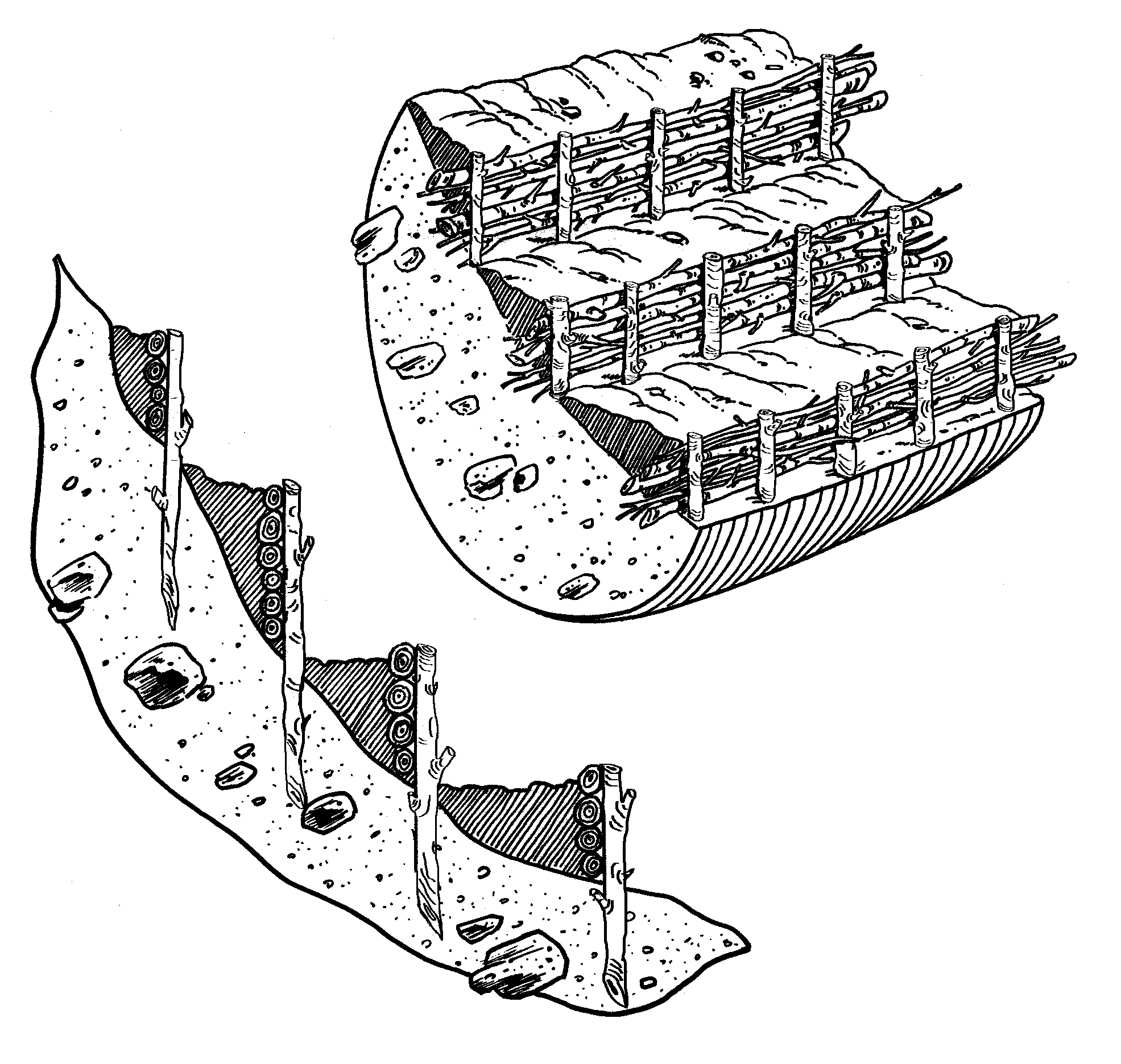
Live-stake wattle fence: horizontal cuttings behind upright live stakes, with backfill forming small terraces. The living material can root where soil moisture supports establishment.
Field Sequence: Early Wattle Fence Performance
These archive photos show why wattle fences matter on the right moist slope: the structure is visible early, then the rooted willow system takes over and the slope shifts from exposed till to dense woody cover.
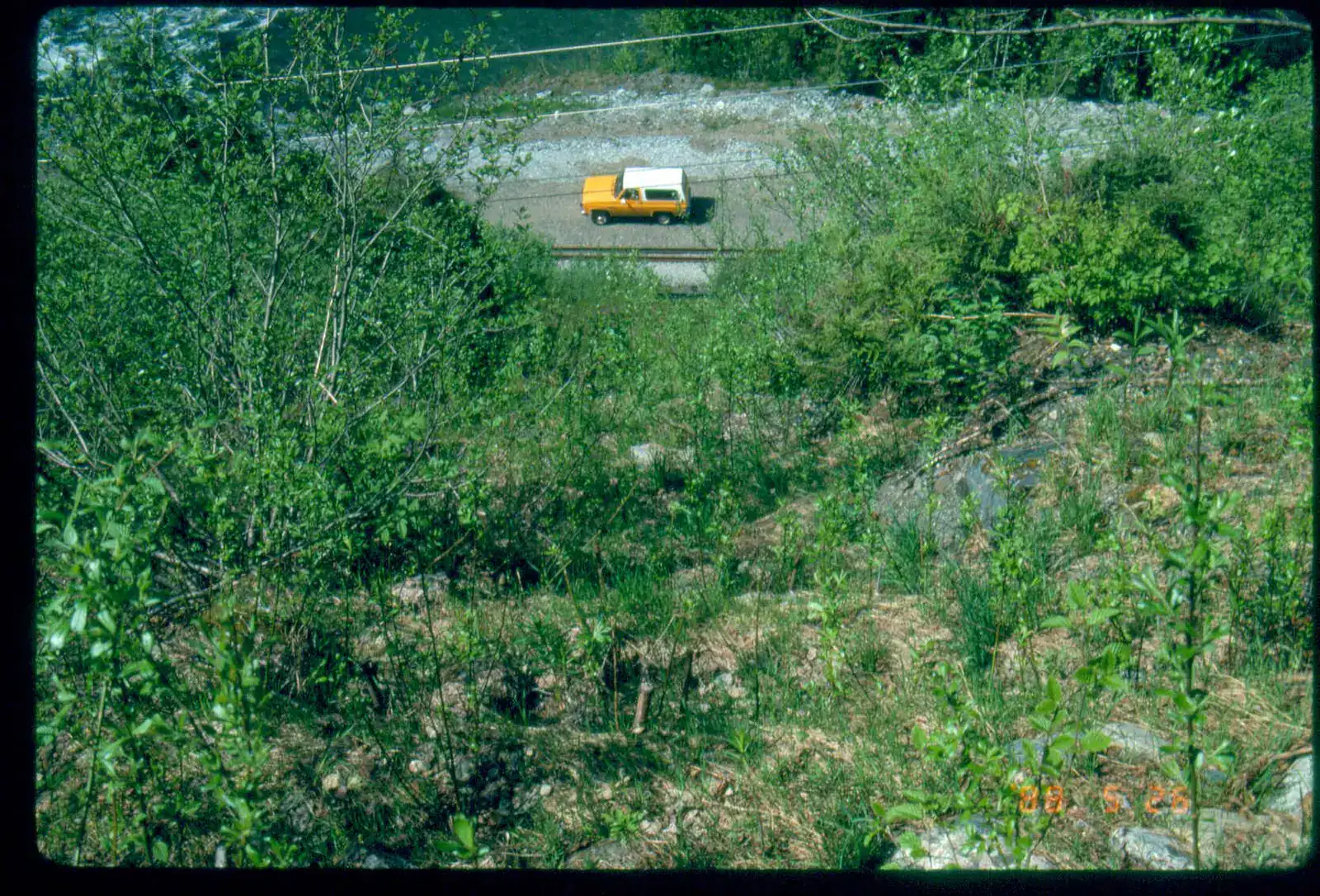
Two seasons after installation, the slope is already holding more vegetation and surface structure.
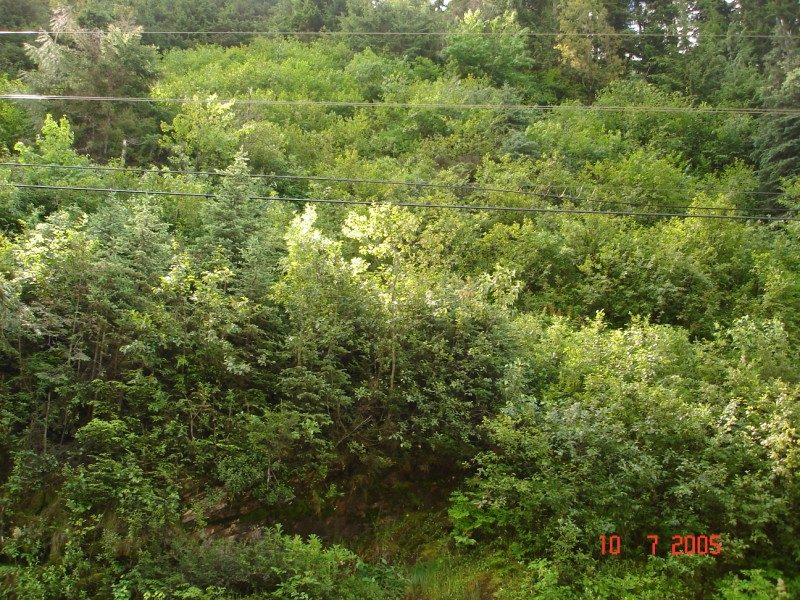
Long-term follow-up shows the terrace lines blending into a dense living slope treatment.
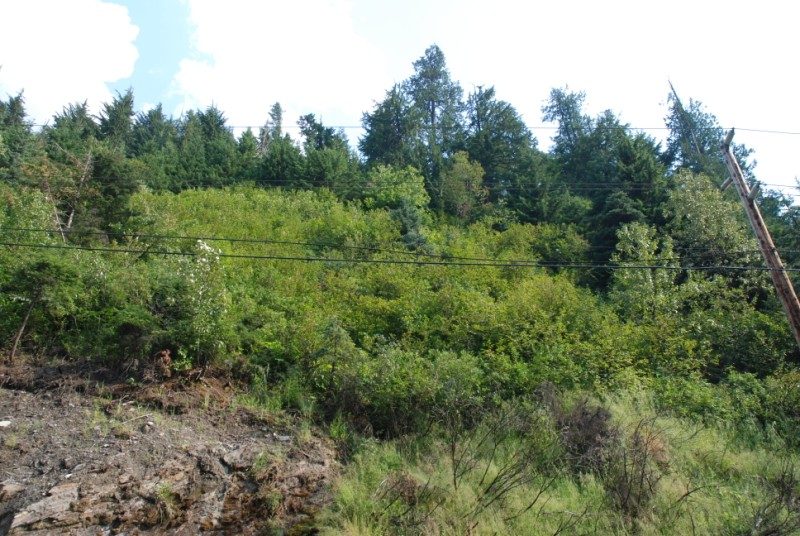
The mature condition demonstrates that the stabilizing work is increasingly done by woody roots, not by a dead structure.
Corridor Example: Bowker Creek and Highway Edges
Wattle fences are not limited to quiet revegetation sites. These corridor slides show the method doing real structural work along a constrained creek edge and in a transportation setting where gully erosion, fluctuating water, and limited space all matter.
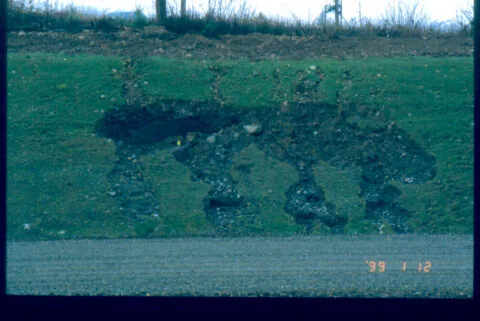
Before treatment: a roadside slope already starting to unravel into gullies.
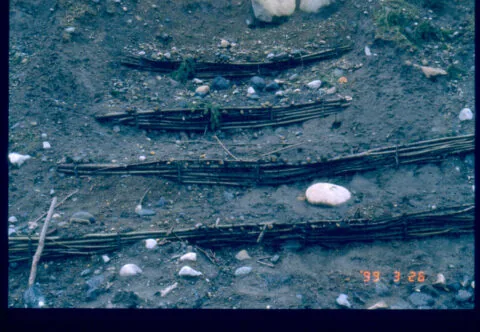
Fresh installation shows the terrace structure and edge control that make wattle fences useful in corridor work.
Within months, dense willow growth is already taking over the stabilizing role from the fresh structure.
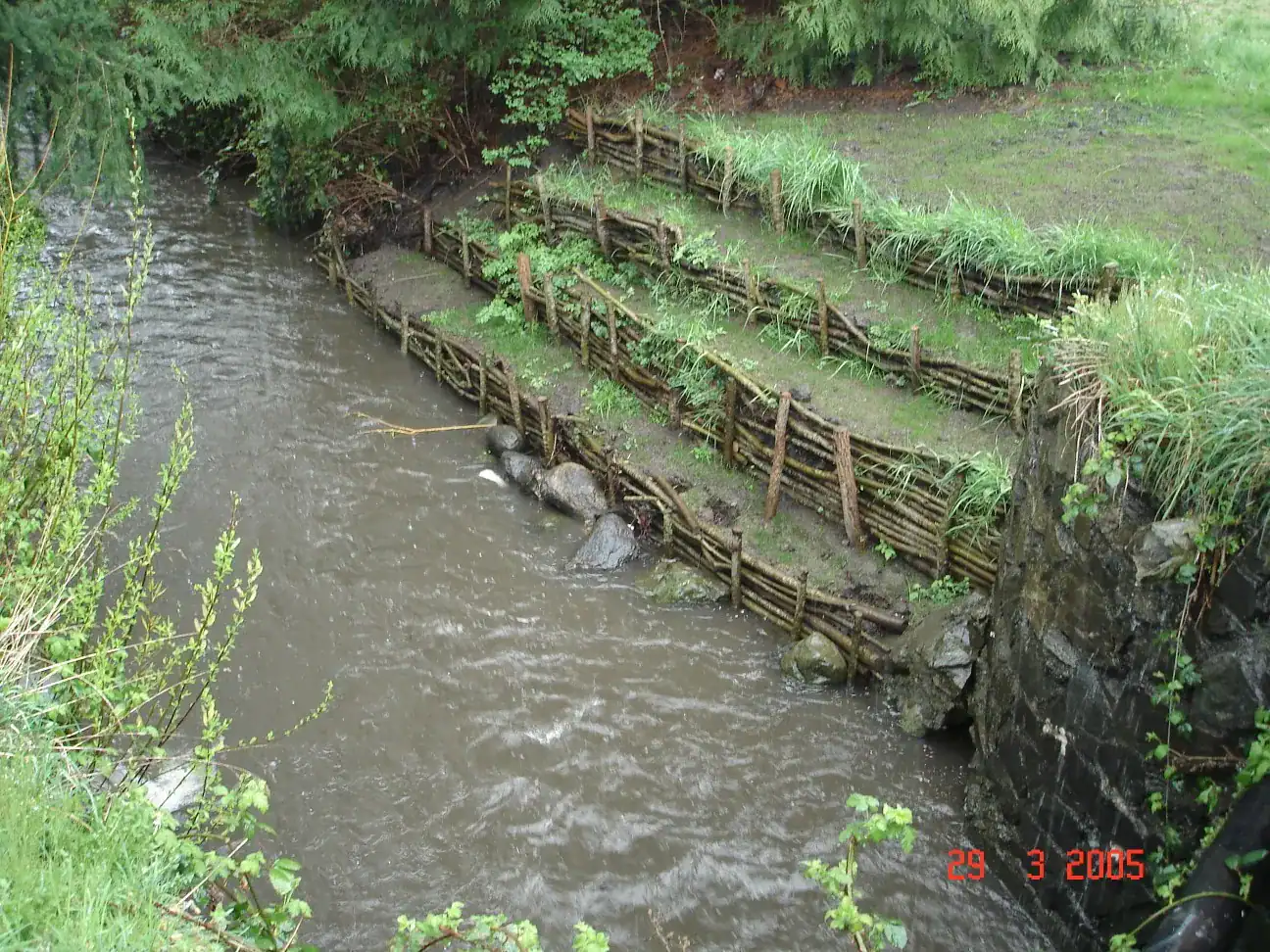
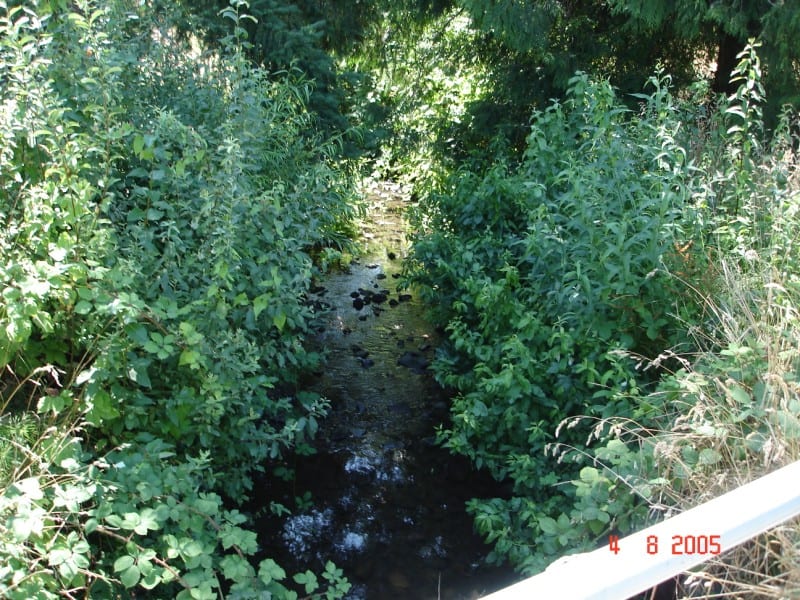
Bowker Creek shows wattle fences supporting organic soils and stabilizing a stream edge during establishment.
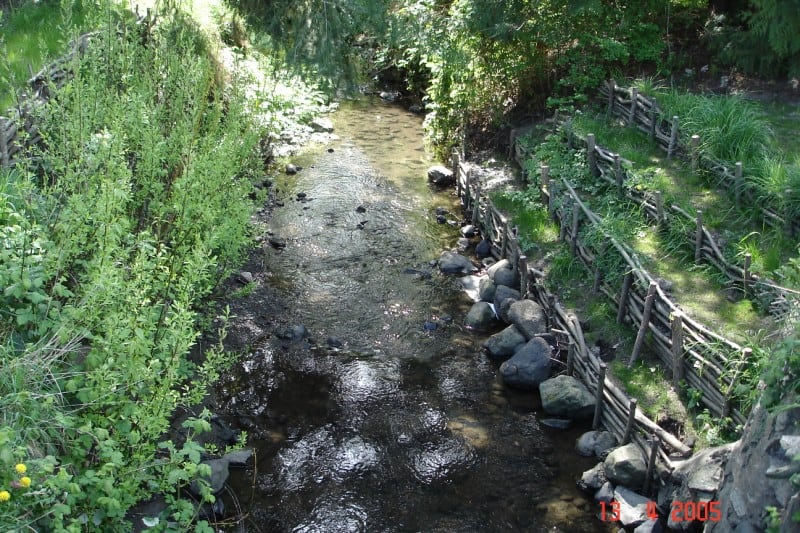
Later-condition corridor vegetation shows why dated field sequences are so persuasive for infrastructure clients.
UBC Cliffs: Wattle Fences Rebuild a Failing Slope
On the sea cliffs at the University of British Columbia, groundwater piping had triggered repeated slope failures. Wattle fences built on the contour, backed by brush layers, re-established the slope face, drained the seepage, and started the willow cover shown in the dated follow-up photographs. This sequence records the change from raw till to a living slope.
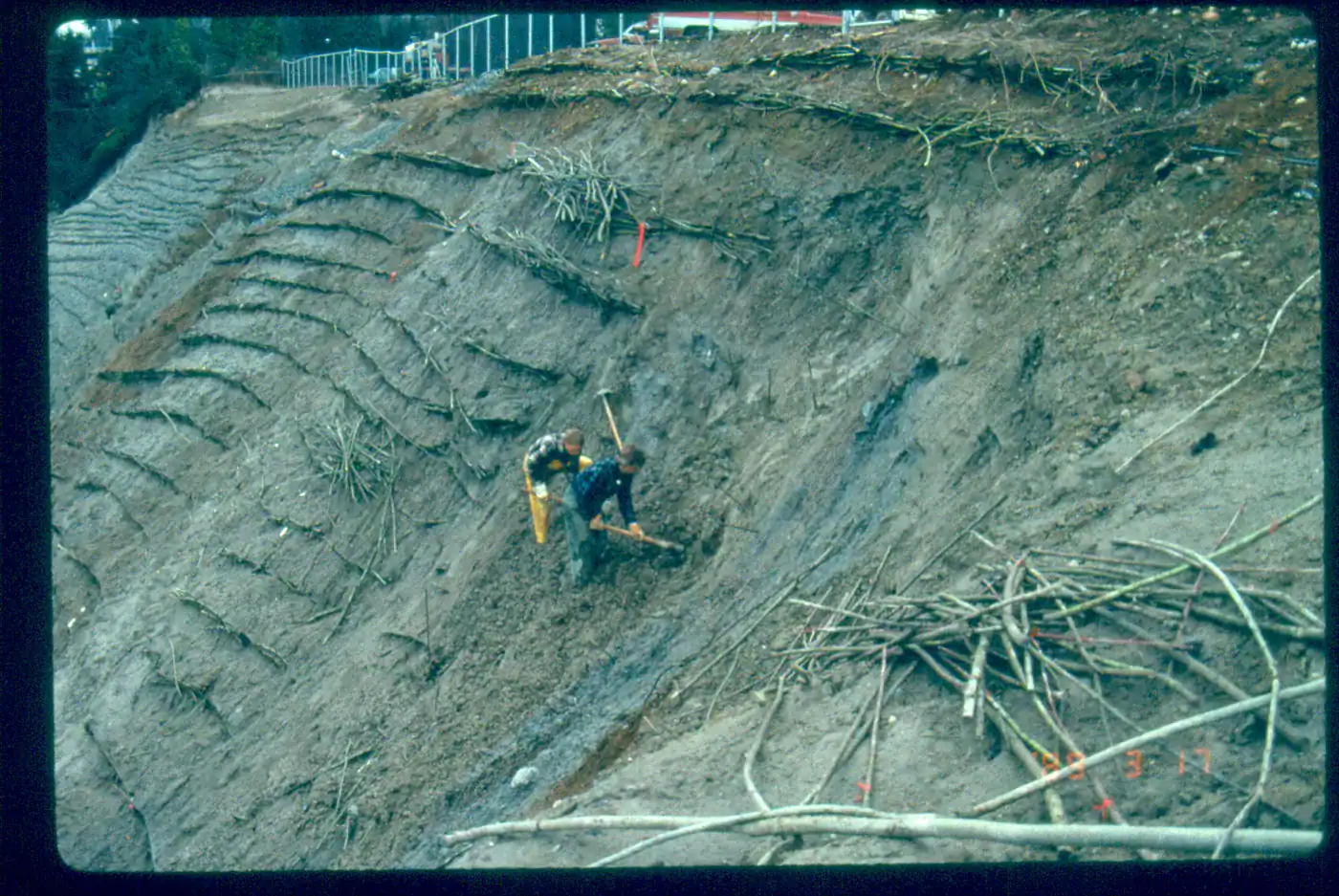
The bare, piping-failed slope on the UBC cliffs. Groundwater seepage had stripped the face back to raw till and kept it moving.
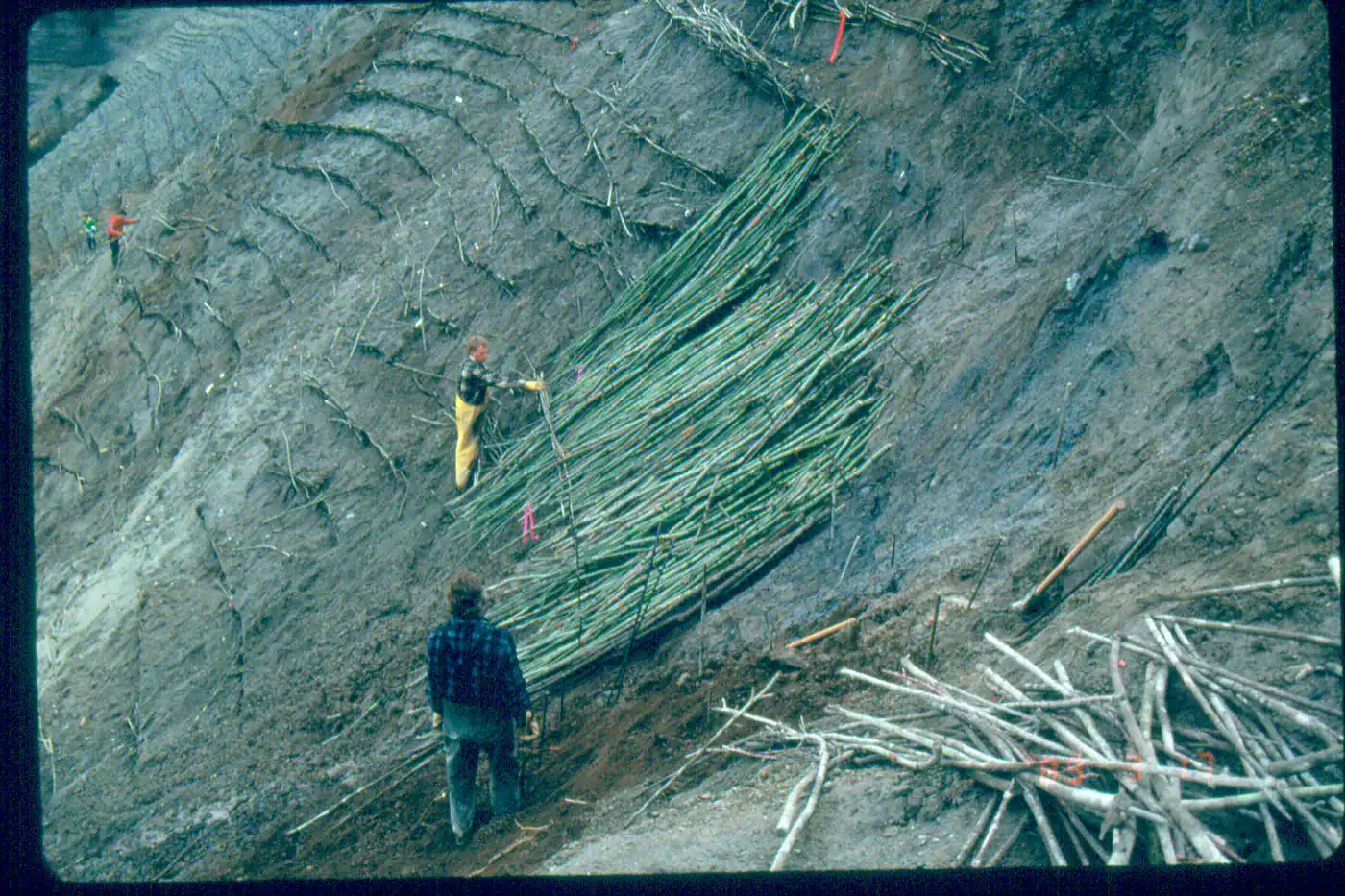
Crews lay in bundles of live willow, working contour by contour across the open face.
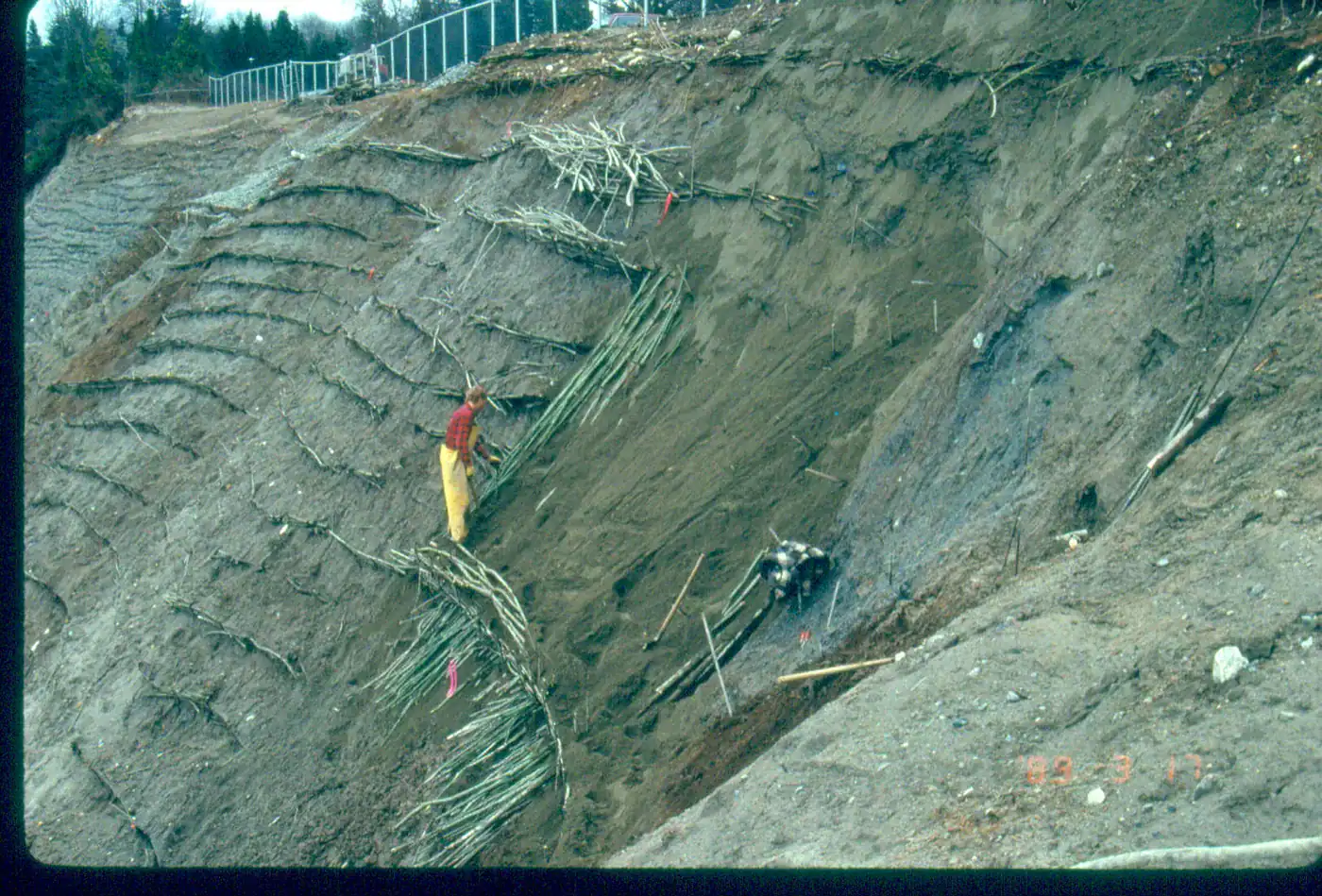
Wattle fences are installed along the contours to re-establish the slope face and catch material ravelling from above.
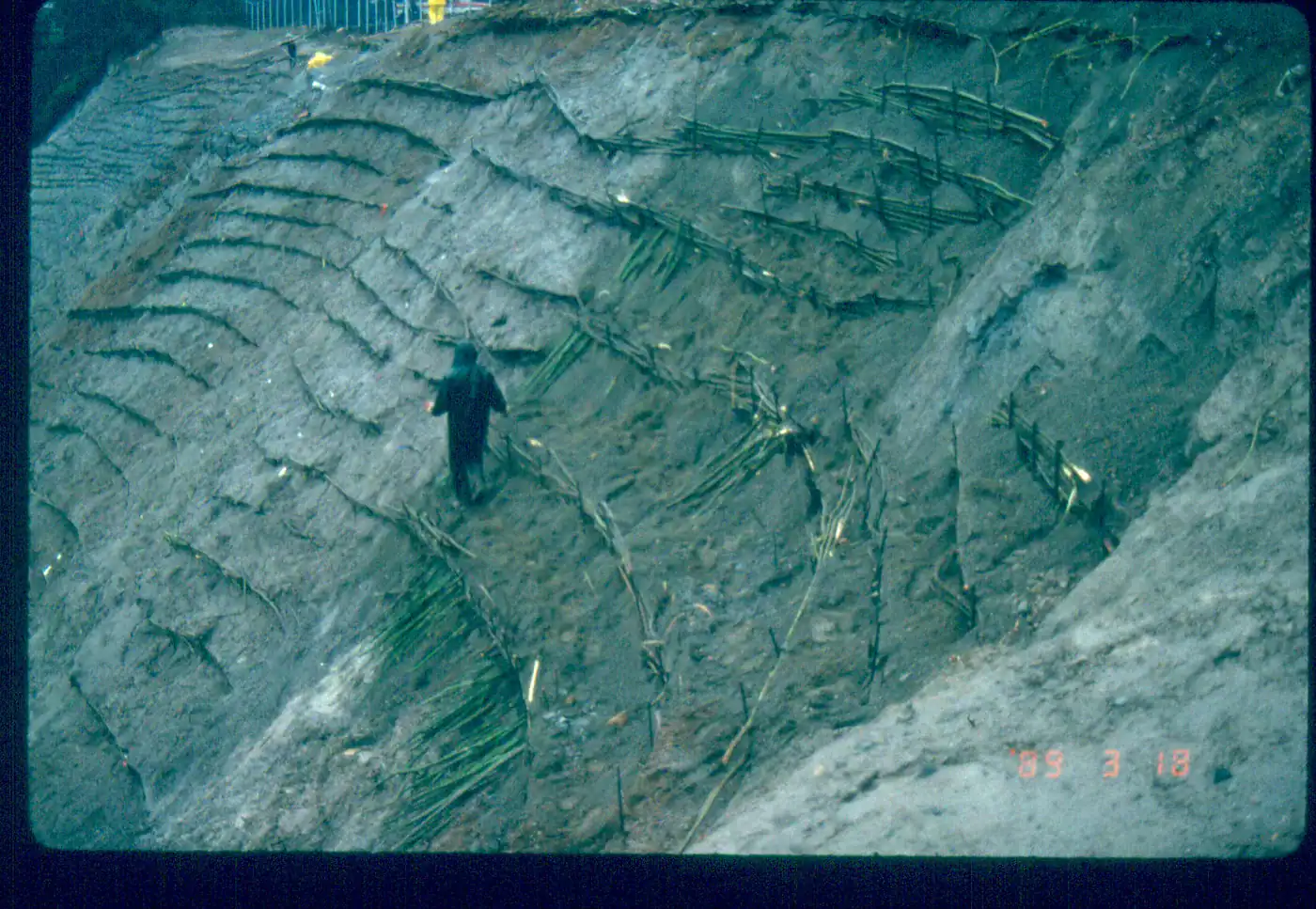
The finished lattice of wattle fences and brush layers drains the seepage and holds the surface long enough for roots to take hold.
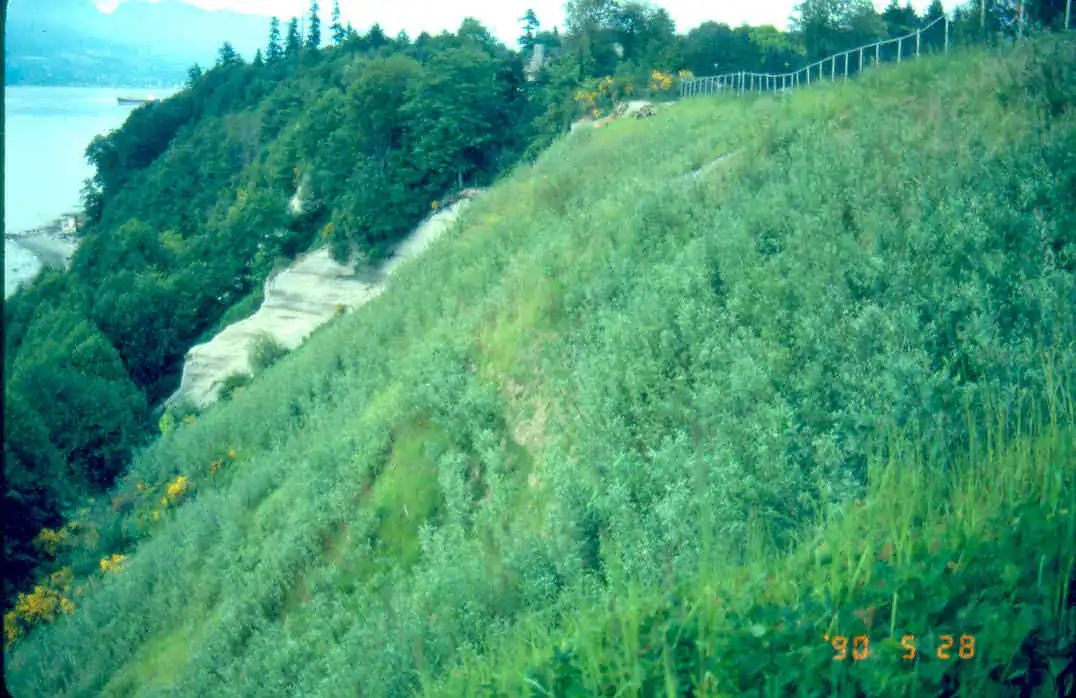
By 1990 the same slope carries dense willow cover above the sea. The living system has taken over the work from the structure.
Immediate Sediment Trap
Wattle fences can trap moving soil and sediment soon after installation. Their effectiveness depends on runoff, soil movement and the condition of the structure.
Live Stems Root on Slope
With suitable moisture, viable cuttings and firm soil contact, live stems can establish roots and add reinforcement as they grow.
Low Disturbance Method
Wattle fencing can be installed with hand tools where safe access and ground conditions allow, helping limit additional disturbance.
Is This the Right Technique for Your Site?
We assess slope angle, soil depth, moisture, and available live material to determine fence spacing and where the treatment needs support from other methods.
RPP wattle fences: a 23-year slope record
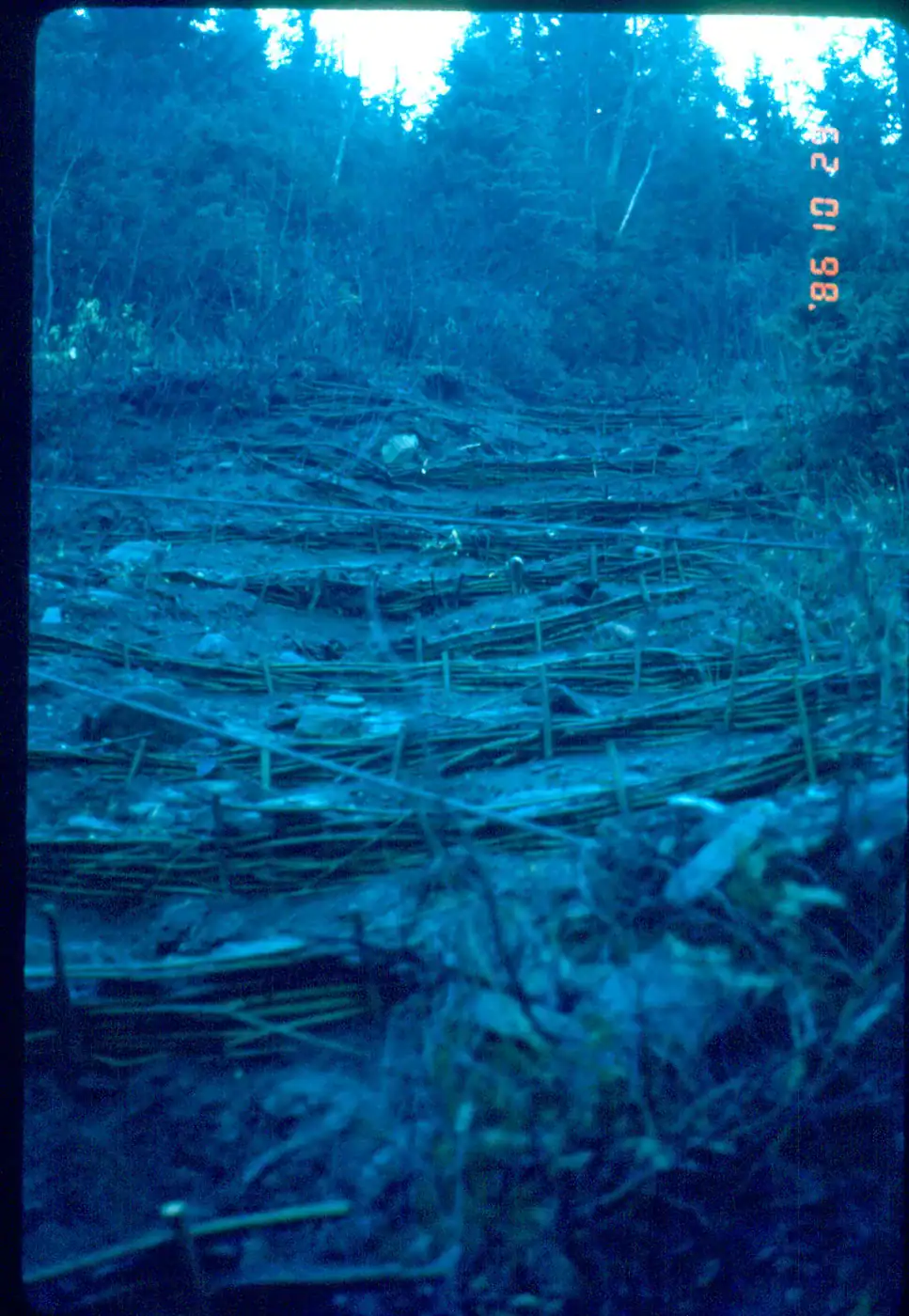
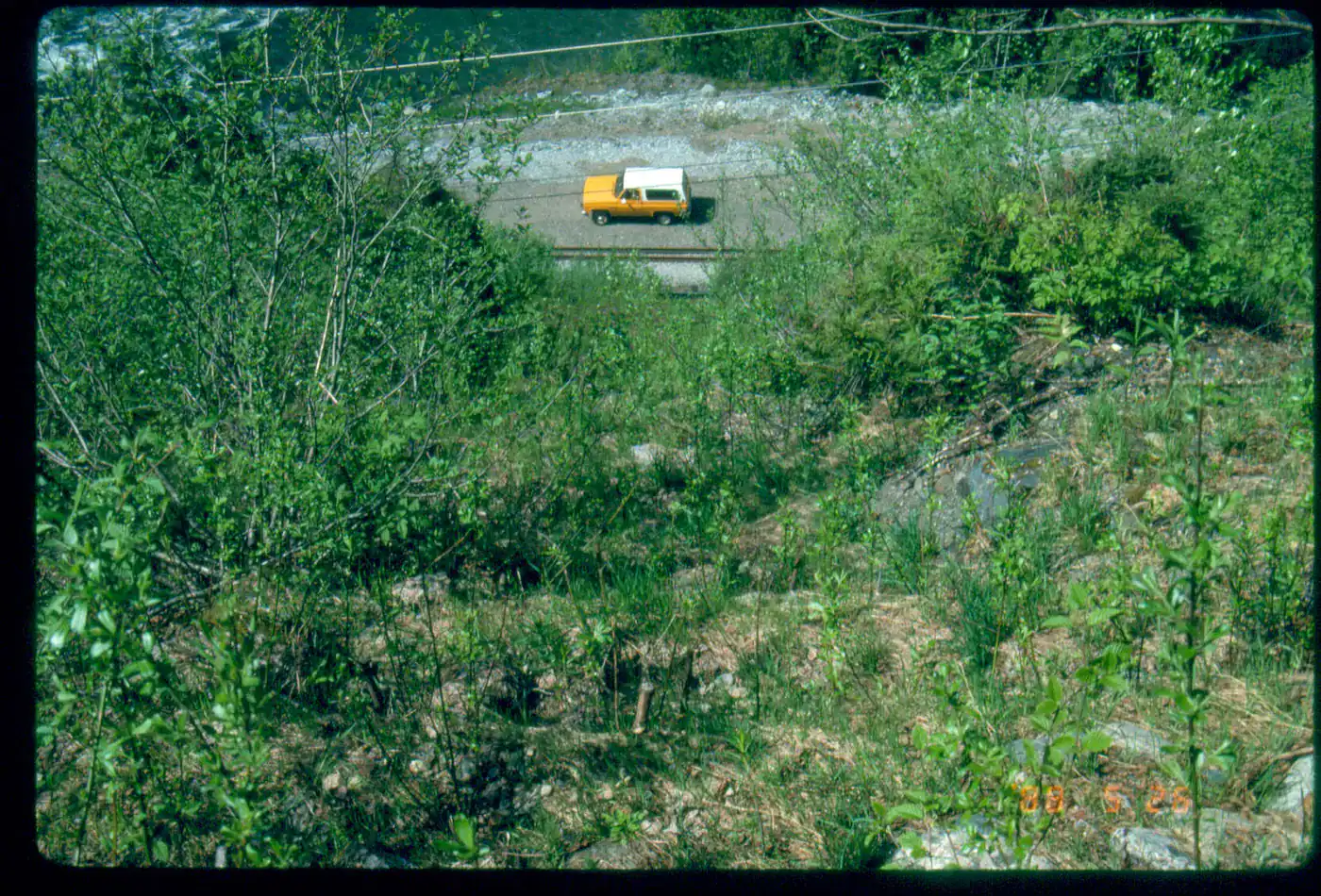
David Polster's RPP field sequence follows one steep till slope from July 1986, through installation and early growth, to a recovered vegetated edge in August 2009.
This is a same-slope historical progression assembled from David's dated field sequence. It is a visual comparison, not a fixed-camera survey pair.
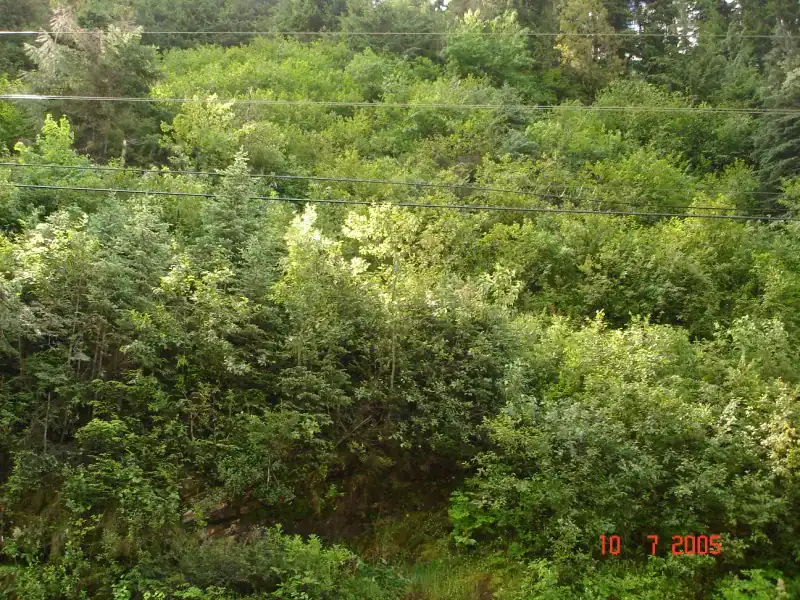
Nose Creek: before and after wattle-fence installation
David Polster's 2005 Nose Creek record shows the eroded bank before treatment and the same restoration effort after wattle fences were installed along the channel edge.
Source: David Polster, Nose Creek 2005 before and after records in the PES Google Drive archive. The views document the treatment progression; they are not a fixed-camera survey pair.
Sources and further reading
These references provide wider technical context. Method selection and design remain site-specific.
Nanaimo road fill wattle fences: a dated field record
This David Polster archive sequence follows wattle fences from installation through an early-season check and a later field record. It is useful as a cautionary example: the source deck records limited growth rather than promising a universal outcome.
Wattle fences are installed across the road fill slope.
Source: David Polster's 2012 Soil Bioengineering Canadian Style deck and matching archival scans. The deck places this sequence under a road fill failure near Nanaimo, BC. The local archive calls it WF Gully, but that filename is not treated as a confirmed project name. This is a historical field record, not a fixed-camera survey comparison or a current client project.